History of Czechia

History

History of Czechia

From the Czech lands to contemporary Czechia: settlement, names, statehood, faith, reform, empire, revival, democracy, occupation, dissent and European integration.

Public overview

A history shaped by the Czech lands

Czech history begins with a territory in the centre of Europe where rivers, uplands and cross-border passages connected communities long before the modern state existed. Bohemia, Moravia and Czech Silesia form the historical frame through which settlement, medieval rule, religious reform, imperial administration, modern national culture and democratic statehood became readable as one long public story.

The name Czechia belongs to the present, but the country it names stands on older layers: the lands of the Bohemian Crown, the Czech language and scholarship, the Czechoslovak democratic inheritance, the experience of occupation and dictatorship, and the post-1989 return to self-government within Europe.
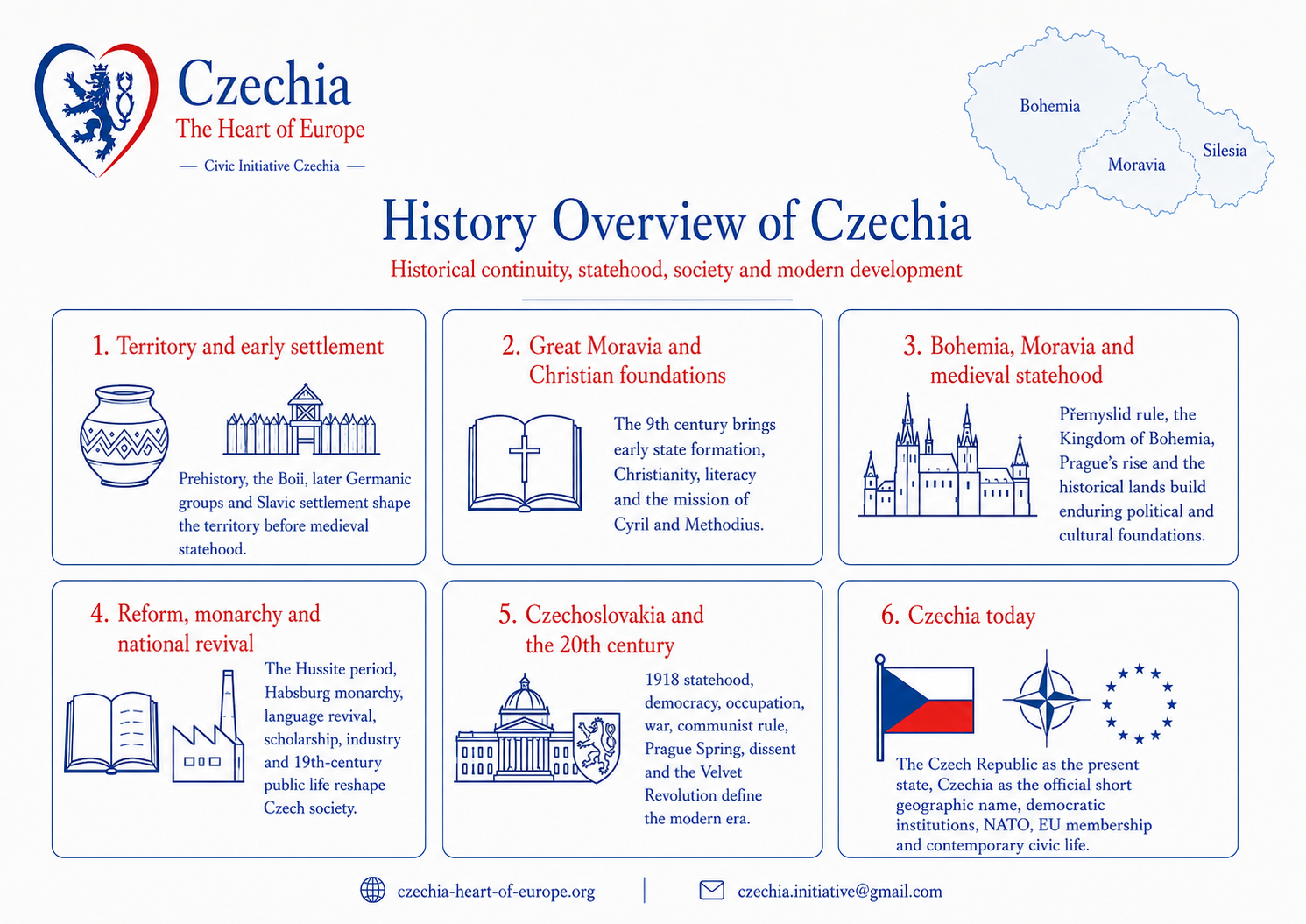
History overview information sheet

Fast orientation

Three geographical names are essential for reading the past. Bohemia became the core medieval kingdom and the best-known historical name abroad. Moravia preserved a distinct eastern historical identity with deep early medieval importance. Czech Silesia links the country to the wider Silesian borderland and Central European history.

Prague is central, but the country’s historical memory also runs through Moravian towns, border mountains, mining districts, spa regions, industrial landscapes, castles, monasteries, universities and places of resistance.

TerritoryBohemia, Moravia and Czech Silesia provide the historical land structure behind Czechia.
StatehoodThe medieval Bohemian state, the Bohemian Crown, Czechoslovakia and the Czech Republic form the main constitutional sequence.
Public memorySaints, reformers, scholars, presidents, dissidents, artists and ordinary civic life keep history visible in the present.
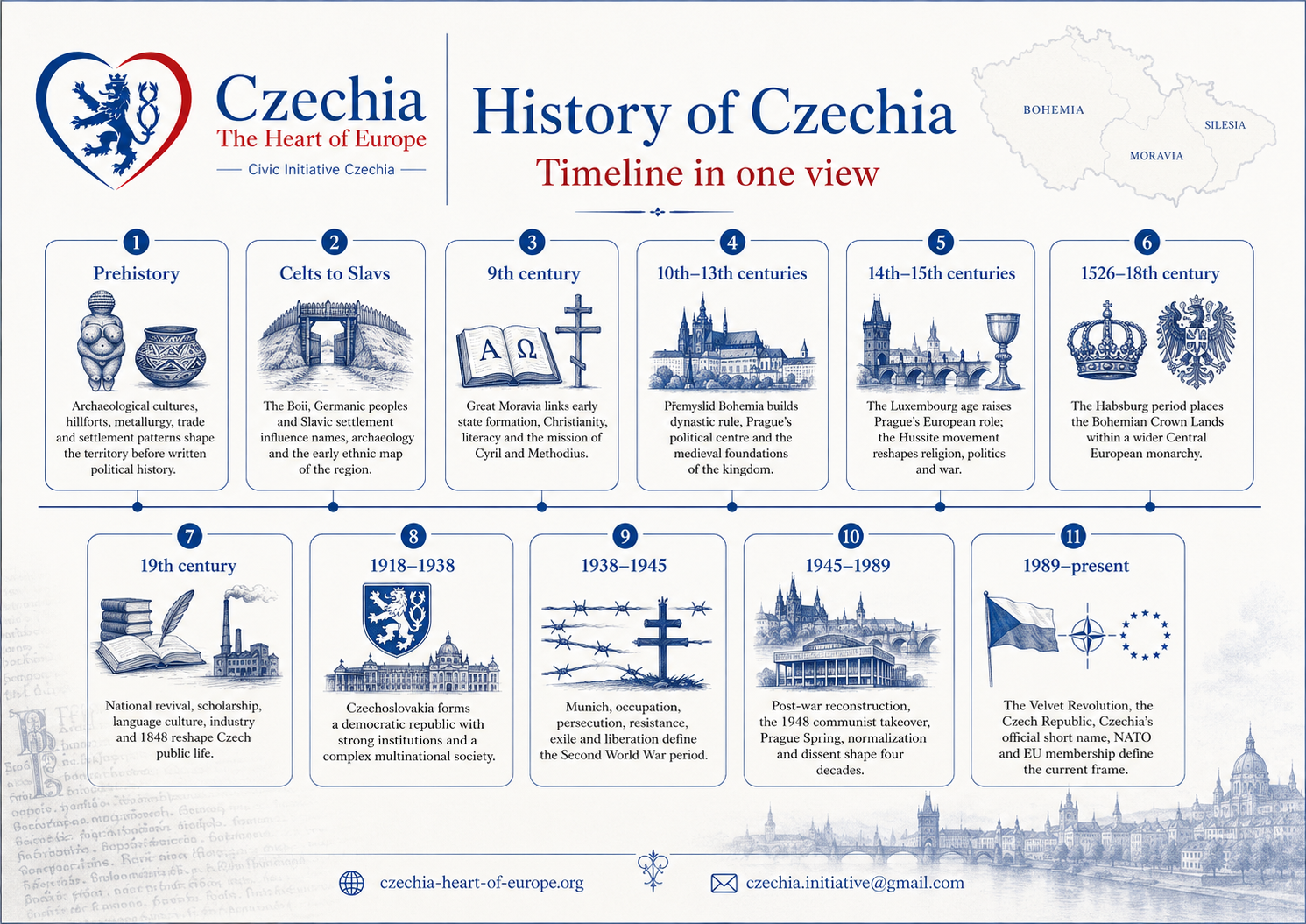
Horizontal timeline information sheet

Timeline in one view

PrehistoryArchaeological cultures, hillforts, trade corridors, metals and settlement patterns prepare the territory before written political history.
Celts to SlavsThe Boii, Germanic peoples and Slavic settlement shape names, archaeology and the early ethnic map of the region.
9th centuryGreat Moravia connects early state formation, Christianity, literacy and the mission of Cyril and Methodius.
10th–13th centuriesPřemyslid Bohemia builds dynastic rule, Prague’s political centre and the kingdom’s medieval foundations.
14th–15th centuriesThe Luxembourg age raises Prague’s European role; the Hussite movement changes religion, politics and war.
1526–18th centuryThe Habsburg period places the Bohemian Crown Lands inside a wider Central European monarchy.
19th centuryNational revival, scholarship, language culture, industry and 1848 transform Czech public life.
1918–1938Czechoslovakia creates a democratic republic with strong institutions and a complex multinational society.
1938–1945Munich, occupation, persecution, resistance, exile and liberation mark the Second World War period.
1945–1989Post-war reconstruction, the 1948 communist takeover, Prague Spring, normalization and dissent shape four decades.
1989–presentThe Velvet Revolution, the Czech Republic, Czechia’s official short name, NATO and EU membership define the current frame.

Historical periods

Before written statehood Prehistoric Czech Lands What to read: settlement, burial cultures, trade corridors, fortified sites, metalworking and the physical preparation of the Czech lands. Names and peoples Celts, Germanic Peoples and Slavic Settlement What to read: Boii, Bohemia, Marcomanni, Quadi, early Slavic communities and the linguistic memory behind later names. Early medieval statehood Great Moravia What to read: Moravian power, Christianisation, Cyril and Methodius, Old Church Slavonic literacy and Central European connections. Duchy and kingdom Přemyslid Bohemia What to read: Prague Castle, dynastic rule, Saint Wenceslas, royal elevation, colonisation and the medieval kingdom. Prague, reform and conflict Luxembourg and Hussite Periods What to read: Charles IV, Charles University, the New Town of Prague, Jan Hus, the Hussite wars and religious reform. Monarchy and crown lands Habsburg and Early Modern Lands What to read: 1526, estates, White Mountain, re-Catholicisation, Baroque culture, reforms and imperial administration. Language and civic programme National Revival and 1848 What to read: Czech language renewal, museums, theatre, scholarship, newspapers, industrial society and modern politics. First Republic Czechoslovakia 1918–1938 What to read: independence, Masaryk, democratic institutions, borderlands, industry, culture and the pressures of the 1930s. Munich and occupation Occupation and War 1938–1945 What to read: Munich Agreement, Protectorate, resistance, Lidice, the Holocaust, exile government and liberation. Control and dissent Post-war and Communist Period 1945–1989 What to read: post-war settlement, 1948 coup, political trials, 1968, normalization, Charter 77 and civic dissent. 1989 and state continuity Velvet Revolution, 1993 and Czechia What to read: November 1989, Václav Havel, democratic transition, dissolution of Czechoslovakia and the Czech Republic. Contemporary frame European Czechia and the Present What to read: NATO, EU membership, Czechia in international systems, public memory, innovation and future-facing society.

Continuities to follow across the periods

Land and bordersThe Czech lands sit between German-speaking, Slavic and wider Danubian worlds. Borders changed, but the historical land structure remained a stable reference.
Language and knowledgeLatin, German and Czech all mattered at different moments. The modern Czech language became a major carrier of scholarship, culture and public identity.
State and citizenshipMedieval crown, imperial province, democratic republic, occupied territory, socialist state and contemporary democracy each changed how people belonged to public life.