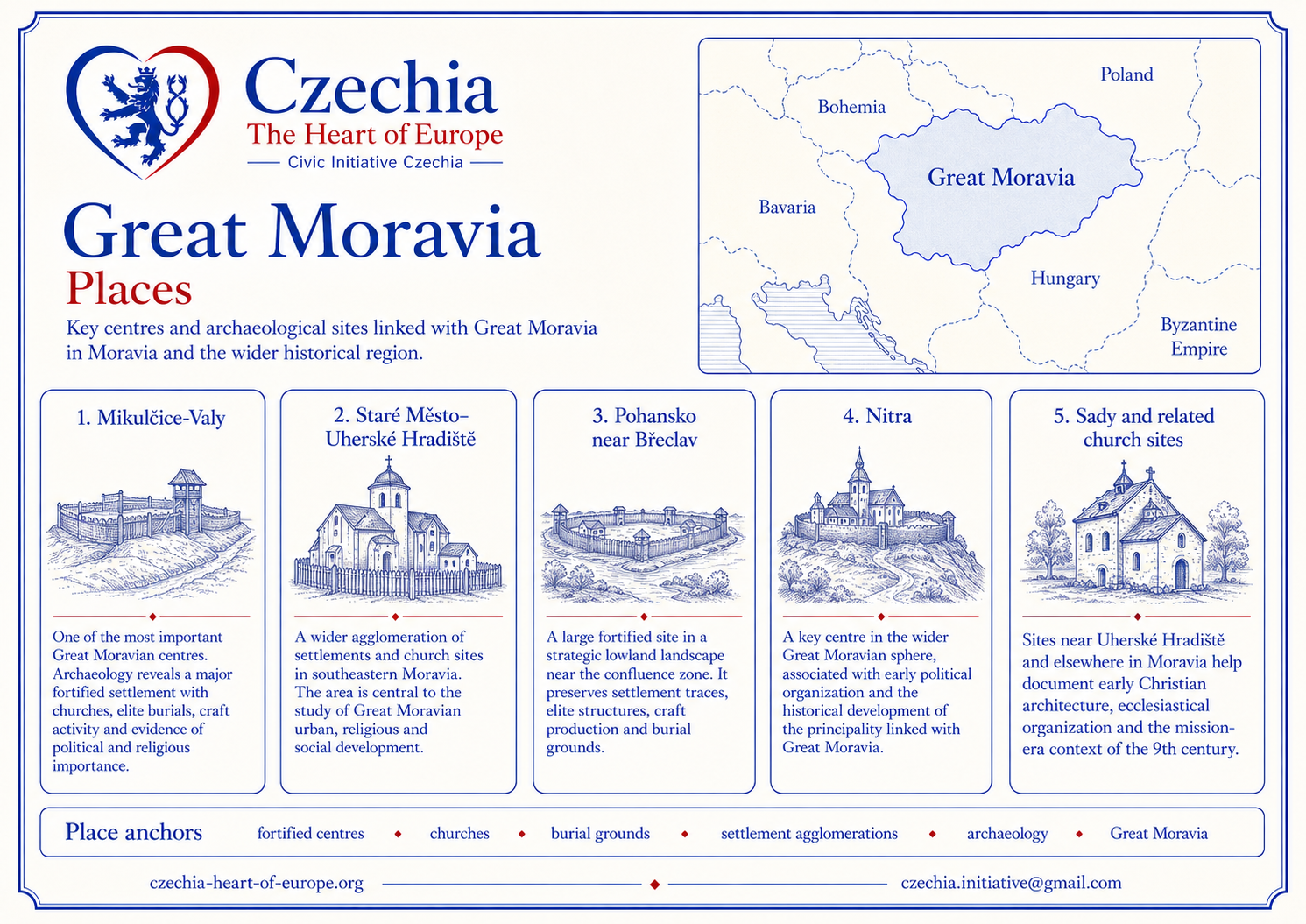
Great Moravia belongs to the formative early medieval history of the Czech lands: Moravian centres, Slavic political power, Christianisation, literacy and Central European diplomacy.
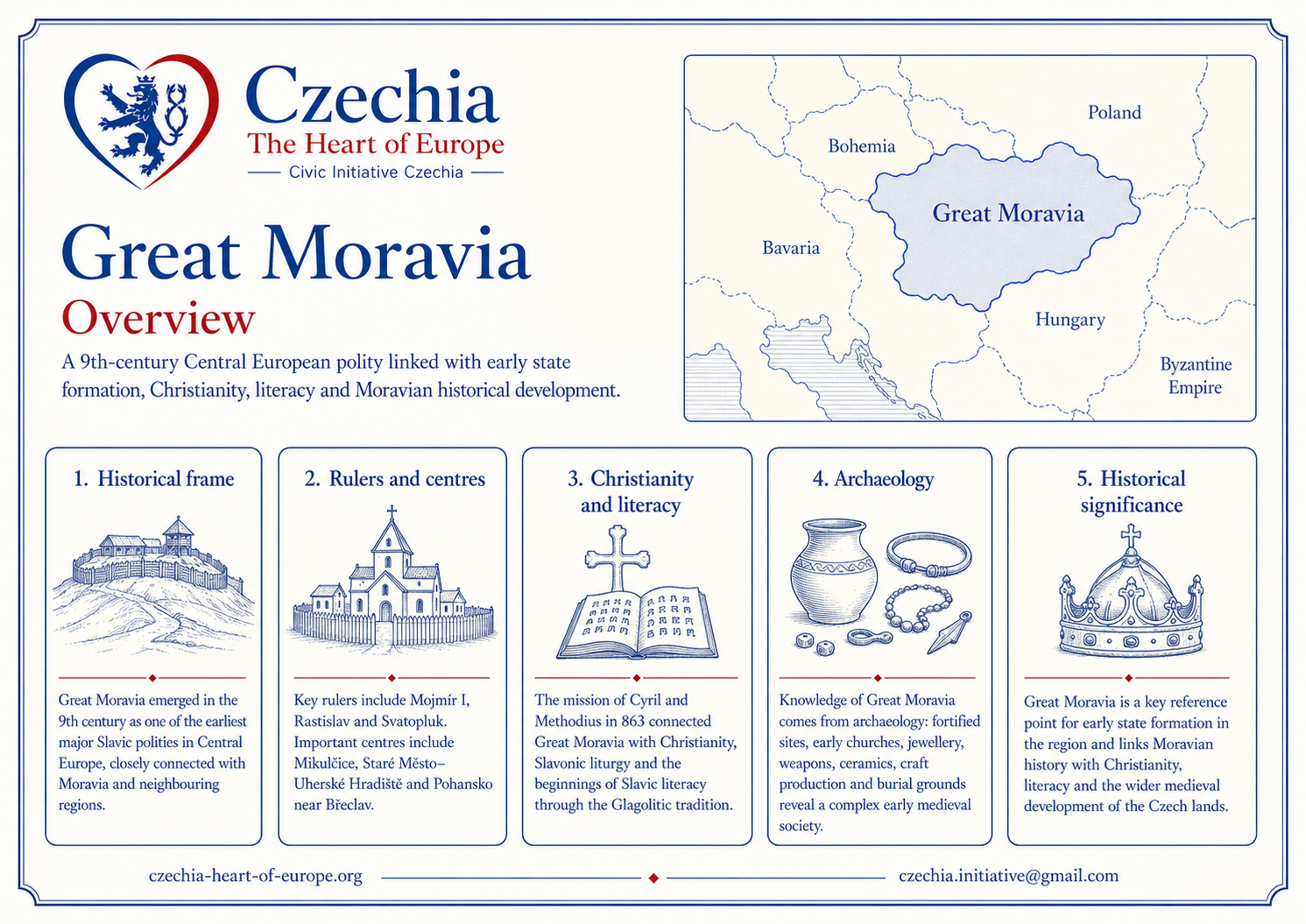
Great Moravia developed in the ninth century as one of the major Slavic political formations of Central Europe. Its centres in Moravia and neighbouring territories connected settlement, elite power, fortified places, Christianity, diplomacy and written culture at a moment when the region was entering the documented medieval world.
For Czech history, Great Moravia is essential because it places Moravia at the beginning of early medieval state formation. It also links the Czech lands to a wider European story: Frankish pressure, Byzantine mission, papal recognition, Slavic liturgy, Latin Christianity and the political competition of Central Europe.
Great Moravia should be read through four connected elements: Moravian power centres, Christianisation, the mission of Cyril and Methodius, and the later memory of Slavic literacy. The period does not stand only as a political episode. It introduces a cultural and religious horizon that shaped how Moravia and the Czech lands entered medieval Europe.
Moravian centresFortified settlements, churches, craft production and elite graves show organised power and social hierarchy.
Christian missionChristianity entered the region through competing western and eastern influences and became part of political legitimacy.
Slavic literacyCyril and Methodius brought a written Slavic liturgical culture that became one of the most important legacies of the period.
Great Moravia grew from an early Slavic environment in which local rulers, fortified centres and Christian contacts were already changing the political landscape. Moravian centres such as Mikulčice, Staré Město and Pohansko are central to understanding this world because archaeology reveals churches, burial grounds, elite objects, workshops and settlement organisation.
The rulers associated with Great Moravia acted in a competitive Central European space. Their authority depended on military strength, alliances, tribute, control of important places, religious legitimacy and negotiation with stronger neighbouring powers.
Fortified centresPower was concentrated in strongholds with churches, workshops, burial sites and elite presence.
Ruling elitesPrinces and local elites connected political authority with warfare, tribute, diplomacy and religious patronage.
Moravian landscapeThe Morava River area and nearby corridors linked the region with Danubian, Frankish and wider Slavic worlds.
Archaeological visibilityObjects, foundations, graves and settlement patterns make the period visible beyond written sources.
Cyril and Methodius
Mission, language and written culture
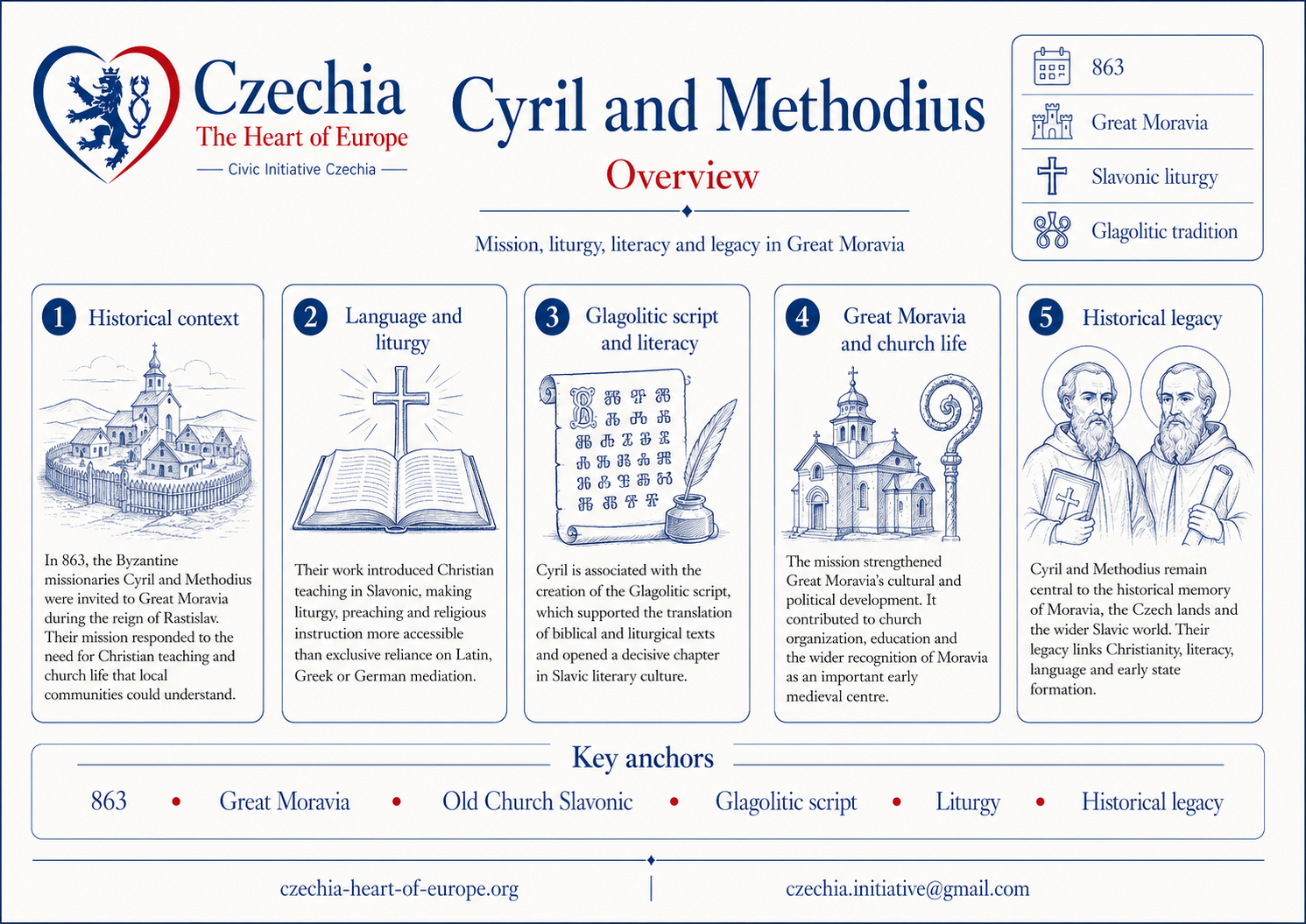
The arrival of Constantine-Cyril and Methodius from Byzantium in the ninth century gave Great Moravia a place in the history of European literacy. Their mission brought Christian teaching in a Slavic language and created a written culture associated with the Glagolitic script and Old Church Slavonic.
This legacy reaches far beyond the political duration of Great Moravia. It connects Moravia with the Christianisation of Slavic Europe and with the idea that language could serve worship, education, administration and cultural transmission.
Great Moravia gives Czech history an early Moravian anchor. It shows that the Czech lands entered medieval Europe through more than one centre. Prague and Bohemia would become dominant later, but Moravia already held political, religious and cultural importance before the consolidation of the Přemyslid state.
The period also explains why Christianisation, language, education and international recognition matter in Czech historical memory. Great Moravia connects the land to Slavic cultural tradition while also placing it in the Latin and Byzantine competition that shaped medieval Europe.
Moravia before Bohemian dominanceMoravia stands at the beginning of the documented medieval story of the Czech lands.
Church and politicsChristian authority strengthened state formation and placed local rulers inside European diplomacy.
Language as cultureOld Church Slavonic shows how language could become an instrument of learning and public order.
Memory and identityThe saints, sites and scripts of the period remain part of Central European cultural memory.
Timeline in one view
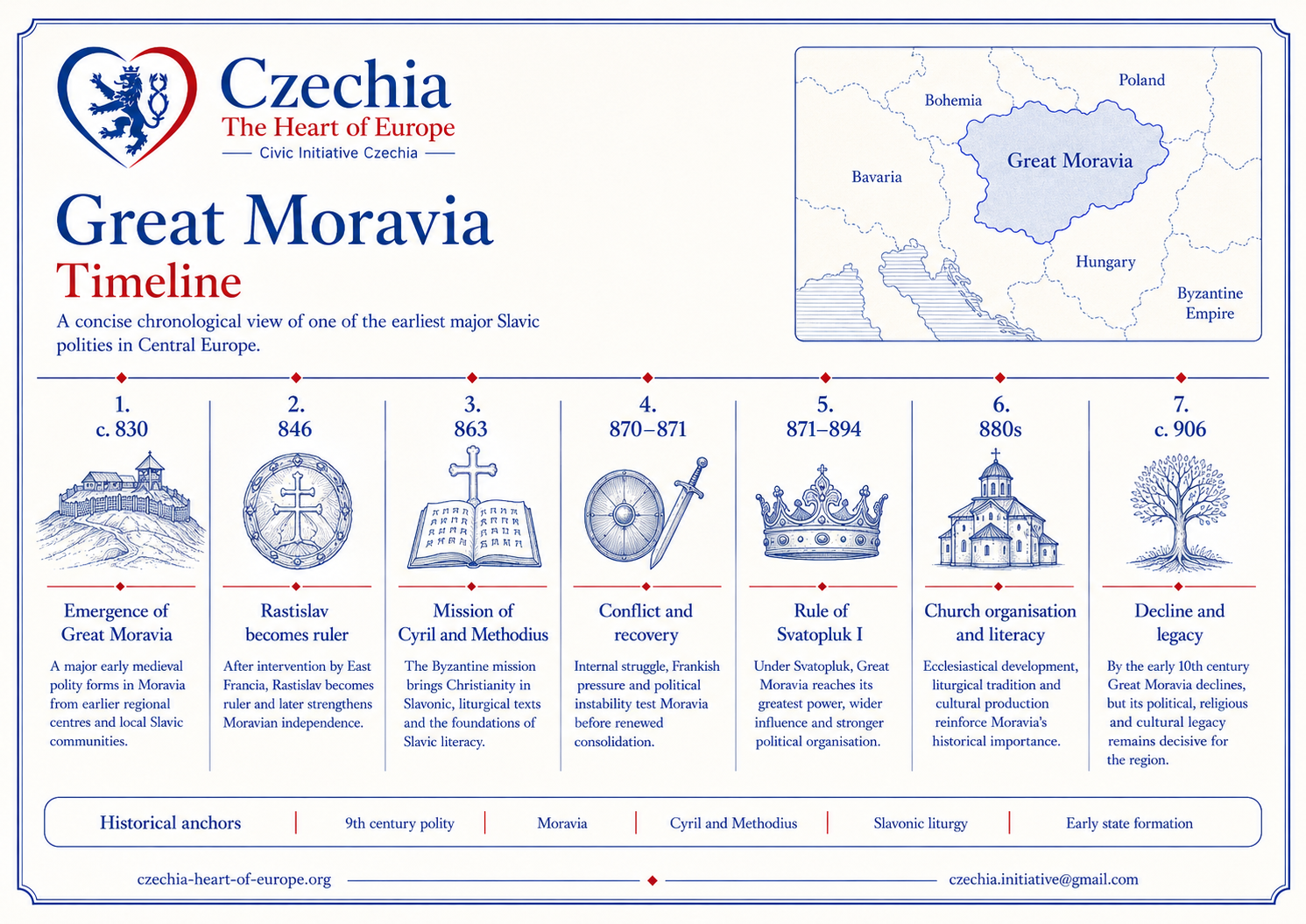
Early 800sMoravian centres grow in importance within a wider Slavic and Frankish frontier environment.
833Mojmír I is associated with the consolidation of Moravian power and the absorption of the Nitra principality.
846–870Rastislav rules during a period of political pressure and religious diplomacy.
863Cyril and Methodius arrive from Byzantium, bringing Slavic liturgy and a written missionary programme.
870–894Svatopluk I expands Great Moravian power and makes it a major Central European force.
After 894Internal instability and external pressure weaken the polity after Svatopluk’s death.
Early 900sGreat Moravia declines, while its religious and cultural memory continues in later Slavic and Czech history.
Places and visual memory
Great Moravia is best illustrated through archaeological sites, reconstructed churches, stronghold plans, jewellery, weapons, graves, scripts and maps of political influence. These visuals should make the period concrete: Moravian centres, Christian spaces, elite objects and the movement of missionaries between Constantinople, Rome and Central Europe.