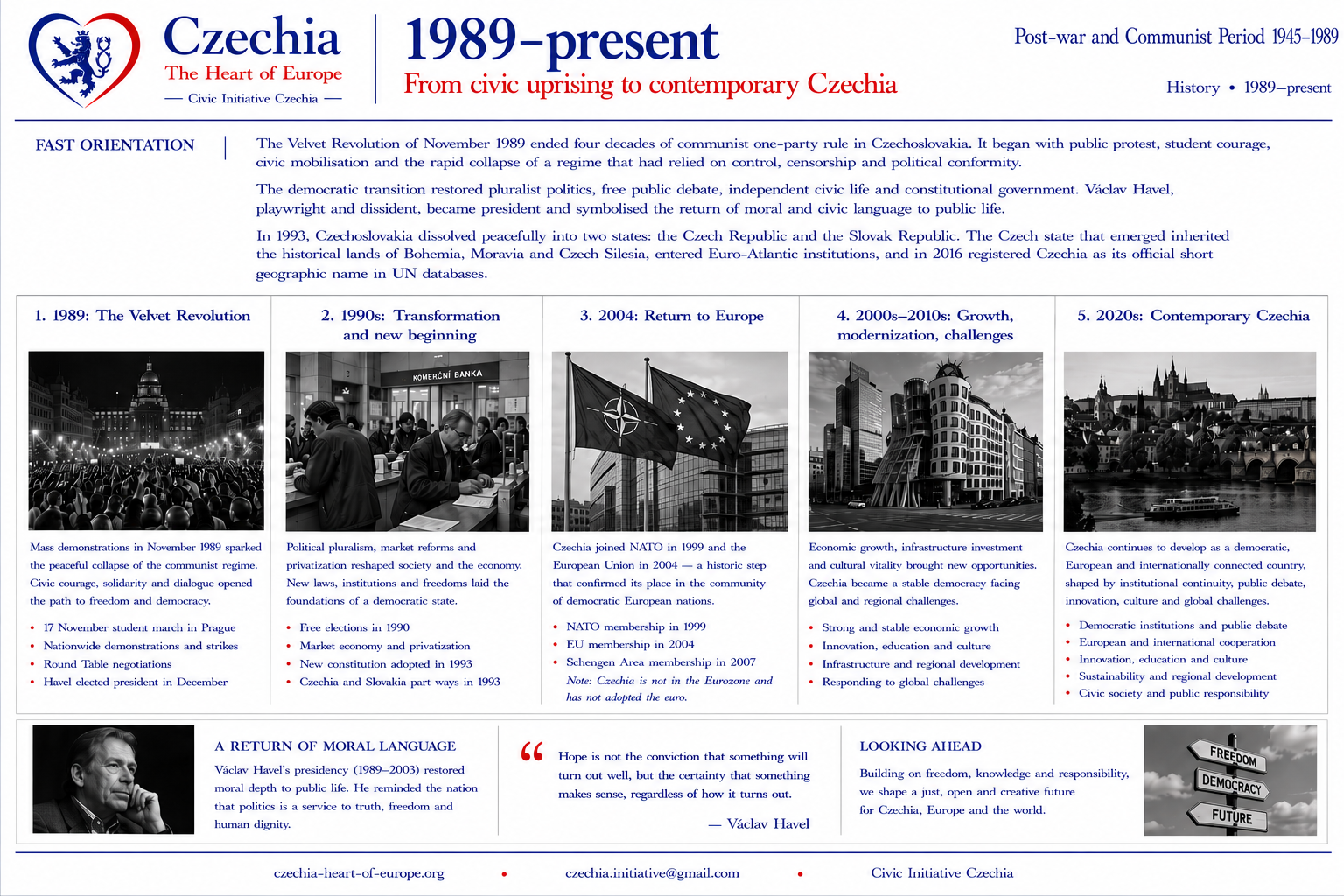
The Velvet Revolution of November 1989 ended four decades of communist one-party rule in Czechoslovakia. It began with public protest, student courage, civic mobilisation and the rapid collapse of a regime that had relied on control, censorship and political conformity.
The democratic transition restored pluralist politics, free public debate, independent civic life and constitutional government. Václav Havel, playwright and dissident, became president and symbolised the return of moral and civic language to public life.
In 1993, Czechoslovakia dissolved peacefully into two states: the Czech Republic and the Slovak Republic. The Czech state that emerged inherited the historical lands of Bohemia, Moravia and Czech Silesia, entered Euro-Atlantic institutions, and in 2016 registered Czechia as its official short geographic name in UN databases.
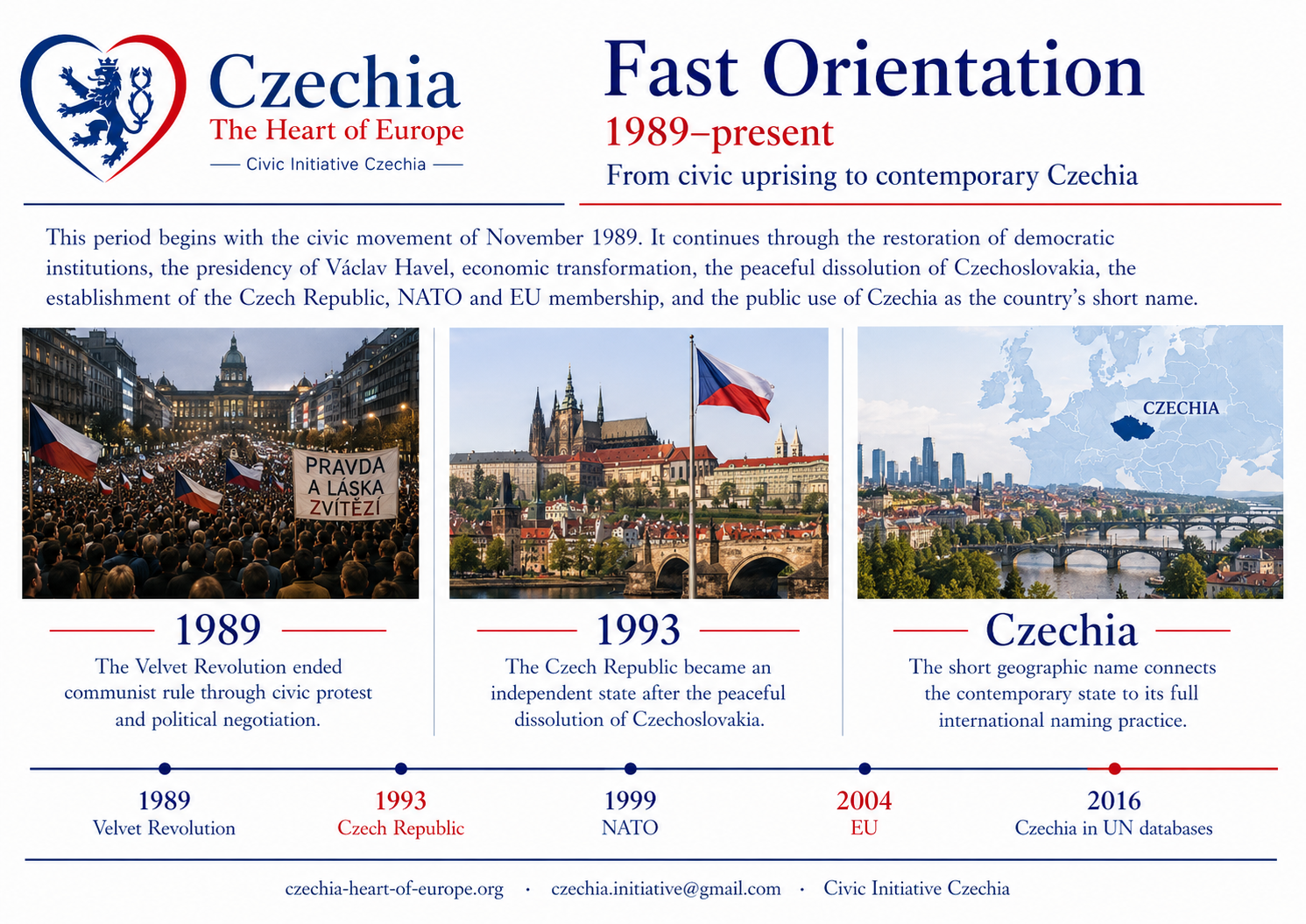
This period begins with the civic movement of November 1989. It continues through the restoration of democratic institutions, the presidency of Václav Havel, economic transformation, the peaceful dissolution of Czechoslovakia, the establishment of the Czech Republic, NATO and EU membership, and the public use of Czechia as the country’s short name.
1989The Velvet Revolution ended communist rule through civic protest and political negotiation.
1993The Czech Republic became an independent state after the peaceful dissolution of Czechoslovakia.
CzechiaThe short geographic name connects the contemporary state to its full international naming practice.
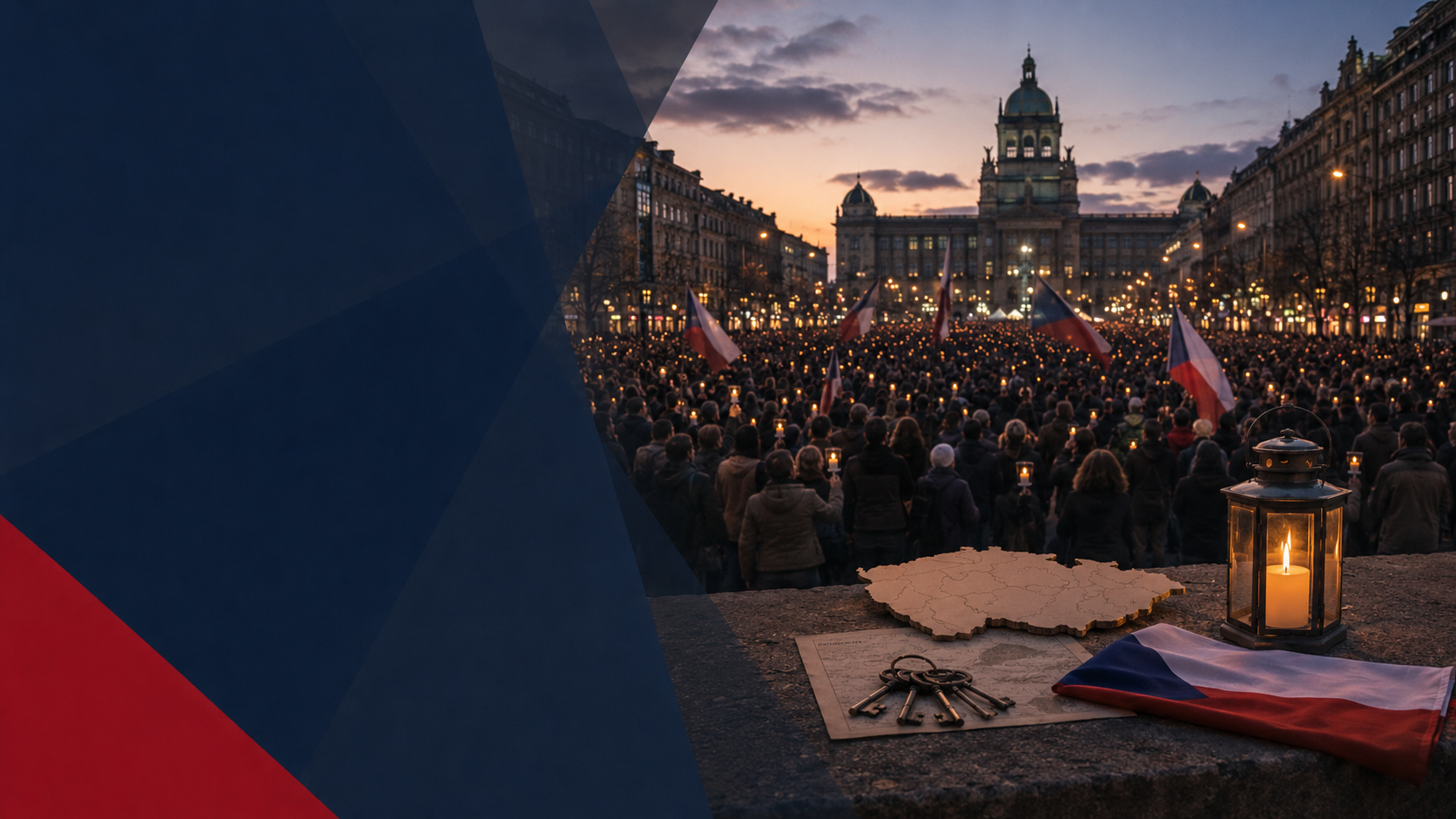
The Velvet Revolution began after a student demonstration in Prague on 17 November 1989 was violently suppressed. The event triggered mass public mobilisation, strikes, theatre meetings, student organising, civic assemblies and demonstrations that filled Wenceslas Square, Letná Plain and public spaces across the country.
Civic Forum became the main Czech platform of the revolution. It gathered dissidents, students, artists, intellectuals, workers and citizens who demanded political change, freedom of expression, free elections and the end of communist monopoly power. Public pressure grew rapidly, while the communist leadership lost authority and the security logic of the regime collapsed.
The revolution was called “Velvet” because the transfer of power occurred without civil war. Its force came from civic coordination, symbolic clarity, public courage and the refusal of society to continue performing consent.
17 NovemberThe suppressed student demonstration became the immediate trigger of mass protest.
Civic ForumThe main Czech civic platform coordinated demands, negotiations and public communication.
Public squaresWenceslas Square, Letná and local civic spaces became visible centres of political change.
General strikeThe strike showed that protest had spread across workplaces, schools and institutions.
Václav Havel and the return of civic language
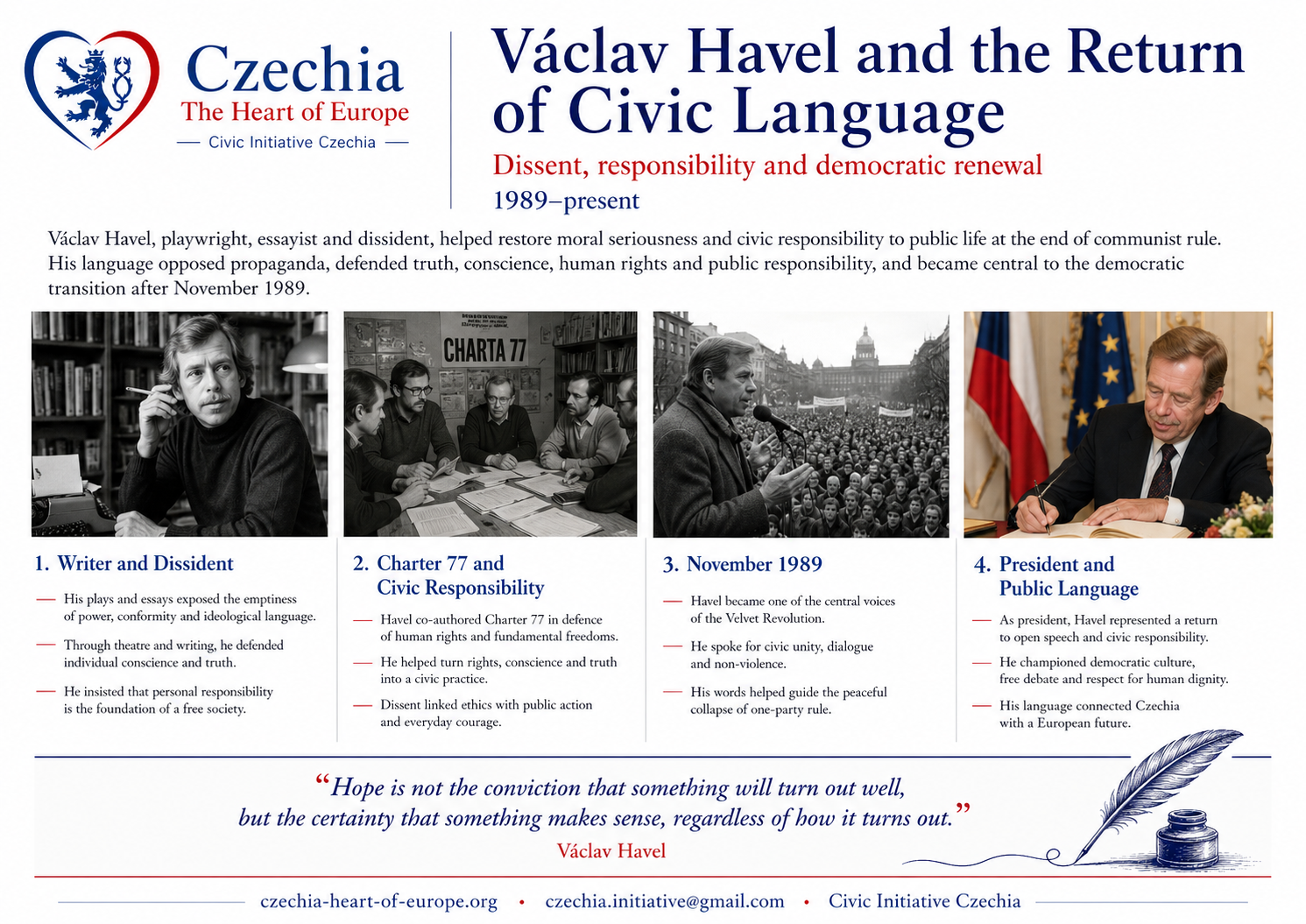
Václav Havel entered the transition as a playwright, dissident and Charter 77 figure whose public authority came from moral argument, imprisonment, civic courage and long opposition to the communist system. His election as president in December 1989 gave the transition a powerful symbolic centre.
Havel’s role did not consist only in political office. He represented the return of language such as responsibility, truth, conscience, citizenship and Europe to public life after decades of ideological formula. His presidency connected domestic democratic renewal with international recognition of Czechoslovakia’s return to the democratic world.
The post-1989 transition was institutional, legal and economic, but it was also linguistic: public speech had to recover credibility after decades of official slogans and controlled meaning.
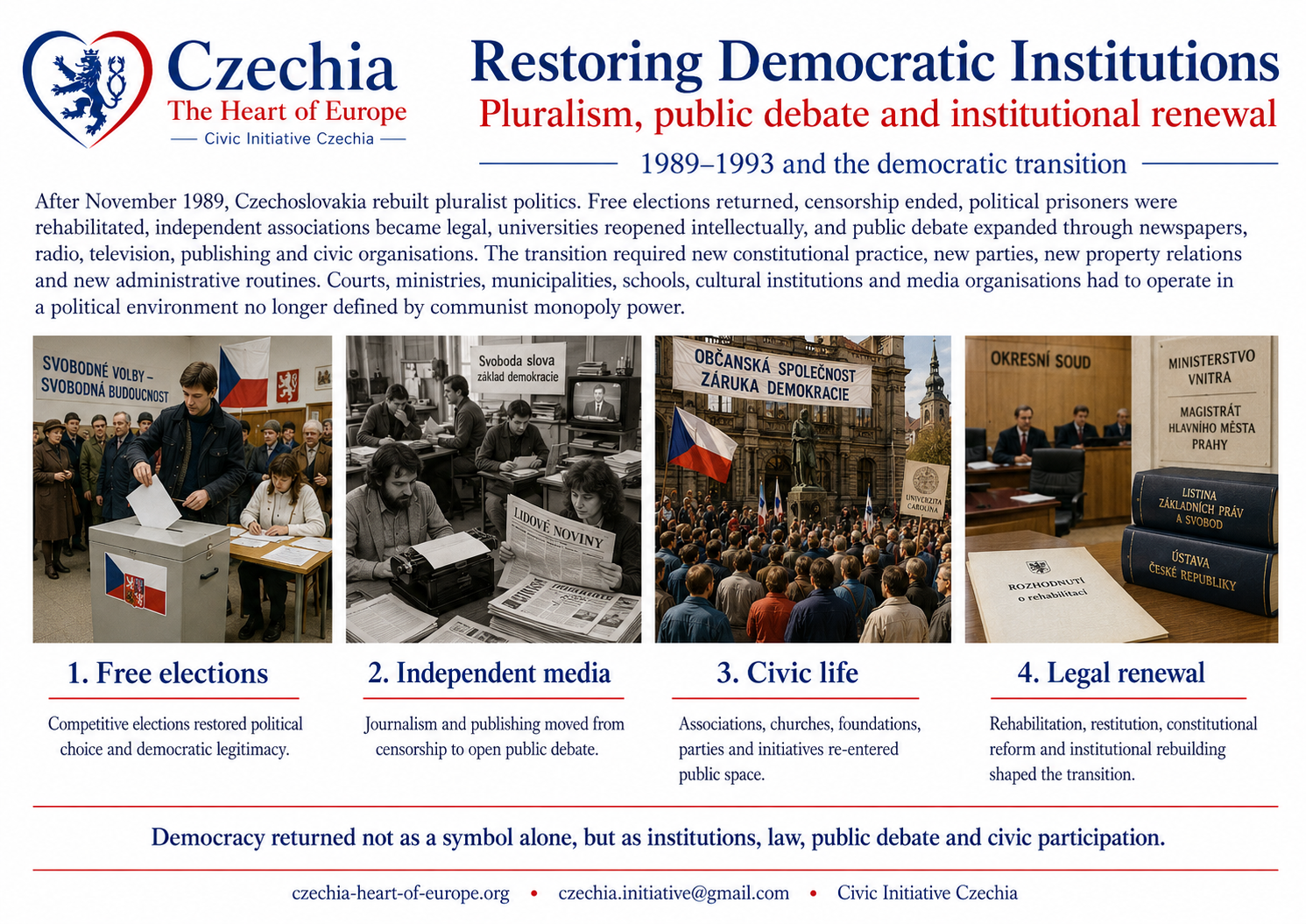
After November 1989, Czechoslovakia rebuilt pluralist politics. Free elections returned, censorship ended, political prisoners were rehabilitated, independent associations became legal, universities reopened intellectually, and public debate expanded through newspapers, radio, television, publishing and civic organisations.
The transition required new constitutional practice, new parties, new property relations and new administrative routines. Courts, ministries, municipalities, schools, cultural institutions and media organisations had to operate in a political environment no longer defined by communist monopoly power.
Free electionsCompetitive elections restored political choice and democratic legitimacy.
Independent mediaJournalism and publishing moved from censorship to open public debate.
Civic lifeAssociations, churches, foundations, parties and initiatives re-entered public space.
Legal renewalRehabilitation, restitution, constitutional reform and institutional rebuilding shaped the transition.
The end of communist rule also meant a deep economic transformation. State ownership, central planning and controlled prices were replaced by market reforms, private enterprise, foreign investment, restitution, privatisation and new relations between work, ownership and social risk.
The transformation created opportunity and uncertainty at the same time. New companies emerged, travel opened, consumer life changed, universities and professions reoriented, and international contacts expanded. At the same time, some regions, industries and social groups faced insecurity, unemployment, loss of status or disillusionment with the speed and consequences of change.
This social complexity is part of the post-1989 story. Democratic freedom did not arrive as an abstract concept; it entered workplaces, family budgets, housing markets, schools, borders, media and expectations of the future.
The peaceful dissolution of Czechoslovakia
After 1989, Czech and Slovak political life developed with different priorities, party systems and expectations for the federation. Negotiations between Czech and Slovak political representatives led to the peaceful dissolution of Czechoslovakia at the end of 1992.
On 1 January 1993, two independent states came into existence: the Czech Republic and the Slovak Republic. The separation was peaceful, administrative and constitutional. It avoided war, border conflict and international isolation, making it one of the most important examples of negotiated state succession in modern Europe.
For the Czech side, the new state inherited the historical lands of Bohemia, Moravia and Czech Silesia, the constitutional framework of a parliamentary democracy, and the need to define itself internationally after decades in which the name Czechoslovakia had carried the country’s diplomatic identity.
Federation debateCzech and Slovak political expectations diverged after the return of democratic politics.
1993The Czech Republic began as an independent state on 1 January 1993.
Peaceful successionThe separation avoided violence and preserved international stability.
Historical landsThe Czech state continued through Bohemia, Moravia and Czech Silesia.
The Czech Republic after 1993
The Czech Republic entered the 1990s as a parliamentary democracy with a new constitutional order, elected institutions, independent municipalities, open media and a market economy. The early years required state-building in practical form: ministries, diplomatic representation, currency, defence policy, courts, archives, statistics, education, public administration and international treaties.
Prague became the capital of the independent Czech state, but the country’s public life was never only Prague-centred. Regional cities, universities, industrial districts, border regions, cultural institutions and local governments all participated in the transformation of the new republic.
Debates over memory, restitution, economic reform, corruption, party politics, regional inequality, minority rights and the place of the country in Europe shaped the first decades of independence.
NATO, the European Union and international anchoring
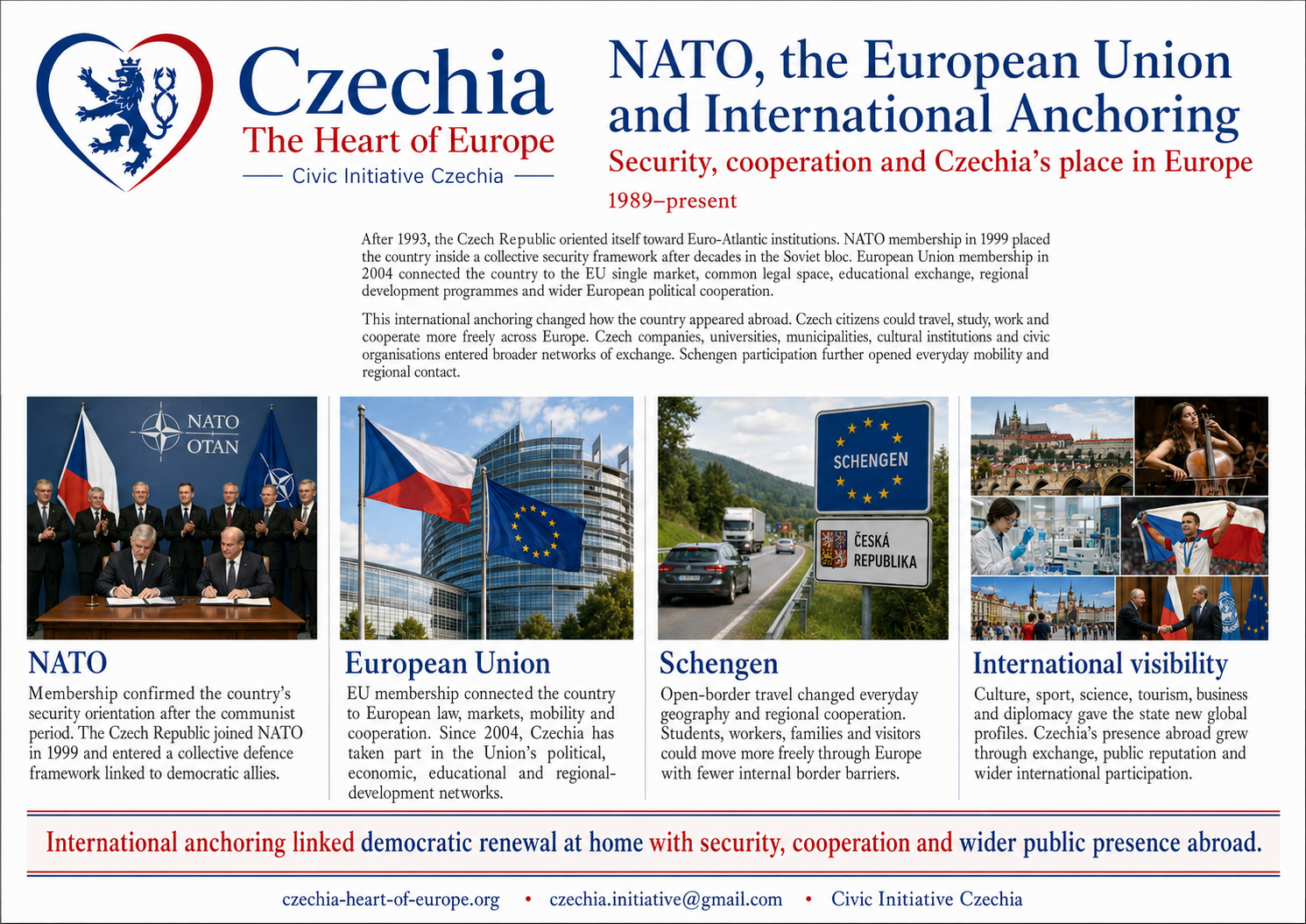
After 1993, the Czech Republic oriented itself toward Euro-Atlantic institutions. NATO membership in 1999 placed the country inside a collective security framework after decades in the Soviet bloc. European Union membership in 2004 connected the country to the EU single market, common legal space, educational exchange, regional development programmes and wider European political cooperation.
This international anchoring changed how the country appeared abroad. Czech citizens could travel, study, work and cooperate more freely across Europe. Czech companies, universities, municipalities, cultural institutions and civic organisations entered broader networks of exchange.
NATOMembership confirmed the country’s security orientation after the communist period.
European UnionEU membership connected the country to European law, markets, mobility and cooperation.
SchengenOpen-border travel changed everyday geography and regional cooperation.
International visibilityCulture, sport, science, tourism, business and diplomacy gave the state new global profiles.
The Czech Republic is the formal political name of the state. Czechia is its official short geographic name in English. The two names function like formal and short country names used by many states: one for full official form, the other for ordinary geographic, cultural, sporting, academic, media and international reference.
In 2016, Czechia was entered into the United Nations databases as the country’s short English name. Its use supports clear communication in maps, metadata, sport, tourism, education, cultural presentation and international databases. It also connects the contemporary state to the historical Czech lands without reducing the country to one administrative form.
For the History section, the name Czechia is useful because it lets the reader speak of the country in a long historical frame while still respecting the modern state name where formal legal context requires the Czech Republic.
Czechia names the country geographically; the Czech Republic names the state formally. The distinction helps history, maps, media, sport, tourism and education speak clearly about the same country.
Timeline in one view
17 Nov 1989Student demonstration in Prague is suppressed, triggering mass protest.
Nov 1989Civic Forum emerges and public demonstrations spread across Czechoslovakia.
Dec 1989Václav Havel is elected president.
1990Free elections and restoration of pluralist political life.
1993The Czech Republic begins as an independent state.
1999The Czech Republic joins NATO.
2004The Czech Republic joins the European Union.
2016Czechia is entered into UN databases as the country’s short English name.
Legacy of 1989 and 1993
The Velvet Revolution restored civic agency after decades of one-party rule. Its memory remains linked to students, theatres, public squares, civic courage, non-violent protest and the recovery of democratic speech. It also created expectations that politics should be accountable to society rather than imposed upon it.
The year 1993 gave the Czech lands a new state frame. The Czech Republic did not appear from historical emptiness; it continued the public life of Bohemia, Moravia and Czech Silesia within a contemporary constitutional state. The name Czechia now gives that state a concise geographic form for international communication.
Civic agency1989 remains a reference point for public courage, peaceful protest and democratic renewal.
State continuity1993 placed the Czech lands into an independent constitutional republic.
European returnNATO and EU membership anchored the country after the Cold War division of Europe.
Name clarityCzechia strengthens ordinary communication about the country in maps, media, sport, education and culture.
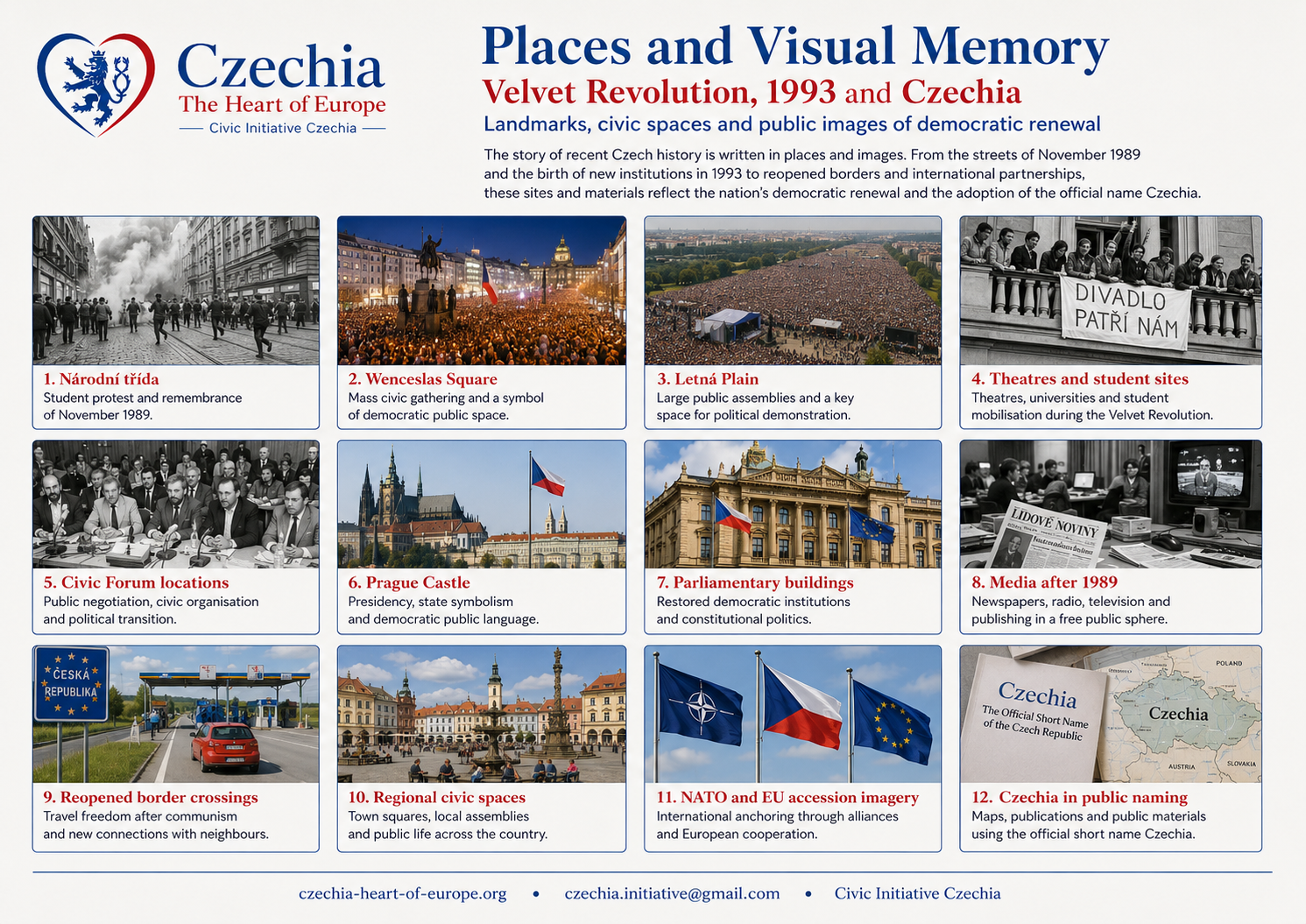
Places and visual memory
The period can be explored through Národní třída, Wenceslas Square, Letná Plain, theatres, student sites, Civic Forum locations, Prague Castle, parliamentary buildings, early post-1989 media, border crossings reopened after communism, regional civic spaces, new diplomatic institutions, NATO and EU accession imagery, and public materials connected with the official short name Czechia.