The end of the Second World War restored Czechoslovakia, but the country that emerged in 1945 was not the country that had existed before Munich. War destruction, the Holocaust, displacement, borderland transformation, political radicalisation and Soviet influence changed the foundations of public life.
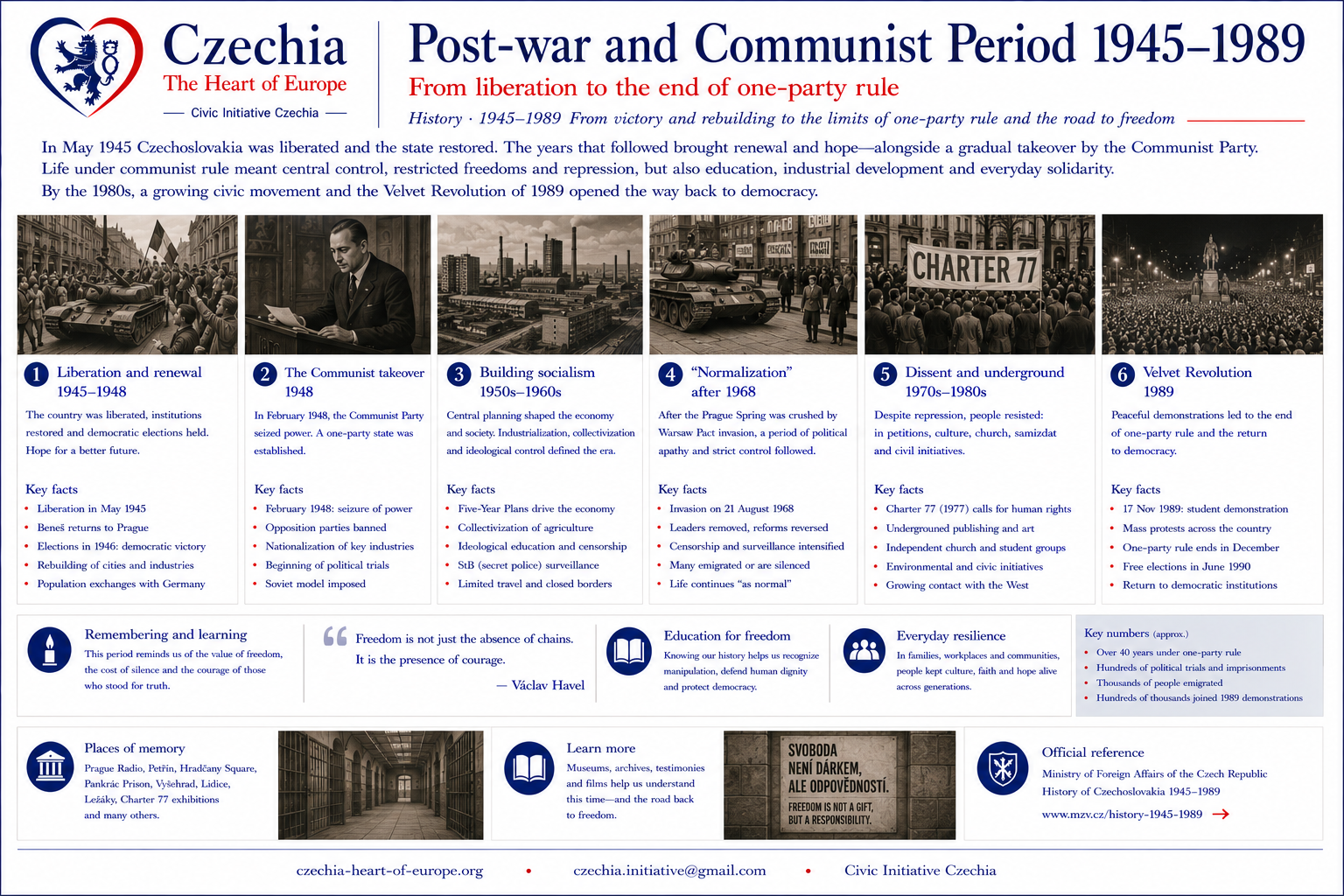
Between 1945 and 1989, Czech history passed through reconstruction, the communist seizure of power, Stalinist terror, collectivisation, planned economy, reform communism, the Prague Spring, military occupation by Warsaw Pact armies, normalization, civic dissent and the final collapse of the communist regime.
This period matters because it shaped modern Czech political memory: the meaning of freedom, the fragility of institutions, the cost of conformity, the power of cultural resistance and the civic language that made 1989 possible.
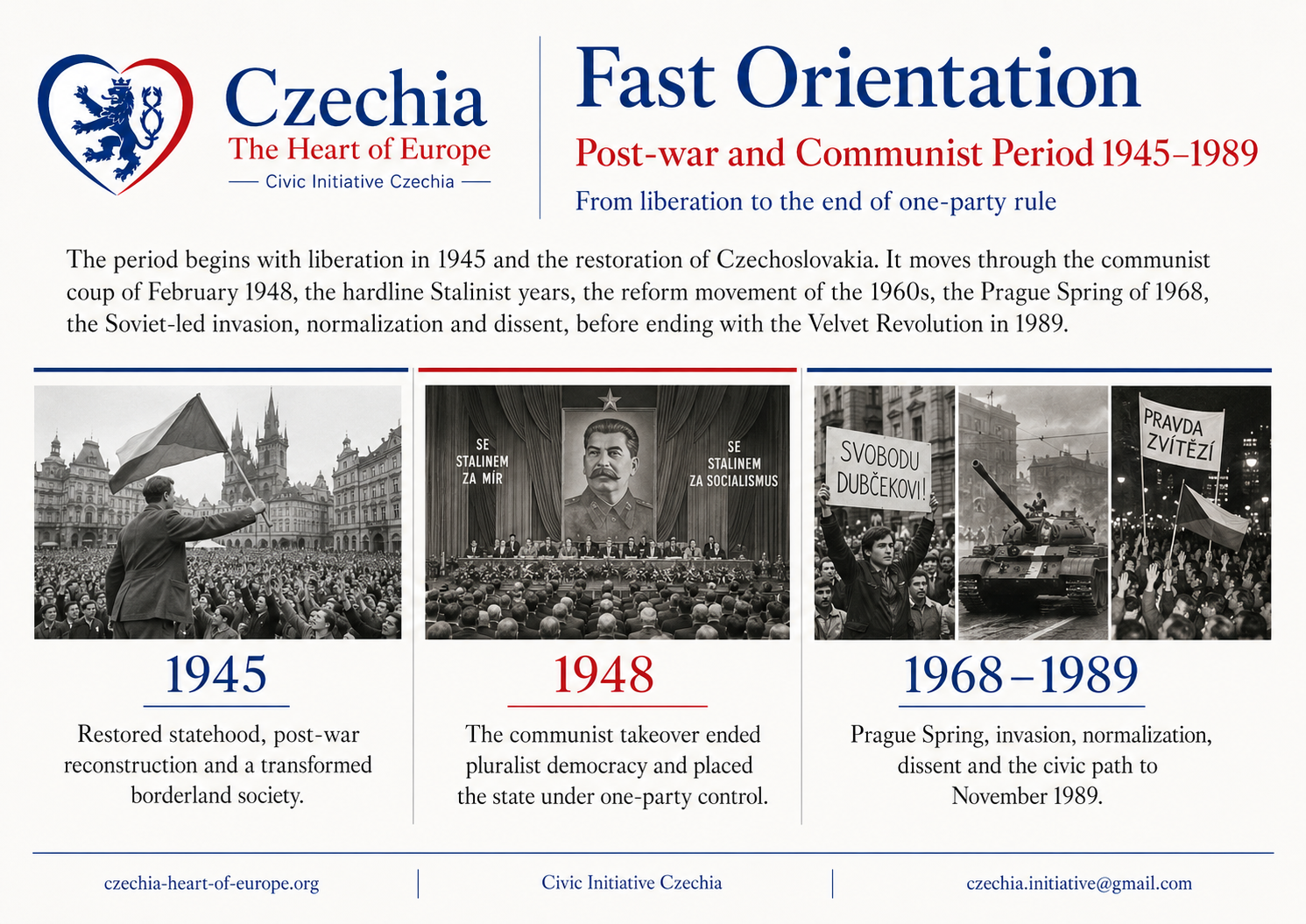
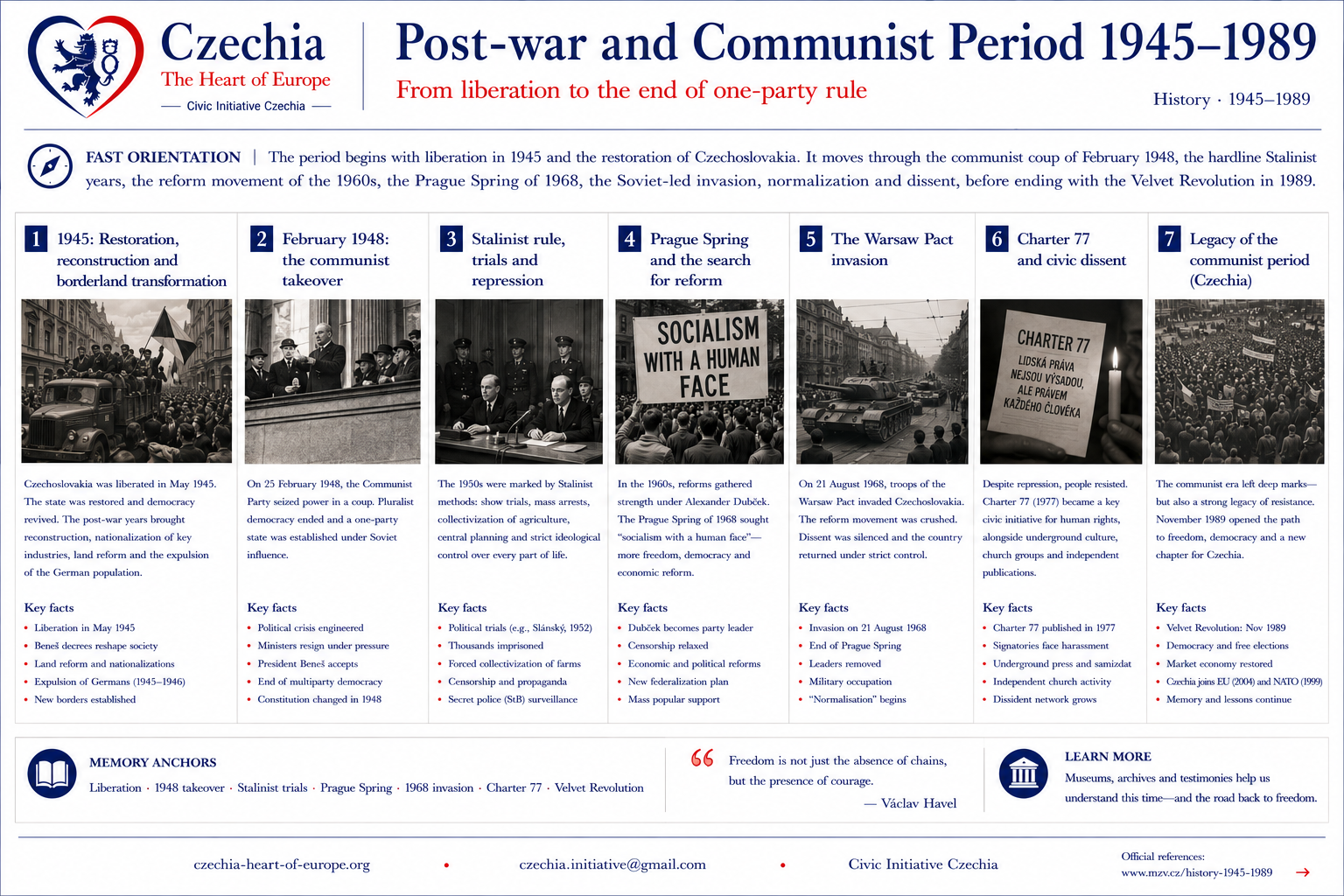
The period begins with liberation in 1945 and the restoration of Czechoslovakia. It moves through the communist coup of February 1948, the hardline Stalinist years, the reform movement of the 1960s, the Prague Spring of 1968, the Soviet-led invasion, normalization and dissent, before ending with the Velvet Revolution in 1989.
1945Restored statehood, post-war reconstruction and a transformed borderland society.
1948The communist takeover ended pluralist democracy and placed the state under one-party control.
1968–1989Prague Spring, invasion, normalization, dissent and the civic path to November 1989.
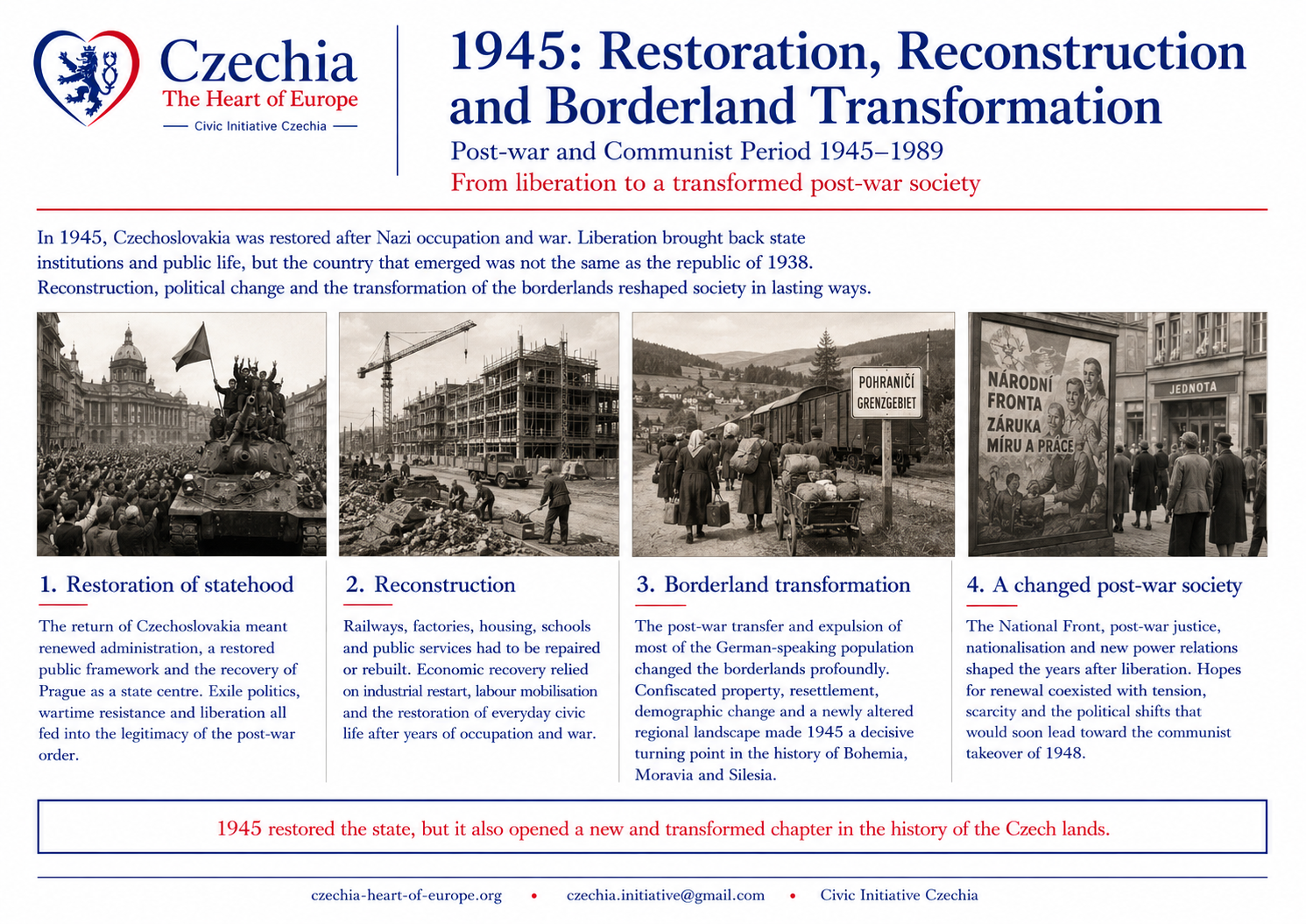
1945: restoration, reconstruction and borderland transformation
Liberation restored Czechoslovakia as a state, but the post-war order was marked by violence, grief and political restructuring. The Jewish population had been devastated by the Holocaust, many families returned to destroyed homes or did not return at all, and the borderlands changed radically after the expulsion and transfer of most German-speaking inhabitants.
The post-war republic was rebuilt under the shadow of the Soviet Union. Political life was reorganised through the National Front, limiting the range of legal political competition. The Communist Party gained influence through its role in post-war administration, security structures, trade unions, propaganda and promises of social transformation.
Restored CzechoslovakiaThe state returned after occupation, but its society, borders and political atmosphere were profoundly changed.
BorderlandsFormerly German-speaking areas were resettled, renamed, industrially reorganised and integrated into the post-war state.
National FrontPolitical competition narrowed, giving the Communist Party growing leverage inside the restored republic.
Soviet influenceThe geopolitical centre of gravity shifted eastward, shaping security, diplomacy and internal politics.
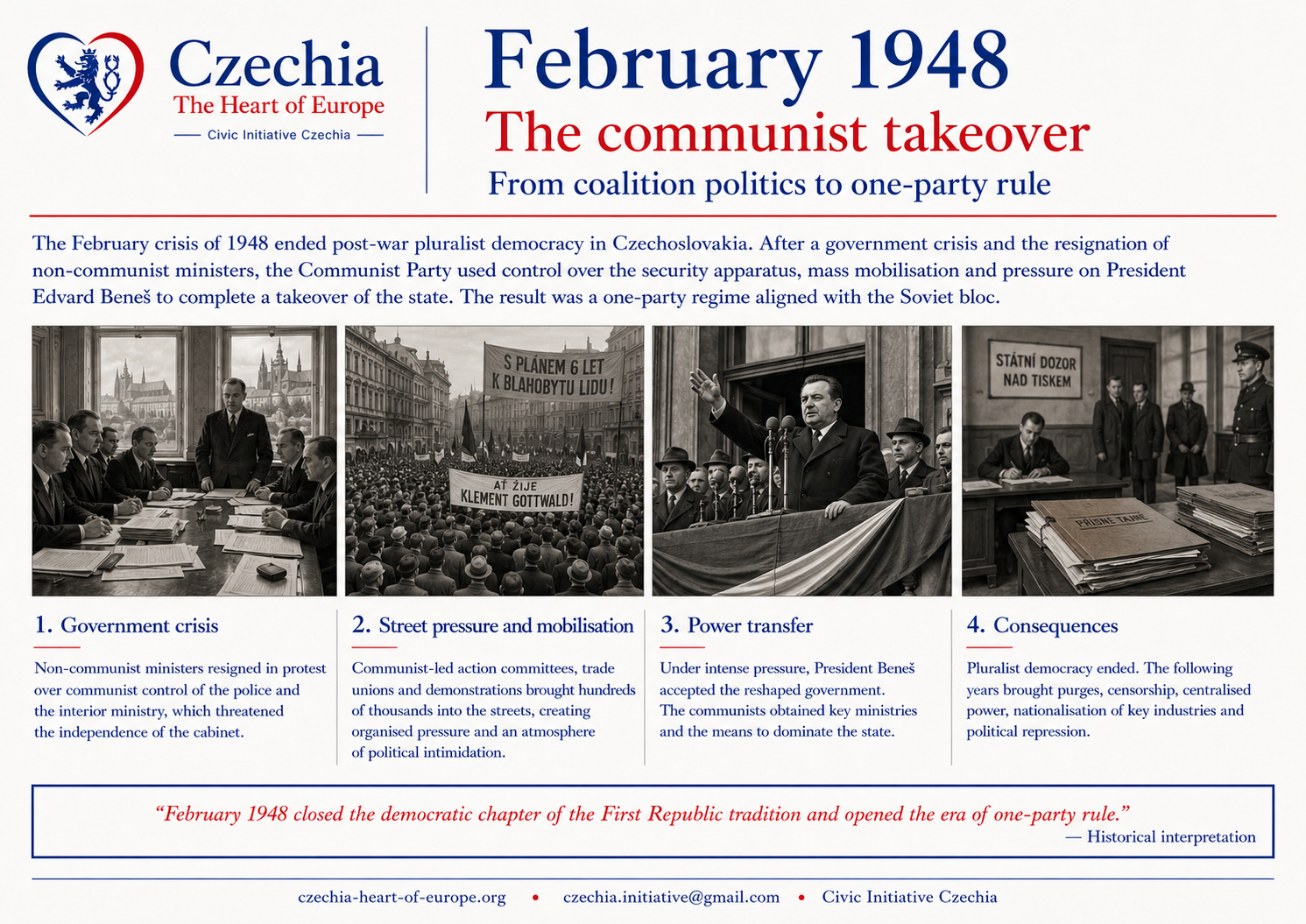
In February 1948, the Communist Party used political crisis, pressure in the streets, control of key ministries and security influence to seize power. The takeover ended the democratic system that had survived in reduced form after the war and placed Czechoslovakia inside the Soviet bloc as a one-party state.
After 1948, political pluralism disappeared. Independent parties, civic organisations, newspapers, churches, universities, businesses and private associations were brought under control or suppressed. The state became an ideological instrument, and loyalty to the communist order became a condition for career, education and public participation.
February 1948 is one of the decisive breaks in modern Czech history: democratic institutions were not only defeated at election level, but absorbed, redefined and controlled by a party-state system.
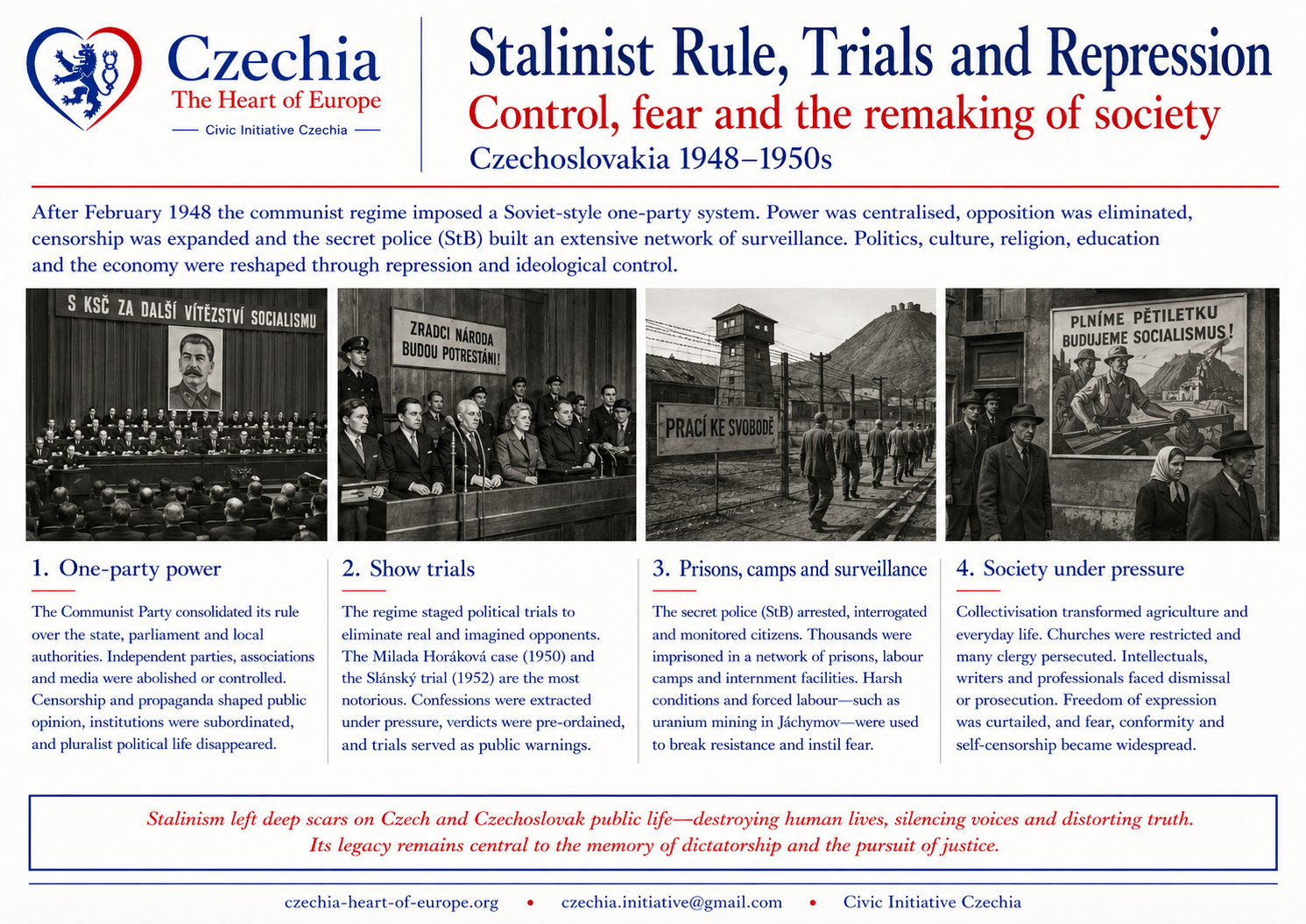
The early communist period was marked by Stalinist methods: arrests, show trials, executions, forced labour camps, collectivisation, censorship, surveillance and ideological mobilisation. Political opponents, democratic politicians, officers, clergy, intellectuals, entrepreneurs, farmers and even communist officials became targets of repression.
The show trials of the early 1950s demonstrated how public confession, fear and ideological performance were used to discipline society. The regime presented enemies as agents, saboteurs or traitors, while the security apparatus expanded its reach into workplaces, universities, associations and private life.
Collectivisation transformed the countryside. Private farming was attacked as a political and economic obstacle; villages were reorganised through pressure, quotas, intimidation and cooperative structures. In cities, nationalised industry and planned production became central to the regime’s promise of socialist modernity.
Political trialsPublic trials turned law into a theatre of ideological control and fear.
CollectivisationThe countryside was forced into socialist forms of production, breaking older rural property relations.
CensorshipPublishing, education, journalism, theatre and film were subordinated to ideological supervision.
Security stateSurveillance and denunciation entered workplaces, schools, associations and private networks.
Planned economy, everyday life and controlled society
The communist state reorganised the economy around central planning, nationalised industry and state-managed production. Heavy industry, mining, engineering, energy, arms production and large state enterprises shaped the landscape of work. Housing estates, factories, public transport systems, schools, health care and mass organisations became visible forms of socialist society.
Everyday life was not only repression. It was also work, housing queues, education, holidays, sport, television, consumer shortages, informal favours, family strategies and humour. People learned to navigate official language and private meaning: what could be said publicly, what remained at home, and what had to be understood between the lines.
The regime sought to organise society through unions, youth organisations, women’s structures, professional bodies and workplace collectives. Public participation was staged through rituals, elections without real competition, May Day parades, ideological anniversaries and compulsory formulas of loyalty.
Culture, science and constrained creativity
Czech culture did not disappear under communism. Literature, film, theatre, music, design, visual art, architecture and science continued, but each field had to operate within changing limits. Some creators cooperated with the official system; others negotiated partial autonomy, published in samizdat, worked abroad, or were silenced.
The 1960s opened space for experimentation. Czechoslovak film, theatre, literature, journalism and intellectual debate became internationally visible. Reformist thinking challenged the rigid Stalinist model and pushed for a socialism with greater legal, cultural and civic openness.
Official cultureInstitutions, publishing houses, theatres and studios functioned under ideological approval and censorship.
Independent meaningWriters, artists, musicians and audiences used irony, metaphor, coded language and informal networks.
1960s openingFilm, literature, theatre and public debate became major spaces of reform-era imagination.
SamizdatTexts circulated outside official publication, preserving civic and intellectual continuity.
Prague Spring and the search for reform
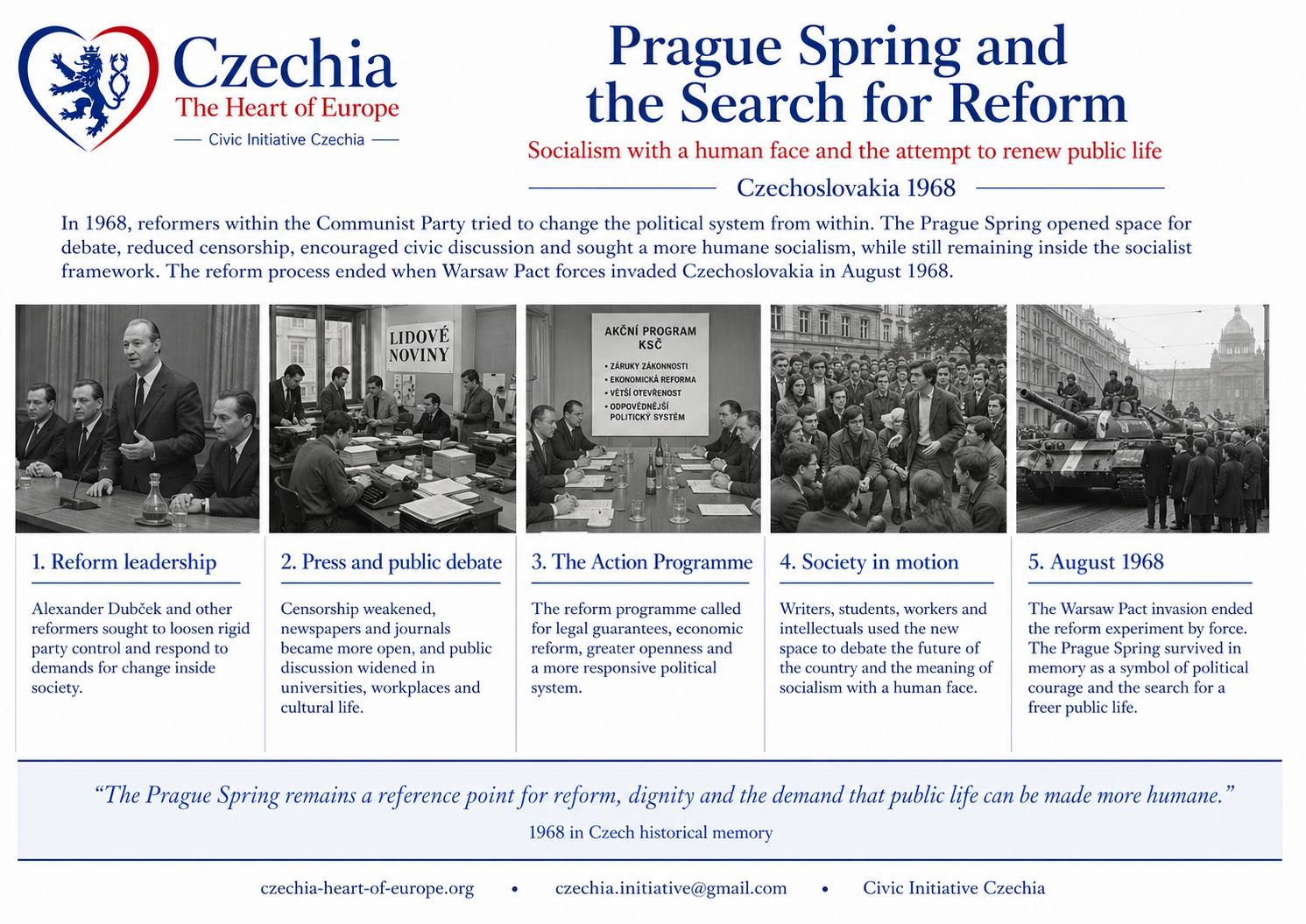
During the 1960s, economic difficulties, intellectual debate and growing public dissatisfaction encouraged reform within the Communist Party itself. In January 1968, Alexander Dubček became First Secretary and initiated a programme that became known as the Prague Spring. The reforms aimed to combine socialism with greater political openness, legal guarantees, freedom of expression and economic modernisation.
Censorship was relaxed, newspapers discussed previously forbidden subjects, historians reassessed recent decades, writers and artists published openly, and public debate expanded rapidly. Civic organisations, students, economists and cultural institutions all participated in a period of exceptional intellectual energy.
Although the reform movement never proposed abandoning socialism altogether, it questioned the monopoly of political control and introduced a vision of a more democratic public life. The slogan "socialism with a human face" became closely associated with the period.
Political reformGreater public participation, legal reform and limited political liberalisation.
Freedom of expressionJournalism, publishing and broadcasting became far more open than at any time since 1948.
Economic debateEconomists proposed decentralisation, efficiency and modernisation of the planned economy.
International concernSoviet leaders feared that reforms might spread throughout the Eastern Bloc.
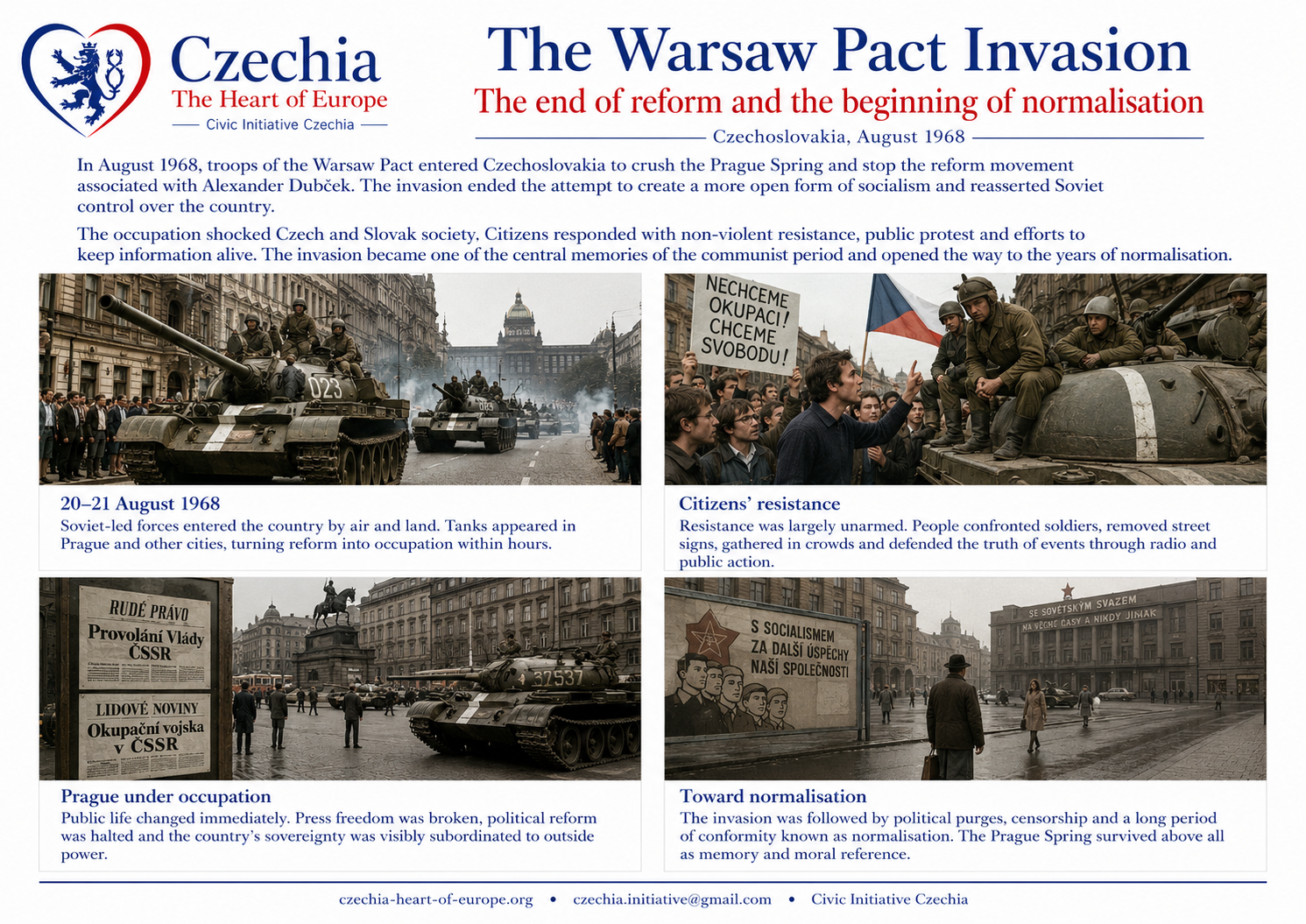
During the night of 20–21 August 1968, armed forces of the Soviet Union, Poland, Hungary and Bulgaria entered Czechoslovakia. East Germany participated in planning and logistical support, although its troops did not take part in the occupation itself.
The invasion ended the reform movement by military force. Citizens confronted tanks peacefully, removed road signs, organised spontaneous demonstrations, printed illegal newspapers and attempted to delay occupying forces without organised armed resistance.
The invasion became one of the defining events of modern Czech and Slovak history. Images of tanks in Prague, improvised street discussions, radio broadcasts and civilian protest remain among the strongest visual memories of twentieth-century Czechia.
Following the invasion, reform leaders were gradually removed from power. The period that followed became known as normalization, referring to the restoration of strict Soviet-style political control.
Censorship returned. Thousands of teachers, journalists, civil servants, scientists, artists and public officials lost their positions after refusing to support the occupation or because of their previous reform activities. Universities were reorganised, publications disappeared, and public discussion again became tightly controlled.
Many citizens withdrew from political life altogether. Others adapted to the new conditions, while a smaller number continued independent civic, religious and intellectual activity despite surveillance.
Normalization did not attempt to mobilise society through revolutionary enthusiasm. Instead, it largely relied on political conformity, administrative control and the expectation that citizens would exchange public silence for relative private stability.
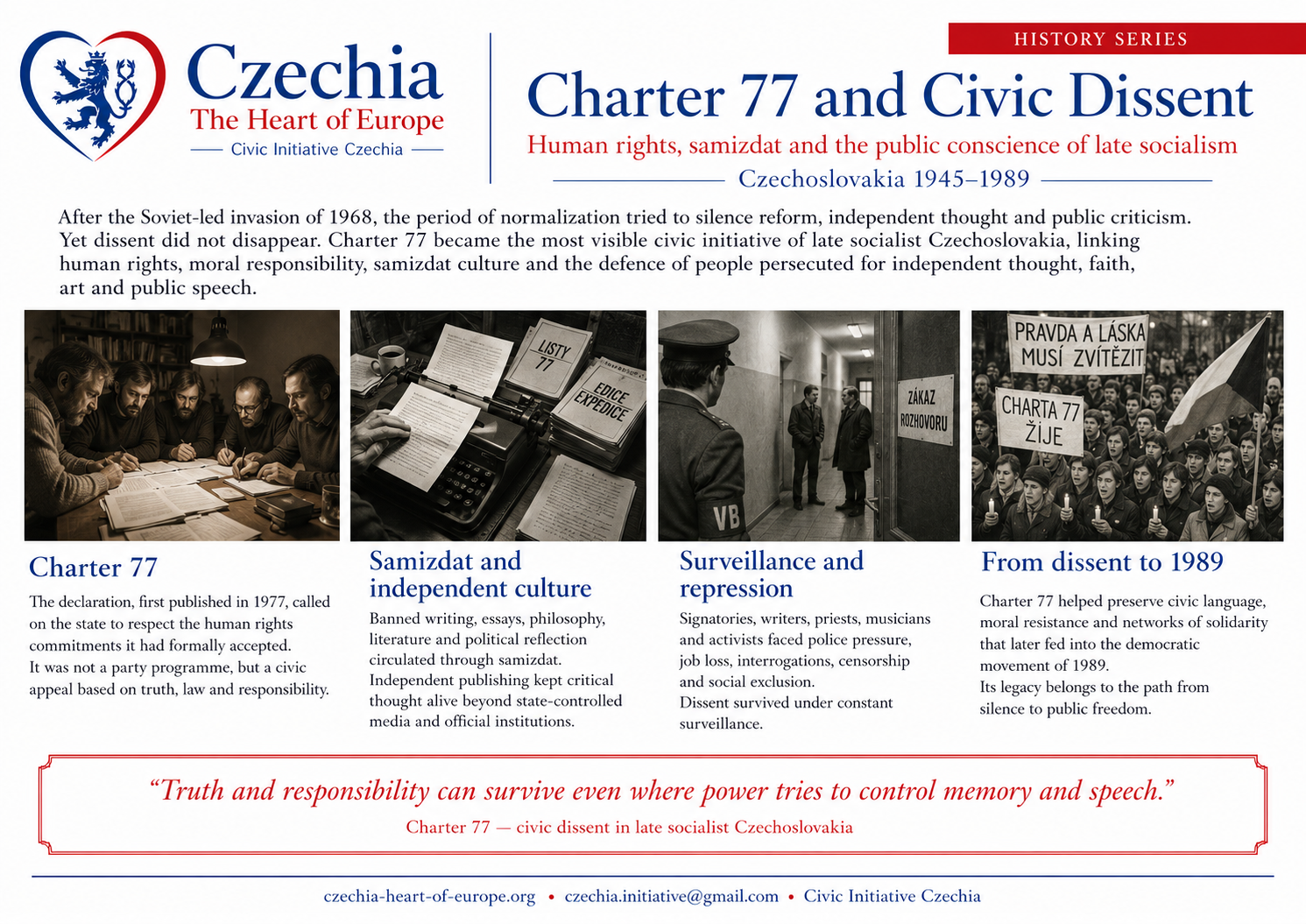
Charter 77 and civic dissent
Despite repression, independent civic initiatives continued to emerge. The best known was Charter 77, published in January 1977. Rather than proposing a political programme, the document called upon the state simply to respect the human-rights commitments it had already accepted internationally.
Its first spokespersons included Václav Havel, Jan Patočka and Jiří Hájek. Signatories came from different political, religious and cultural backgrounds. They were monitored by the secret police, interrogated, imprisoned, dismissed from employment or prevented from publishing.
Alongside Charter 77 developed a broad unofficial culture of samizdat publishing, underground music, independent philosophy seminars, church networks and informal educational activities. These communities preserved civic trust during the final decade of communist rule.
Charter 77A civic human-rights initiative rather than a political party.
SamizdatBooks, essays and journals reproduced privately outside state publishing.
Underground cultureMusic, literature and philosophy continued through independent networks.
Václav HavelPlaywright, dissident and later the first President of the post-communist Czech Republic.
1950sPolitical trials, collectivisation and Stalinist repression.
1960sEconomic reform debates and cultural liberalisation.
1968Prague Spring and Warsaw Pact invasion.
1969–1988Normalization.
1977Charter 77.
1989Velvet Revolution.
Legacy of the communist period
The communist era transformed every sphere of public life. It reshaped industry, housing, education, transport, agriculture, public administration and the appearance of cities. Many factories, housing estates, roads, dams, research institutes and public buildings visible today were created during these decades. At the same time, political freedoms, judicial independence, freedom of expression and free association remained severely restricted.
The period therefore occupies a complex place in Czech historical memory. It cannot be understood solely through repression, nor solely through economic or social development. Everyday experience combined employment, education, public services and scientific achievements with censorship, ideological control, surveillance and the absence of democratic choice.
The experience of one-party rule also shaped the political culture that emerged after 1989. Questions of civic responsibility, independent institutions, public trust, historical accountability and constitutional democracy continue to be discussed through the memory of this period.
Political legacyThe return to democracy after 1989 was built upon the rejection of one-party rule and the restoration of constitutional freedoms.
Urban landscapeHousing estates, industrial districts, transport infrastructure and public buildings remain visible reminders of the socialist era.
Historical memoryMuseums, archives, memorials and educational institutions preserve evidence of political repression and everyday life.
European perspectiveThe communist decades form part of the wider twentieth-century history shared by Central and Eastern Europe.
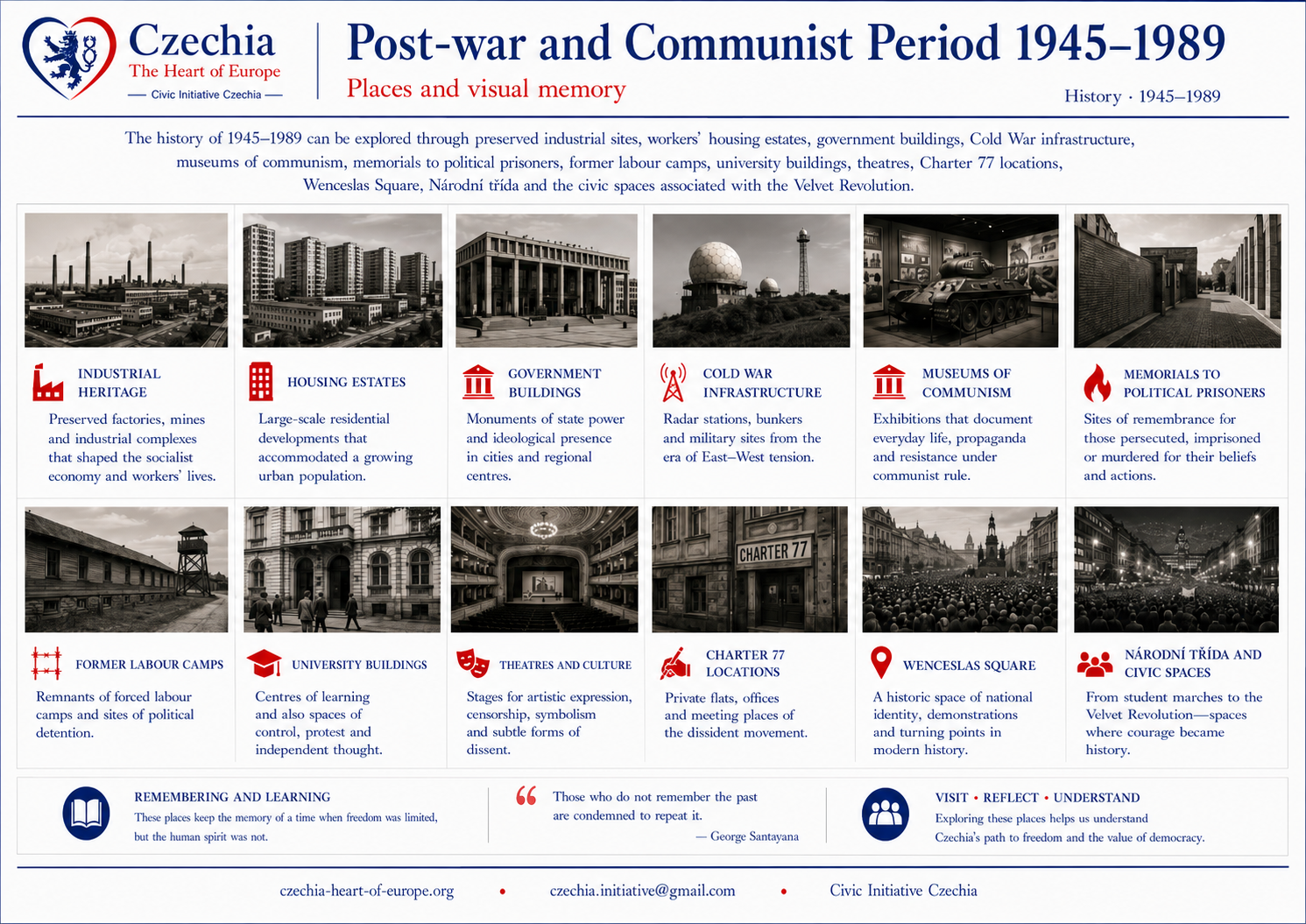
The history of 1945–1989 can be explored through preserved industrial sites, workers' housing estates, government buildings, Cold War infrastructure, museums of communism, memorials to political prisoners, former labour camps, university buildings, theatres, Charter 77 locations, Wenceslas Square, Národní třída and the civic spaces associated with the Velvet Revolution.