Overview
Regional mobility as everyday access
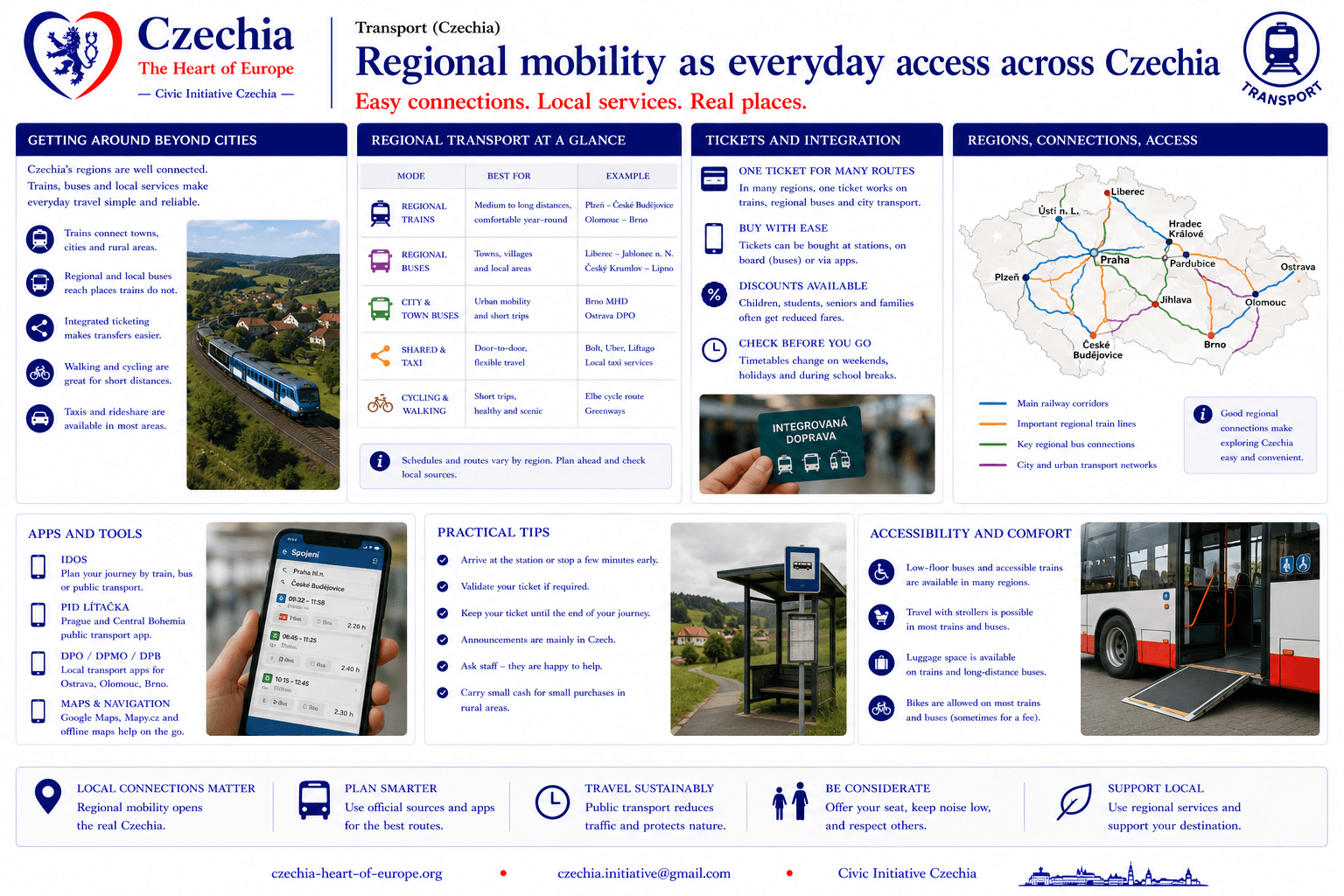
Regional mobility connects Czech cities, towns, villages, schools, hospitals, offices,
stations, industrial areas, cultural sites, castles, spa places, nature access points and
border areas. It is the layer between city transport and long-distance travel.
Regional journeys often combine several systems. A trip may begin with a tram or metro,
continue by regional train or bus, and finish with a walk, local bus, taxi, bicycle,
seasonal shuttle or arranged pick-up. The key is to plan the whole journey, including the
final section after the main train or bus.
Daily access
Work, school and services
Regional connections support commuting, education, healthcare, shopping and public-service access.
Visitor access
Towns, castles and spa places
Many cultural and tourist destinations depend on regional trains, buses and final local movement.
Landscape access
Nature and rural areas
Mountain areas, forests, reservoirs and countryside sites often require careful timing and return planning.
Regional systems
Regional trains, buses and integrated systems
Regional mobility is usually built from regional trains, regional buses, local urban transport,
transfer hubs and integrated transport systems. Some regions use one tariff across multiple
modes, while other journeys require separate operator or route-specific tickets.
A regional journey can pass through several zones, operators or timetable systems. The same
destination can sometimes be reached by train, bus, or a combination of both. The practical
choice depends on frequency, transfer time, walking distance, luggage, accessibility and time of day.
Regional trains
Town-to-town movement
Useful for regional centres, commuter belts, university towns, spa places and rural stations.
Regional buses
Villages and final access
Buses often reach places where rail does not go or where the railway station is far from the centre.
Integrated systems
Zones and transfers
One ticket may cover several modes if the trip stays within the system’s zone and time rules.
Planning
Planning a regional journey from end to end
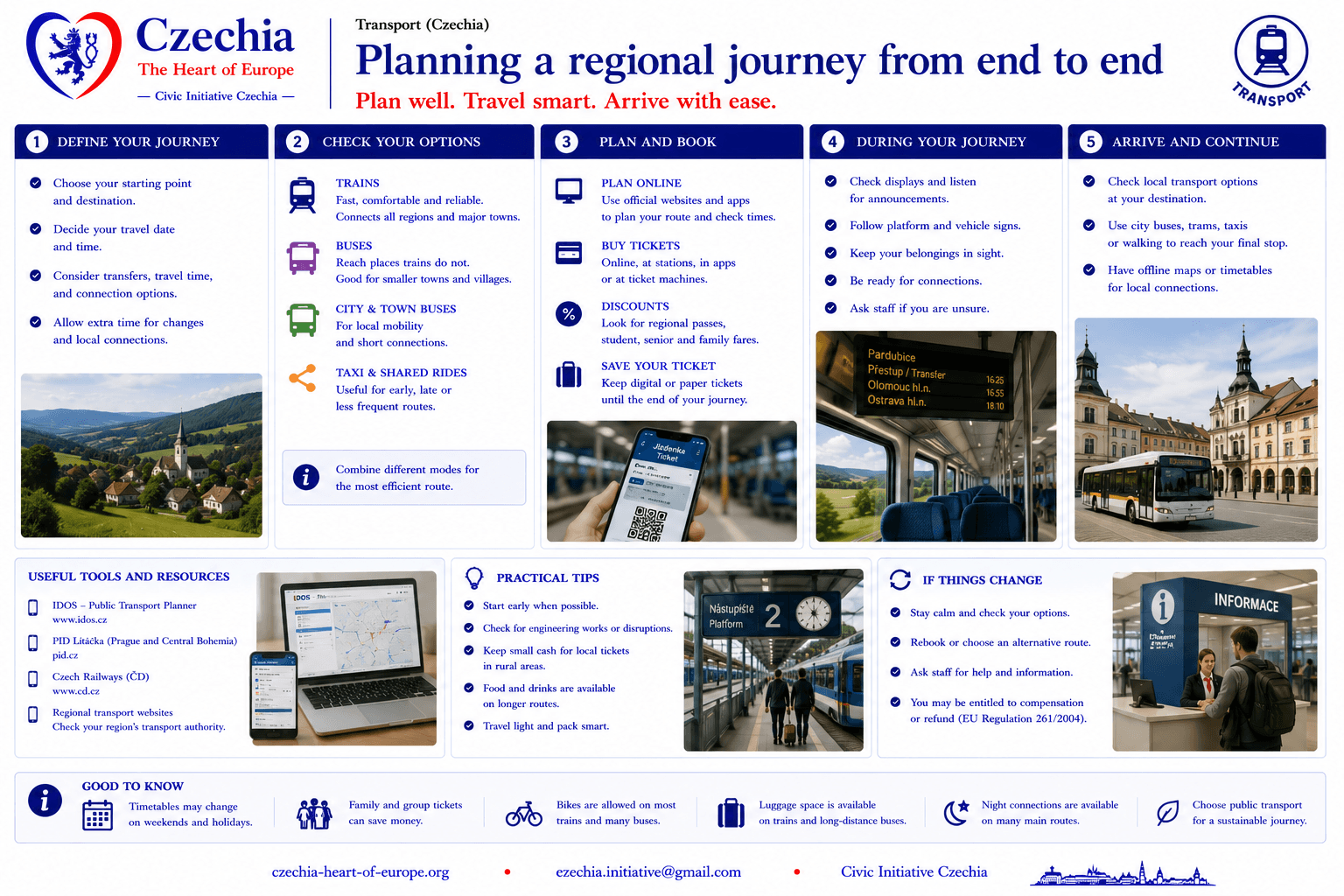
Regional travel works best when the journey is planned from door to door. The main train or bus
is only one part of the trip. The first stop, transfer, final stop, walking path, luggage, weather,
opening hours and return option can matter as much as the main connection.
Start point
Confirm the exact station, bus stop, platform, stop side or city district where the trip begins.
Main connection
Compare train, bus and combined options by travel time, transfers, frequency and final arrival point.
Last mile
Check the final walk, local bus, taxi, shuttle, bike option or pick-up before leaving.
Return
Check the last return connection, weekend timetable and backup option before committing to the trip.
Conditions
Allow for weather, terrain, luggage, children, reduced mobility, fatigue and late-evening limits.
Regional rule: always check the return trip before departure.
Some regional or seasonal connections are less frequent in the evening, on weekends or outside peak periods.
Tickets
Tickets, zones and regional validity
Regional tickets may be time-based, zone-based, route-based, operator-based or part of an
integrated transport system. A ticket can cover one vehicle, several transfers, a whole region,
selected zones, a day product, a group, a bicycle or a reduced-fare passenger category.
Before buying, check whether the ticket is accepted on the selected operator and whether it covers
all transfers. Regional systems can be useful, but their validity depends on the exact region,
zones, time period and passenger rules.
Zone validity
Where the ticket works
Check that all zones or tariff areas used by the journey are included.
Time validity
How long it works
Transfers usually need to stay within the ticket’s valid time period.
Operator validity
Who accepts it
Some tickets are limited to a system, operator, train category or local fare area.
Ticket check: regional tickets can look similar while having different validity.
Check zone, time, operator and passenger category before boarding.
Places
Towns, castles, spa places and cultural sites
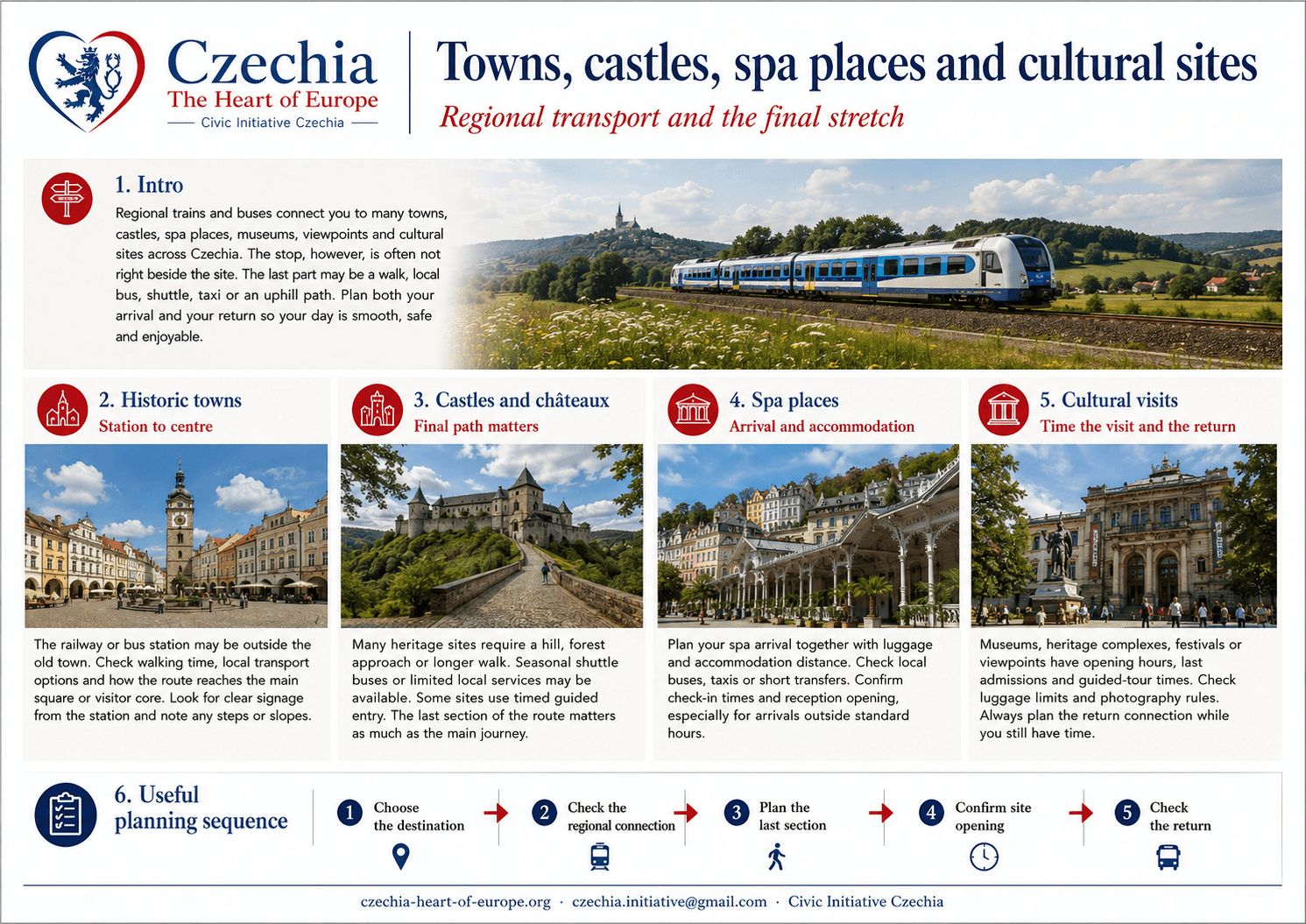
Many Czech towns and heritage places are reachable by regional transport, but the station or bus
stop may not be directly beside the site. Castles, châteaux, historic centres, spa districts,
museums and viewpoints often require a final walk, local bus, shuttle, taxi or uphill path.
For cultural visits, combine transport planning with opening hours, ticketed entry, seasonal
schedules, guided-tour times, luggage storage and the return journey. A perfect arrival time is
less useful if the return connection is too late, too early or too far from the site.
Historic towns
Station to centre
Check walking time from the station or bus stop to the historic centre.
Castles and châteaux
Final path matters
The last section may involve a hill, forest path, seasonal bus or limited local service.
Spa places
Arrival and accommodation
Check station distance, local bus, taxi and luggage needs before arrival.
Nature access
Landscapes, trails and rural destinations
Regional mobility is often the way visitors reach mountains, forests, reservoirs, protected
landscapes, trailheads and rural accommodation. These journeys can be beautiful but sensitive
to weather, daylight, path condition, mobile signal, seasonal timetables and return frequency.
Nature access should be planned with the final terrain in mind. A station near a trail does not
always mean an easy walk. Check distance, elevation, surface, weather, return connection, water,
toilets and emergency access.
Trailheads
Station or stop to path
Check the first walking section before relying on public transport access.
Weather
Regional conditions change
Mountains, forests and rural roads can change quickly with fog, snow, heat, storms or darkness.
Return
Last connection
For nature trips, the return timetable is part of the safety plan.
Timing
Weekends, holidays, seasons and late travel
Regional timetables can differ between weekdays, weekends, holidays, school periods, tourist
seasons and late evenings. A connection that works in the morning may not work the same way
after a museum visit, hike, dinner, concert or delayed arrival.
Seasonal travel can add extra buses, tourist connections, bike services or shuttles in some
areas, while other places may have reduced frequency outside the main season.
Weekdays
Commuter patterns
Some regional services are strongest around work and school movement.
Weekends
Lower frequency or tourist focus
Weekend timetables may be less frequent or adapted to visitor movement.
Late travel
Backup before departure
Late buses, trains and taxis can be limited outside larger cities.
Practical situations
Regional mobility FAQ
Is regional mobility only for tourists?
No. Regional mobility supports everyday life as well as tourism: work, school, health care, offices, shopping, family visits, towns, cultural sites and landscape access.
Should I choose train or bus?
Compare the whole journey, including transfers and the final stop. Rail may be faster between towns, while buses may reach village centres, castles, spa districts or rural destinations more directly.
Can one ticket cover train and bus?
Sometimes. Integrated transport systems can cover several modes, but validity depends on the region, zones, time period, operator and passenger category.
Why does the final kilometre matter so much?
Regional stations and bus stops may be outside the historic centre, castle entrance, hotel, trailhead or spa district. The last walk, bus, taxi or shuttle should be checked before departure.
Are regional buses frequent?
Frequency varies by region, weekday, school period, weekend, season and time of day. Always check the return connection before leaving.
Can I rely on taxis in small towns?
Sometimes, but not always immediately. For late arrivals, rural accommodation or mobility needs, arrange taxi or pick-up before departure.
How should I plan a castle or nature trip?
Check opening hours, final walking distance, elevation, weather, daylight, return connection, toilets, water and whether the site has seasonal transport.
Official references
Primary regional mobility references
Use official sources for current timetables, regional connections, rail information,
public transport systems, visitor information and transport policy.
Transport pages
Continue by transport topic
Transport overview
Transport in Czechia
Country-level orientation to public transport, rail, roads, airports, regional mobility and safety.
Public transport
City and local systems
Metro, trams, buses, trolleybuses, tickets, validation, inspections and passenger rules.
Rail
National, regional and international rail
Trains, stations, tickets, operators, reservations and rail travel.
Roads & driving
Road movement and vehicle use
Roads, driving, parking, tolls, winter conditions and vehicle use.
Airports
Air travel and arrivals
Airports, arrivals, transfers, airport-city links and passenger orientation.
Accessible mobility
Barrier-free and inclusive movement
Low-floor services, station access, mobility support, strollers and calm travel needs.
Cycling & walking
Soft mobility and public-space movement
Walking, cycling, shared mobility, bikes on trains and public-space safety.
Foreigners & newcomers
First transport orientation
Tickets, validation, inspections, useful words and common first-arrival mistakes.
Freight & logistics
Goods movement and corridors
Road freight, rail freight, logistics hubs, industry links and European corridors.
Safety & disruptions
Delays, closures and incidents
Replacement transport, weather disruption, lost property, emergency numbers and safety notices.