Transport in Czechia

Life & Services · Transport

Transport in Czechia

Country-level orientation to public transport, rail, roads, airports, regional mobility, accessibility, cycling, newcomers, freight, logistics, safety and disruptions.

Daily mobilitywork, school, services
Regional accesstowns, regions, landscapes
Gatewaysstations, airports, corridors
Rulestickets, roads, safety

Transport overview

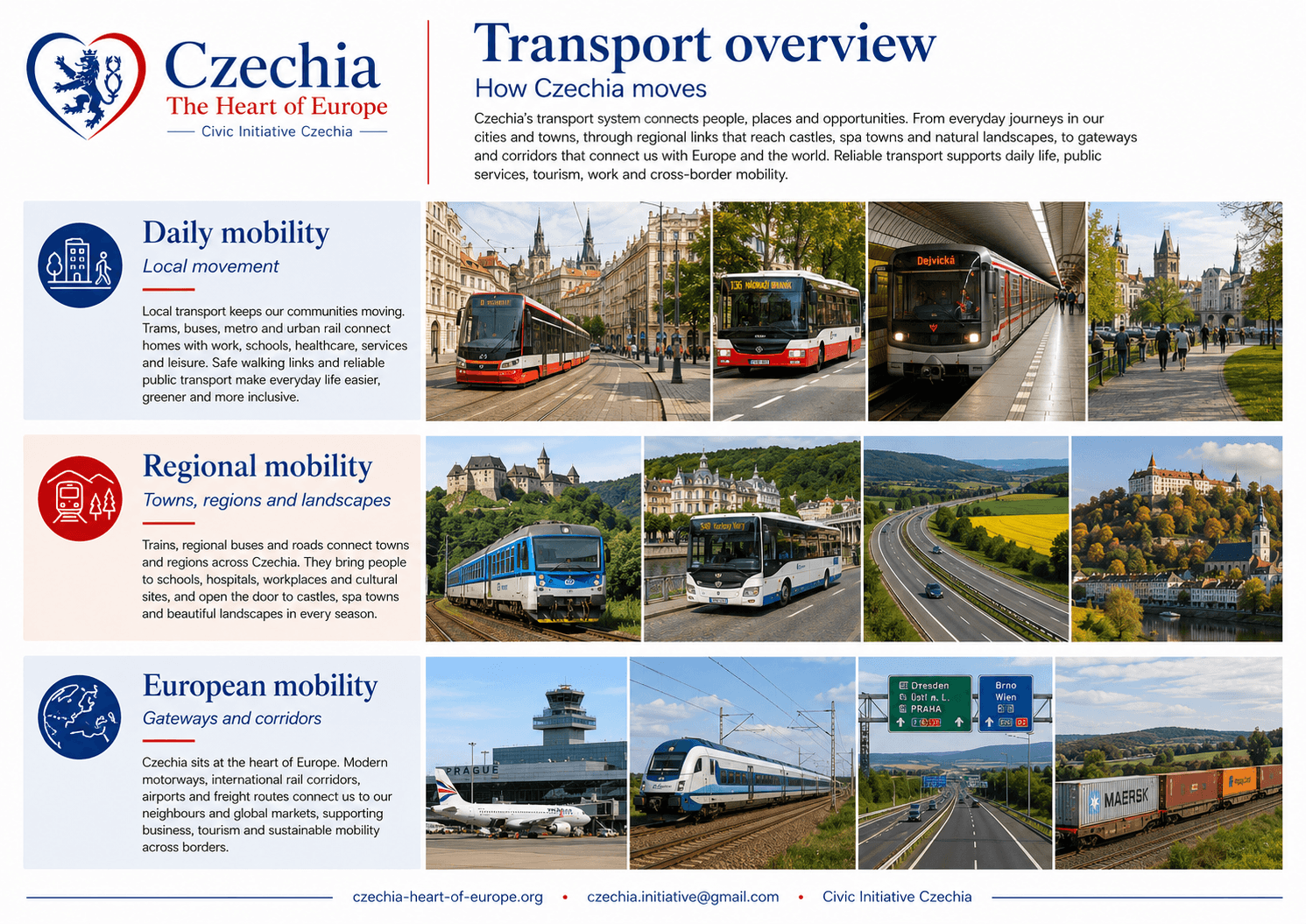
How Czechia moves

Transport in Czechia links everyday life, public services, regions, study, work, tourism, business, accessibility and international movement. The country’s mobility system combines dense city transport, national and regional rail, roads, airports, cycling, walking and strategic European corridors.

Daily mobility Local movement Work, school, services, healthcare, shopping, family life and local public transport.
Regional mobility Towns, regions and landscapes Rail, buses and roads connect regions, castles, spa places, landscapes and public services.
European mobility Gateways and corridors Rail, roads, airports, freight corridors and cross-border links connect Czechia outward.
How Czechia moves through daily, regional and European mobility
Open image ↗ Download PNG

Practical orientation

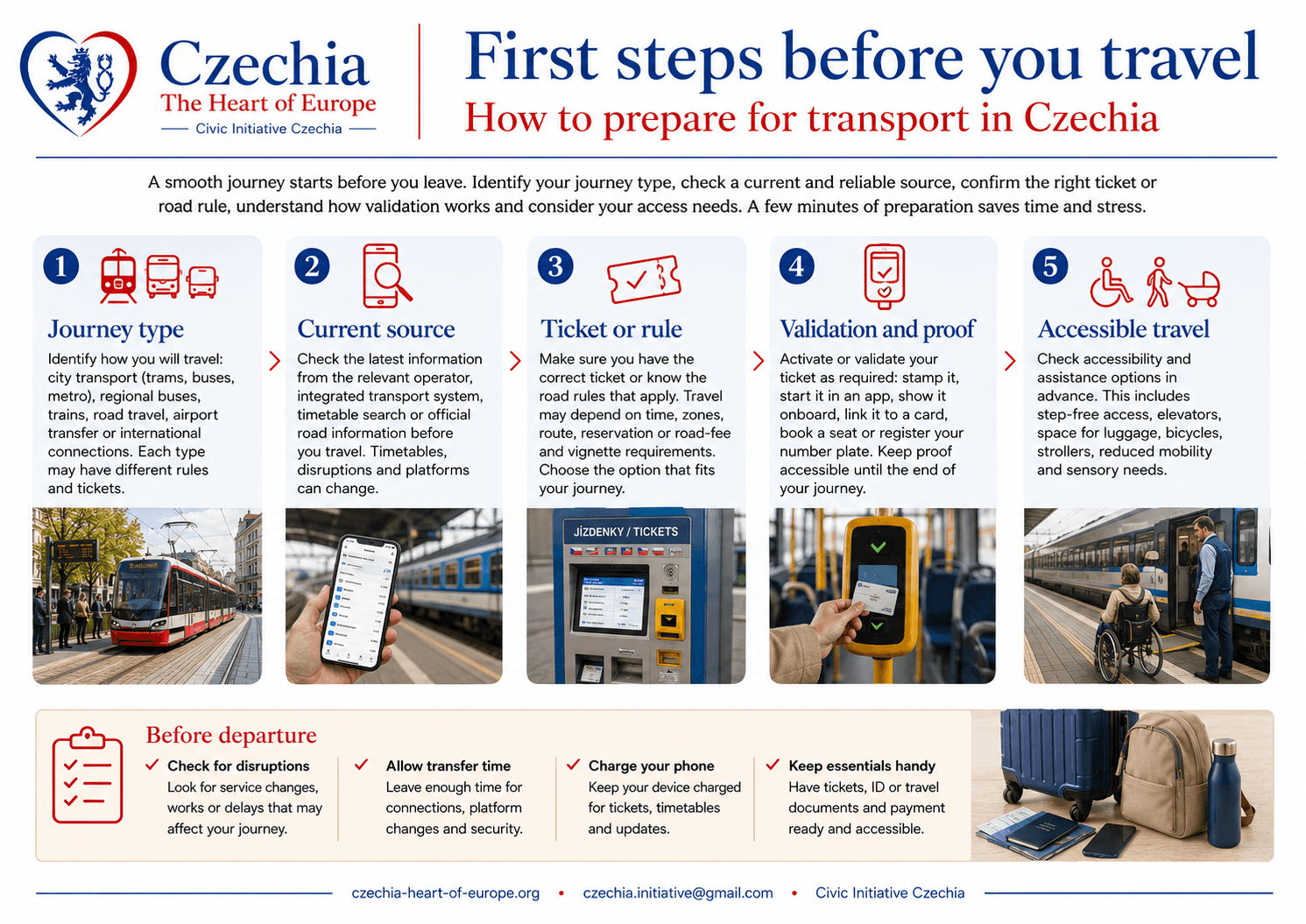
First steps before you travel

The useful order is simple: identify the type of journey, check the current source, choose the correct ticket or road requirement, and keep proof available until the journey is finished.

Journey type Separate city transport, regional transport, rail, road, airport transfer and international travel.
Current source Use the relevant operator, integrated system, timetable search or official road source before travelling.
Ticket or rule Check whether the trip is time-based, zone-based, route-based, reservation-based or road-fee-based.
Validation Confirm whether a ticket must be stamped, activated, shown in an app or linked to a card or vehicle plate.
Accessible travel For reduced mobility, strollers, luggage, bicycles or sensory needs, check stations, vehicles and assistance before departure.
First steps before travelling in Czechia
Open image ↗ Download PNG

Status: 18 June 2026

Ticket types & price snapshot

Czechia does not have one universal transport price. City fares, regional integrated systems, rail tickets, airport links, taxis and motorway vignettes follow different rules. This snapshot gives dated orientation and points visitors to official purchase sources.

Prague public transport / PID

Full fare, age 15–60. Prices shown for Prague short-term tickets.

Validity PID Lítačka app Paper ticket
30 min. 36 CZK 39 CZK
90 min. 46 CZK 50 CZK
24 hours 140 CZK 150 CZK
72 hours 340 CZK 350 CZK
30/90 min. not for Petřín funicular 24h/72h include Petřín funicular

SMS tickets in Prague

SMS tickets are Prague-only and have specific validity limits.

SMS code Validity Price
DPT42 30 min. 42 CZK
DPT55 90 min. 55 CZK
DPT150 24 hours 150 CZK
DPT350 72 hours 350 CZK

Regional, rail and intercity travel

Regional public transport usually depends on zones, time validity and the integrated transport system. Train prices are route-based and may depend on distance, train type, reservation, purchase time, discount card, group type and operator.

Regional integrated ticketsregion and zone systems Single rail ticketsroute and operator rules All-day ticketsselected products Bike / dog ticketsoperator-specific conditions

For rail, calculate the current route price in the official railway e-shop or operator app before buying.

Motorways: electronic vignette

Standard-fuel passenger vehicles up to 3.5 t, 2026 time-fee announcement.

Type Validity 2026 price
1-day selected calendar day 230 CZK
10-day 10 consecutive days 300 CZK
30-day 30 consecutive days 480 CZK
Annual one year / annual product 2,570 CZK

Buy only through the official eDalnice service or official sales points. Some third-party sites add service fees.

Practical situations

Travel situations FAQ

Short answers for everyday transport situations: luggage, companion animals, basic needs, ticket checks, safety, stations, sensory needs and vulnerable travellers.

Luggage: can I travel with suitcases or bags?

Usually yes, but keep luggage close, do not block doors, aisles or priority areas, and check the relevant operator rules for oversized items. In stations and crowded vehicles, keep documents, phone and wallet secured on the body rather than in an outer pocket or an open bag.

Companion animals, pets and assistance dogs

Rules can differ by operator, city, vehicle type and ticket system. Before travelling, check the official operator conditions for pets, carriers, muzzles, leashes, fares and assistance dogs.

Strollers, wheelchairs, mobility aids and bicycles

Use marked doors and priority spaces when available. For wheelchairs, reduced mobility, bicycles, strollers or larger equipment, check accessibility information before travel, especially for older stations, regional services and replacement buses.

Sports equipment, skis, bicycles and bulky items

Check the operator rules before travelling with skis, bicycles, scooters, large backpacks, musical instruments or other bulky equipment. Keep items controlled and away from doors, priority spaces and emergency passages.

Travelling with children

Prepare the route before entering the station or vehicle. Keep children away from platform edges, doors and gaps. Save tickets and destination names offline, agree on a meeting point, and plan for fatigue, snacks, toilets and delays.

Taxi, rideshare and airport pick-ups

Use official airport, station or app-based pick-up points where possible. Check the destination and approximate price before departure, confirm the vehicle and driver in the app when using rideshare, and avoid accepting random offers from unofficial drivers.

WC, water and basic needs

Plan basic needs before long journeys or transfers. Look for station toilets, staffed information points, cafés, shops, pharmacies or safe waiting areas. Carry water when practical, especially with children, older travellers, medication, heat or delays.

Accident, incident or risk alert

Move away from immediate danger, stay visible, follow official staff instructions, and do not crowd the incident area. For urgent danger, injury, fire, violence or serious medical concern, call the appropriate emergency number and give the location clearly.

Aggressive, intoxicated, disoriented or closely watched persons

Do not argue, film closely, mock, challenge or physically intervene. Increase distance, move to a staffed or better-lit area, alert transport staff, security or police, and protect children or vulnerable travellers first.

Pickpockets and personal safety

Use normal big-city caution in busy stations, crowded trams, metro areas, tourist routes and platforms. Keep documents, phone and wallet secured; avoid leaving bags open or unattended; and step aside before checking maps, tickets or messages.

Autism, dementia, sensory overload or cognitive fatigue

Plan quieter routes and transfer points when possible. Save screenshots of tickets, platform numbers and destination names. Travel outside peak hours when practical, keep one clear meeting point, and use simple written instructions for companions, carers or family members.

Personal privacy: adults, children and identifiable people

Respect image rights and private situations. Avoid photographing or publishing identifiable children, vulnerable people, medical situations, conflict, distress, disability, ticket checks or private moments without clear consent and a valid reason.

Ticket checks and inspections

Keep your ticket, pass or app ready until the trip is fully finished. If inspected, stay calm and show the ticket clearly. For uncertainty, ask the official operator or station information point rather than relying on random advice from strangers.

Lost property, lost person or sudden confusion

Move to a safe visible place, look for official staff, information desks or emergency points, and call the appropriate emergency number if someone is at risk. For children, older people, dementia, disorientation or medical concerns, treat the situation early rather than waiting.

Official references

Official transport references

Use official sources for current routes, fares, airport transfers, ticket rules, motorway vignettes, service changes and passenger information.

  • Ministry of Transport of Czechia National transport authority and transport policy reference.
    Ministry of Transport
  • Prague Integrated Transport / PID Tickets, validation, zones, tourist tickets and PID Lítačka.
    PID ticket information
  • Prague Public Transit Company / DPP Public transport to and from Václav Havel Airport Prague.
    DPP airport transport
  • České dráhy / Czech Railways Train travel, tickets, domestic rail and international rail orientation.
    Czech Railways
  • Václav Havel Airport Prague Airport transport, parking, public transport, taxis, coaches and Airport Express.
    Prague Airport transport
  • eDalnice Official electronic motorway vignette information and purchase.
    eDalnice

Transport pages

Continue by transport topic