The eastern historical land of Czechia, shaped by the Morava River, fertile lowlands, vineyards, mountain frontiers, historic cities, castles, industry and deep Central European connections.
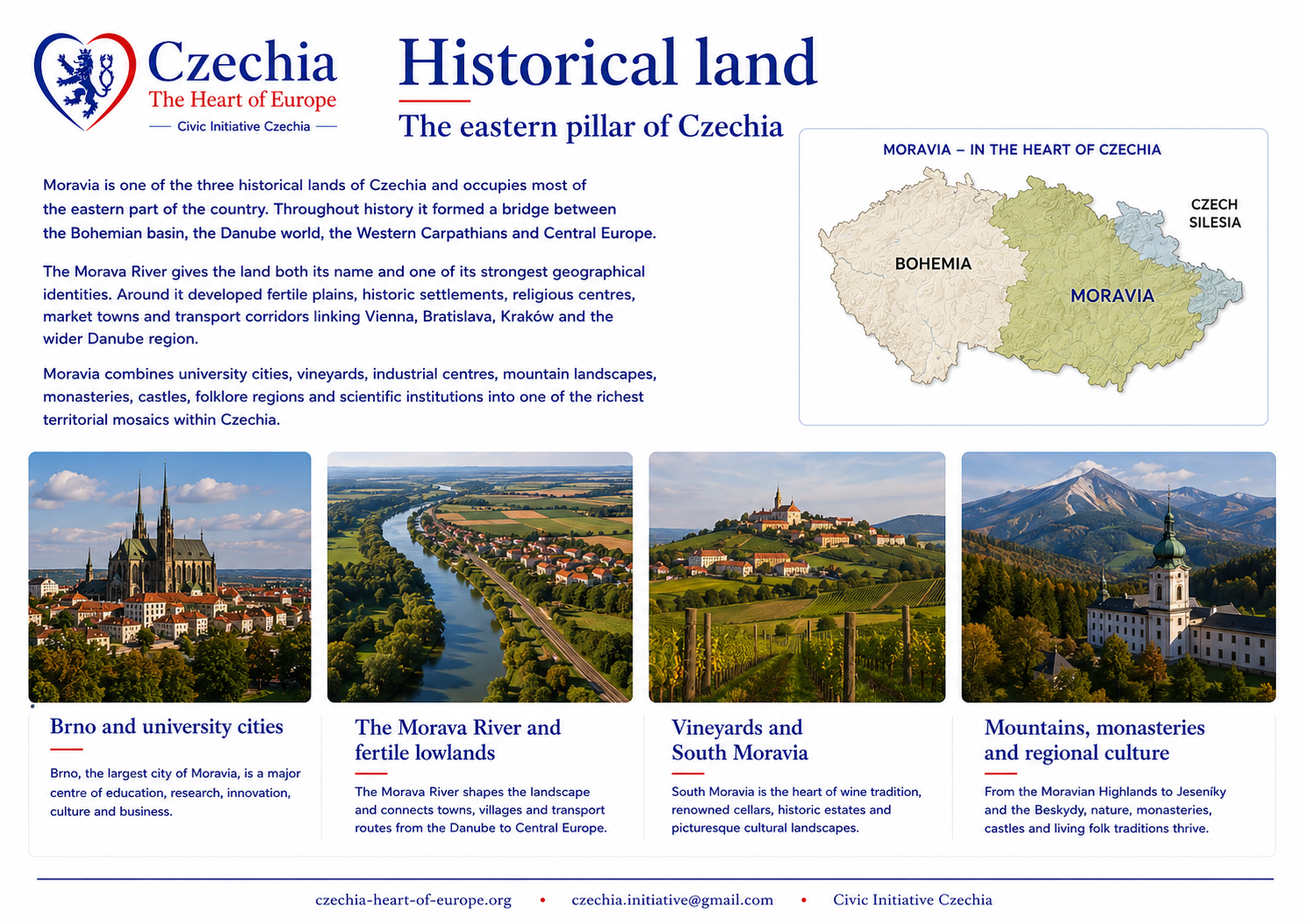
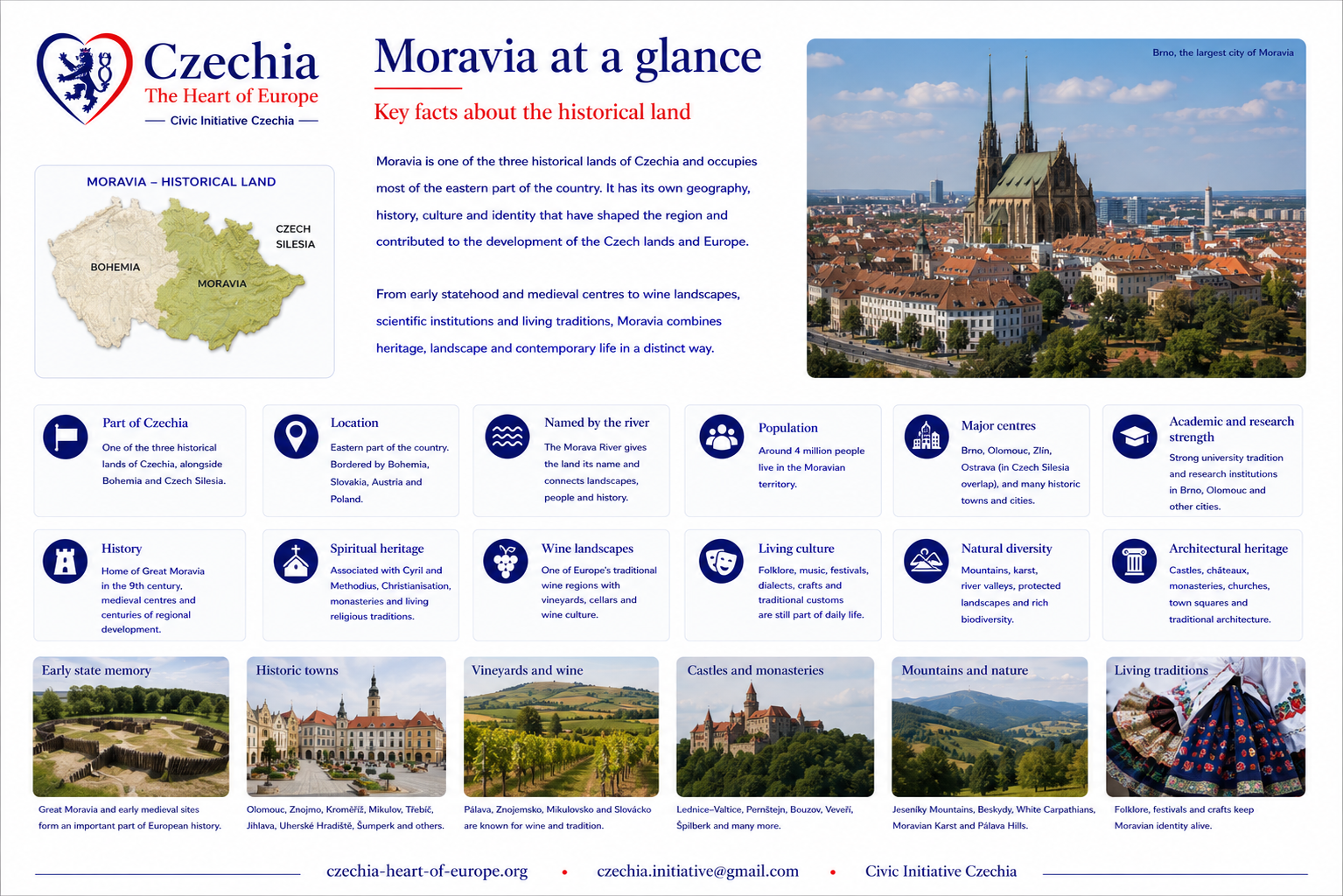
Moravia is one of the three historical lands of Czechia and occupies most of the eastern part of the country. Throughout history it formed a bridge between the Bohemian basin, the Danube world, the Western Carpathians and Central Europe.
The Morava River gives the land both its name and one of its strongest geographical identities. Around it developed fertile plains, historic settlements, religious centres, market towns and transport corridors linking Vienna, Bratislava, Kraków and the wider Danube region.
Moravia combines university cities, vineyards, industrial centres, mountain landscapes, monasteries, castles, folklore regions and scientific institutions into one of the richest territorial mosaics within Czechia.
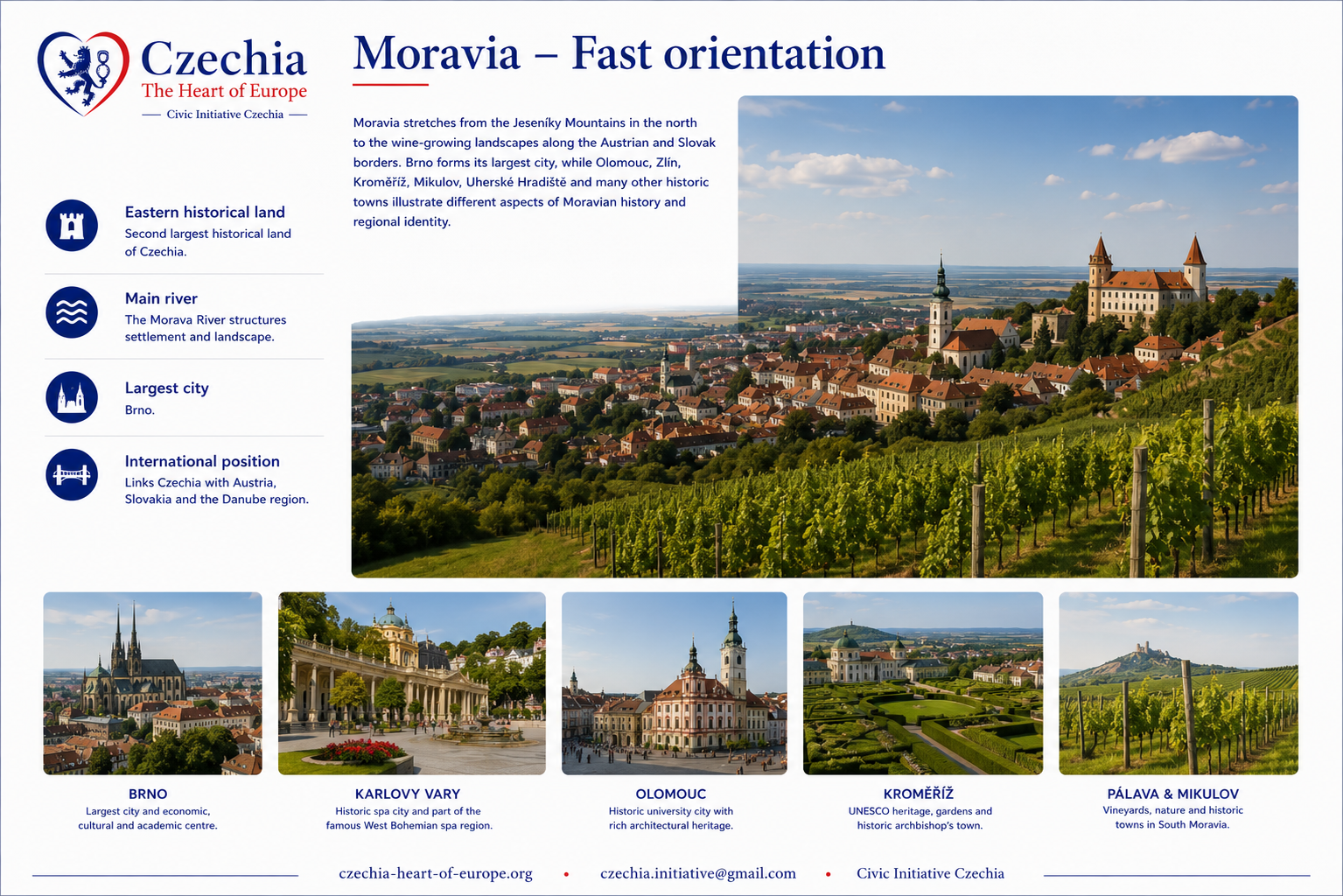
Moravia stretches from the Jeseníky Mountains in the north to the wine-growing landscapes along the Austrian and Slovak borders. Brno forms its largest city, while Olomouc, Zlín, Kroměříž, Mikulov, Uherské Hradiště and many other historic towns illustrate different aspects of Moravian history and regional identity.
Eastern historical landSecond largest historical land of Czechia.
Main riverThe Morava River structures settlement and landscape.
Largest cityBrno.
International positionLinks Czechia with Austria, Slovakia and the Danube region.
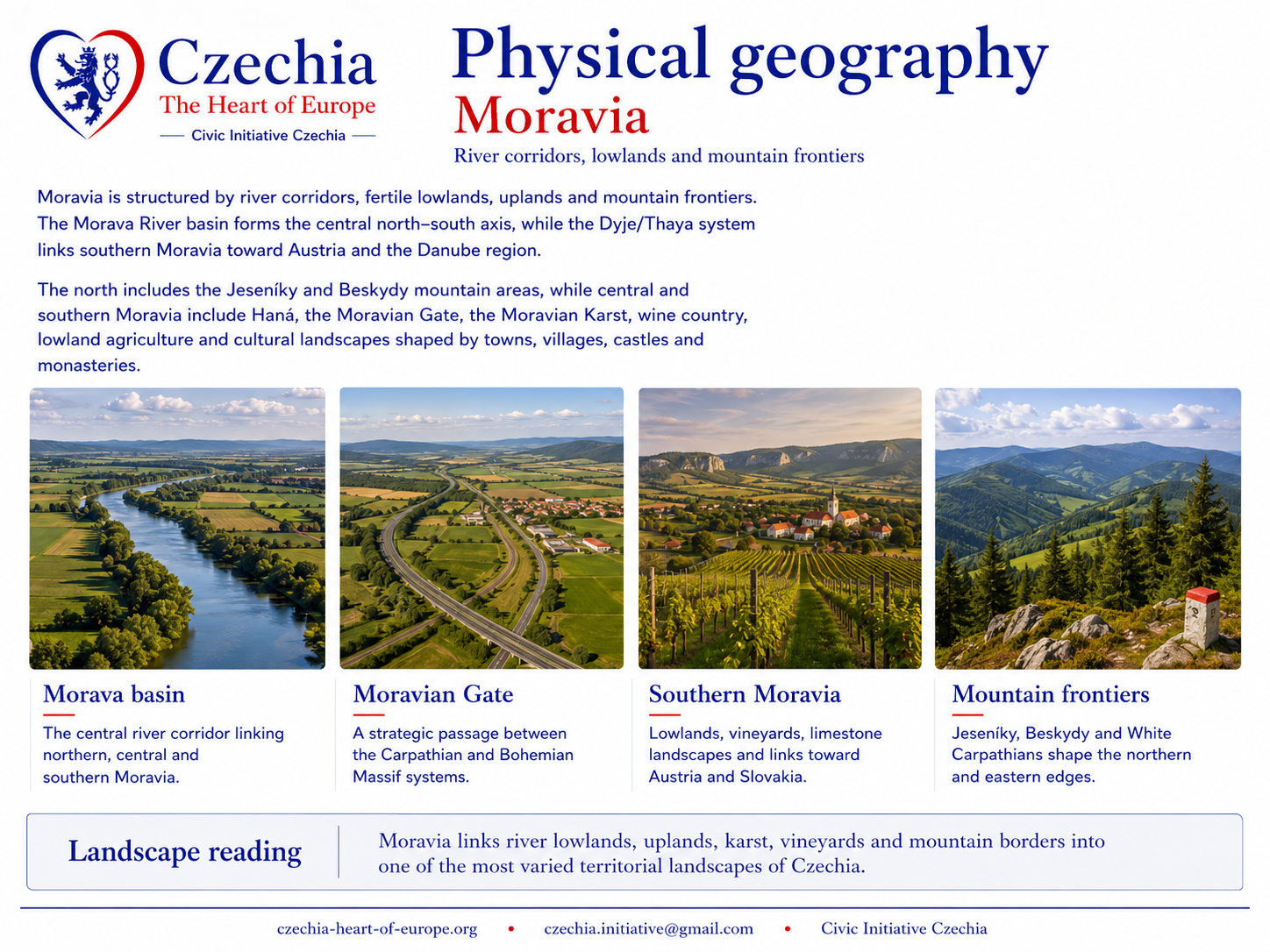
Moravia is structured by river corridors, fertile lowlands, uplands and mountain frontiers. The Morava River basin forms the central north-south axis, while the Dyje/Thaya system links southern Moravia toward Austria and the Danube region.
The north includes the Jeseníky and Beskydy mountain areas, while central and southern Moravia include Haná, the Moravian Gate, the Moravian Karst, wine country, lowland agriculture and cultural landscapes shaped by towns, villages, castles and monasteries.
Morava basinThe central river corridor linking northern, central and southern Moravia.
Moravian GateA strategic passage between the Carpathian and Bohemian Massif systems.
Southern MoraviaLowlands, vineyards, limestone landscapes and links toward Austria and Slovakia.
Mountain frontiersJeseníky, Beskydy and White Carpathians shape the northern and eastern edges.
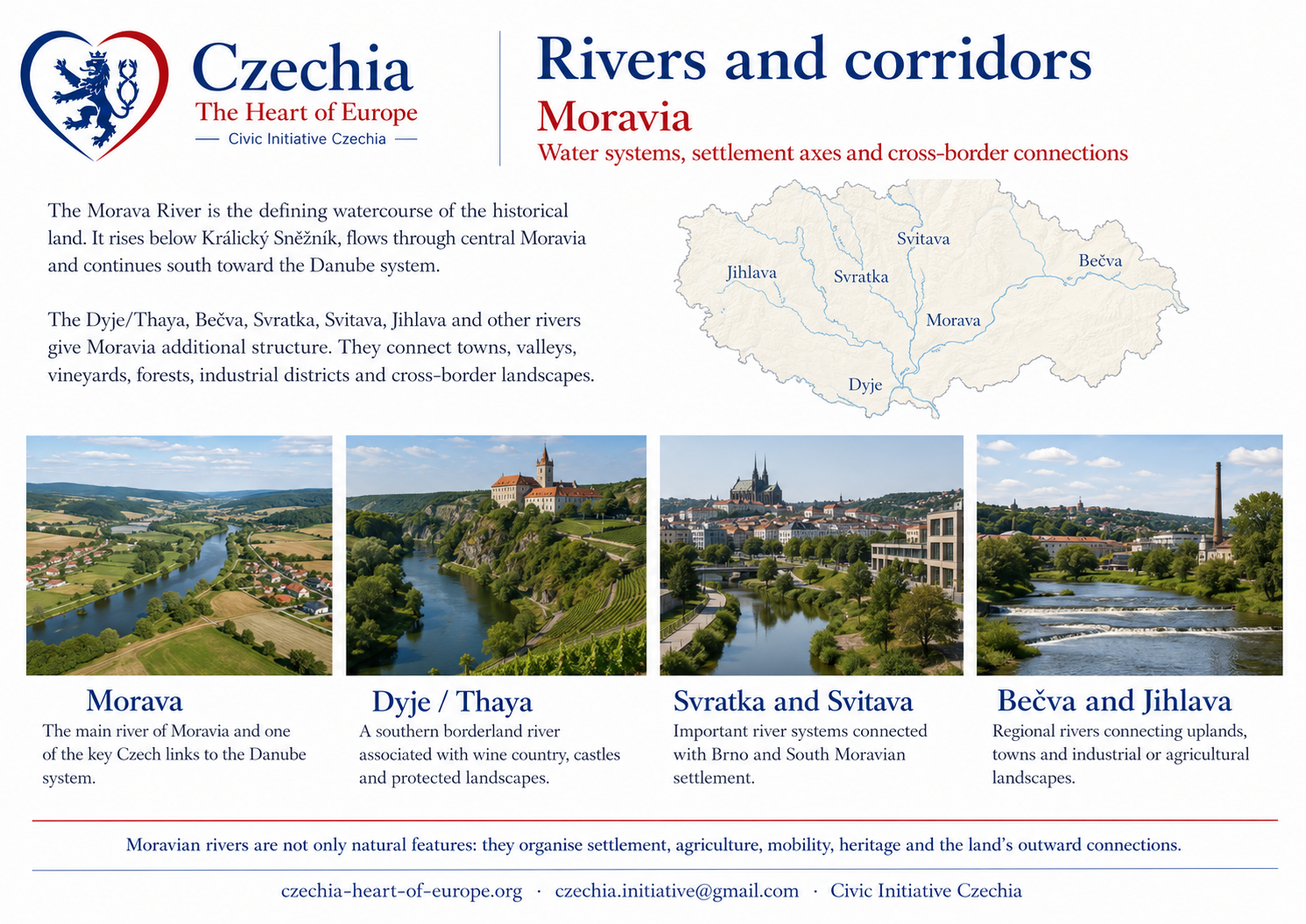
The Morava River is the defining watercourse of the historical land. It rises below Králický Sněžník, flows through central Moravia and continues south toward the Danube system.
The Dyje/Thaya, Bečva, Svratka, Svitava, Jihlava and other rivers give Moravia additional structure. They connect towns, valleys, vineyards, forests, industrial districts and cross-border landscapes.
MoravaThe main river of Moravia and one of the key Czech links to the Danube system.
Dyje / ThayaA southern borderland river associated with wine country, castles and protected landscapes.
Svratka and SvitavaImportant river systems connected with Brno and South Moravian settlement.
Bečva and JihlavaRegional rivers connecting uplands, towns and industrial or agricultural landscapes.
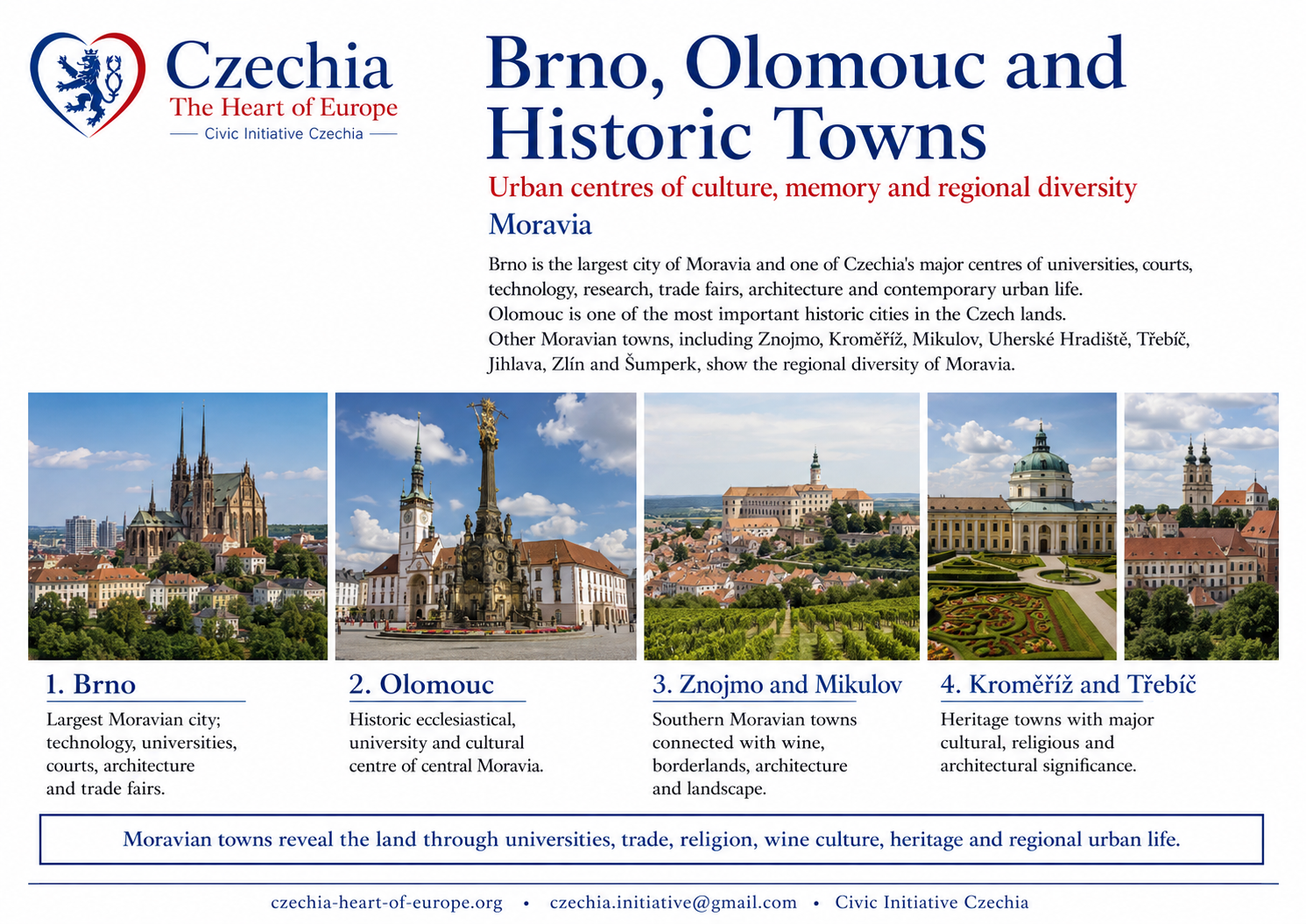
Brno is the largest city of Moravia and one of Czechia's major centres of universities, courts, technology, research, trade fairs, architecture and contemporary urban life.
Olomouc is one of the most important historic cities in the Czech lands. Other Moravian towns, including Znojmo, Kroměříž, Mikulov, Uherské Hradiště, Třebíč, Jihlava, Zlín and Šumperk, show the regional diversity of Moravia.
BrnoLargest Moravian city; technology, universities, courts, architecture and trade fairs.
OlomoucHistoric ecclesiastical, university and cultural centre of central Moravia.
Znojmo and MikulovSouthern Moravian towns connected with wine, borderlands, architecture and landscape.
Kroměříž and TřebíčHeritage towns with major cultural, religious and architectural significance.
Moravia is strongly associated with Great Moravia, one of the most important early medieval formations in Central Europe. Its memory connects Moravia with Christianisation, Slavic literacy, the mission of Cyril and Methodius and the early political landscape of the region.
Early statehoodGreat Moravia belongs to the earliest major political formations associated with the Czech lands.
Cyril and MethodiusTheir mission connected Moravia with Slavic literacy and Christian culture.
Old Church SlavonicLiturgical and literary memory tied Moravia to wider Slavic intellectual history.
Archaeological memorySites in Moravia preserve evidence of early medieval settlement, power and religious life.
Wine landscapes and traditional agriculture
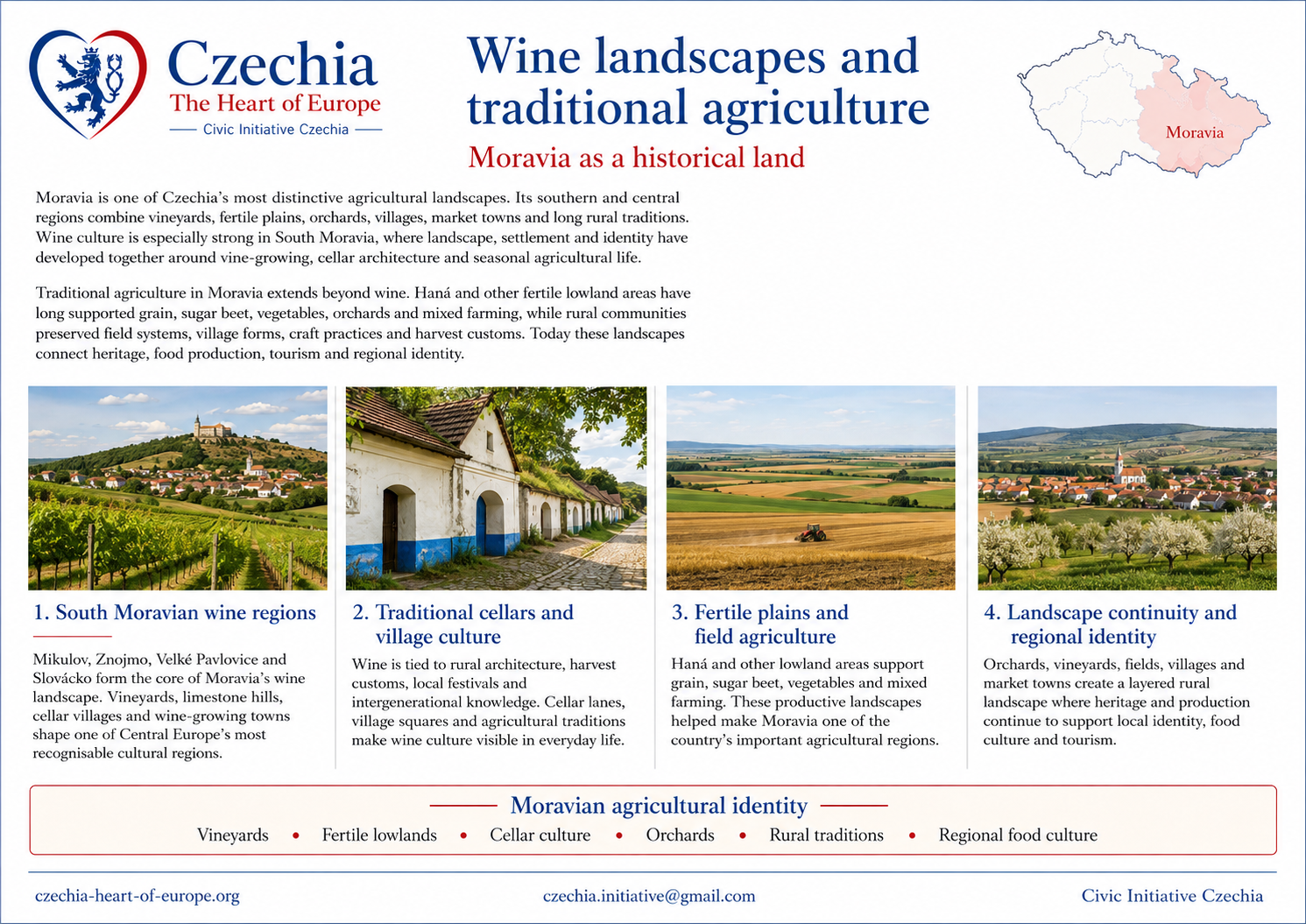
Southern Moravia is Czechia's principal wine-producing region and one of the country's most distinctive cultural landscapes. Vineyards, wine villages, cellars, orchards, limestone hills and historic market towns form a landscape where agriculture, architecture, tourism and regional identity have developed together for centuries.
Wine regionsMikulov, Znojmo, Velké Pavlovice and Slovácko form the core of Czech wine production.
Cultural landscapeVineyards, villages, chapels and cellar streets create a distinctive regional character.
Traditional agricultureFruit growing, vineyards, cereals and mixed farming remain important across southern Moravia.
TourismWine trails, cycling, gastronomy and heritage attract visitors throughout the region.
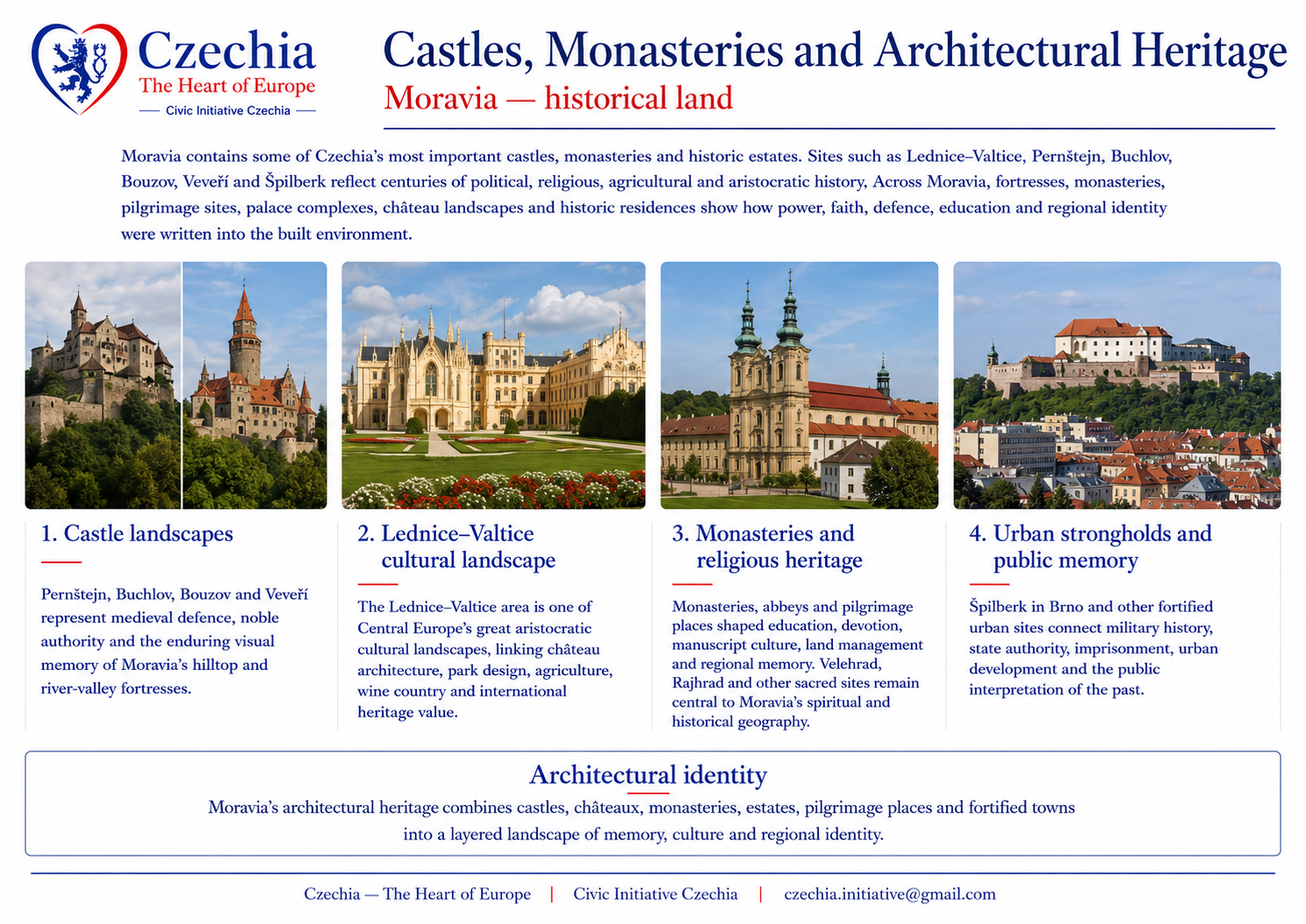
Moravia contains some of Czechia's most important castles, monasteries and historic estates. Sites such as Lednice–Valtice, Pernštejn, Buchlov, Bouzov, Veveří and Špilberk reflect centuries of political, religious, agricultural and aristocratic history.
Lednice–ValticeA UNESCO cultural landscape combining architecture, gardens, forestry and designed countryside.
ŠpilberkBrno's dominant castle, later fortress and prison, today an important museum.
Pernštejn and BuchlovMajor medieval castles preserving noble and defensive traditions.
MonasteriesReligious institutions shaped education, architecture, agriculture and regional culture.
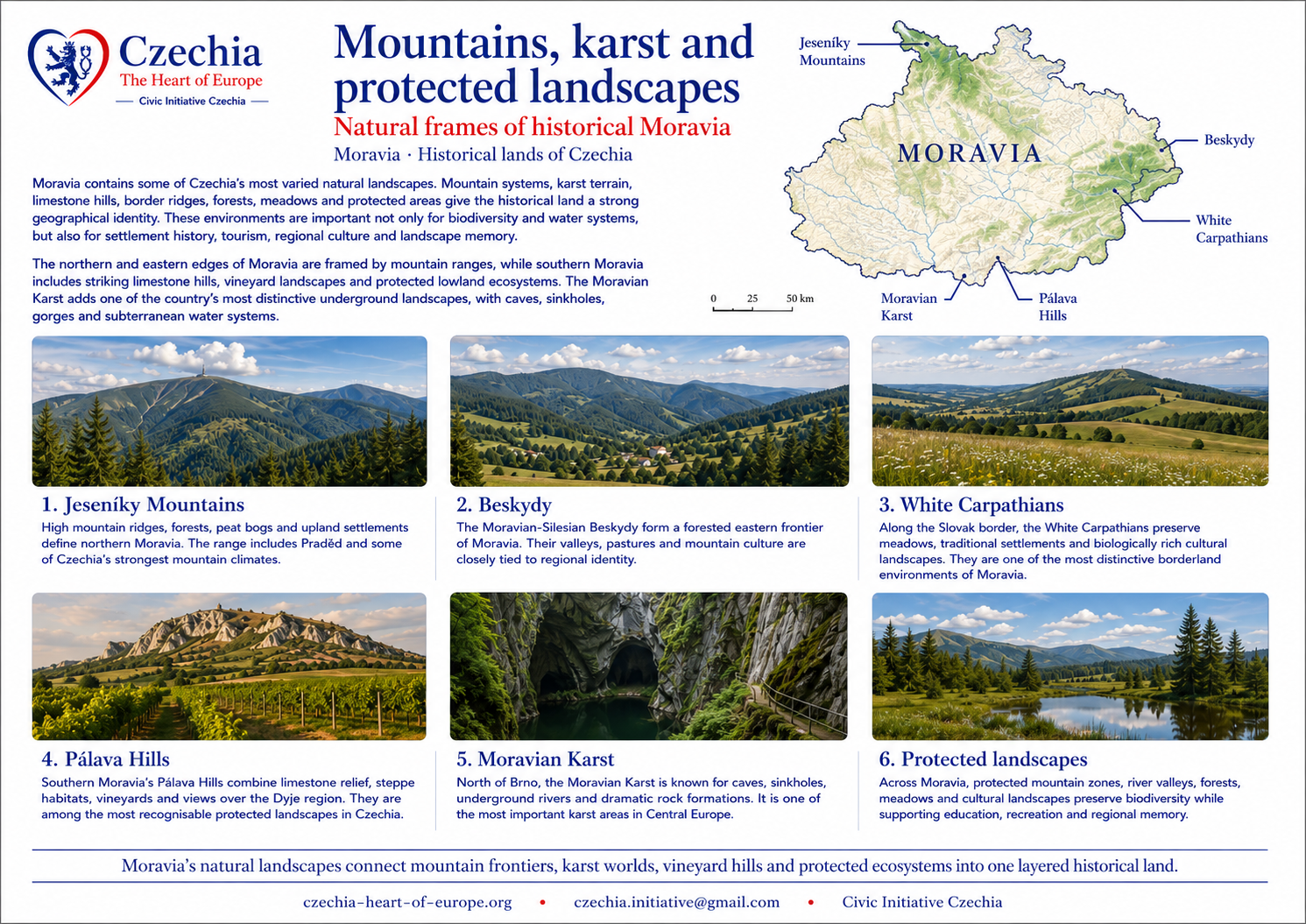
Moravia contains some of Czechia's most varied natural environments. The Jeseníky Mountains, Beskydy, White Carpathians and Pálava Hills provide contrasting mountain, forest and vineyard landscapes, while the Moravian Karst preserves one of Central Europe's most important cave systems.
Moravian KarstCaves, sinkholes, underground rivers and limestone landscapes.
PálavaLimestone hills overlooking vineyards and the Dyje basin.
BeskydyMountain forests and traditional Wallachian landscapes.
White CarpathiansSpecies-rich meadows and traditional cultural landscapes on the Slovak border.
Modern Moravia combines historical industry with contemporary research and innovation. Brno has become one of Czechia's strongest technology centres, while traditional engineering, machinery, electronics, transport equipment, food production and research continue across the region.
Brno technologyUniversities, research institutes, software, engineering and innovation.
ZlínIndustrial heritage linked with the Baťa tradition and modern manufacturing.
EngineeringMachinery, transport equipment, electronics and specialised production.
ResearchScience parks, universities and European research cooperation support future development.
Regional identity, folklore and living culture
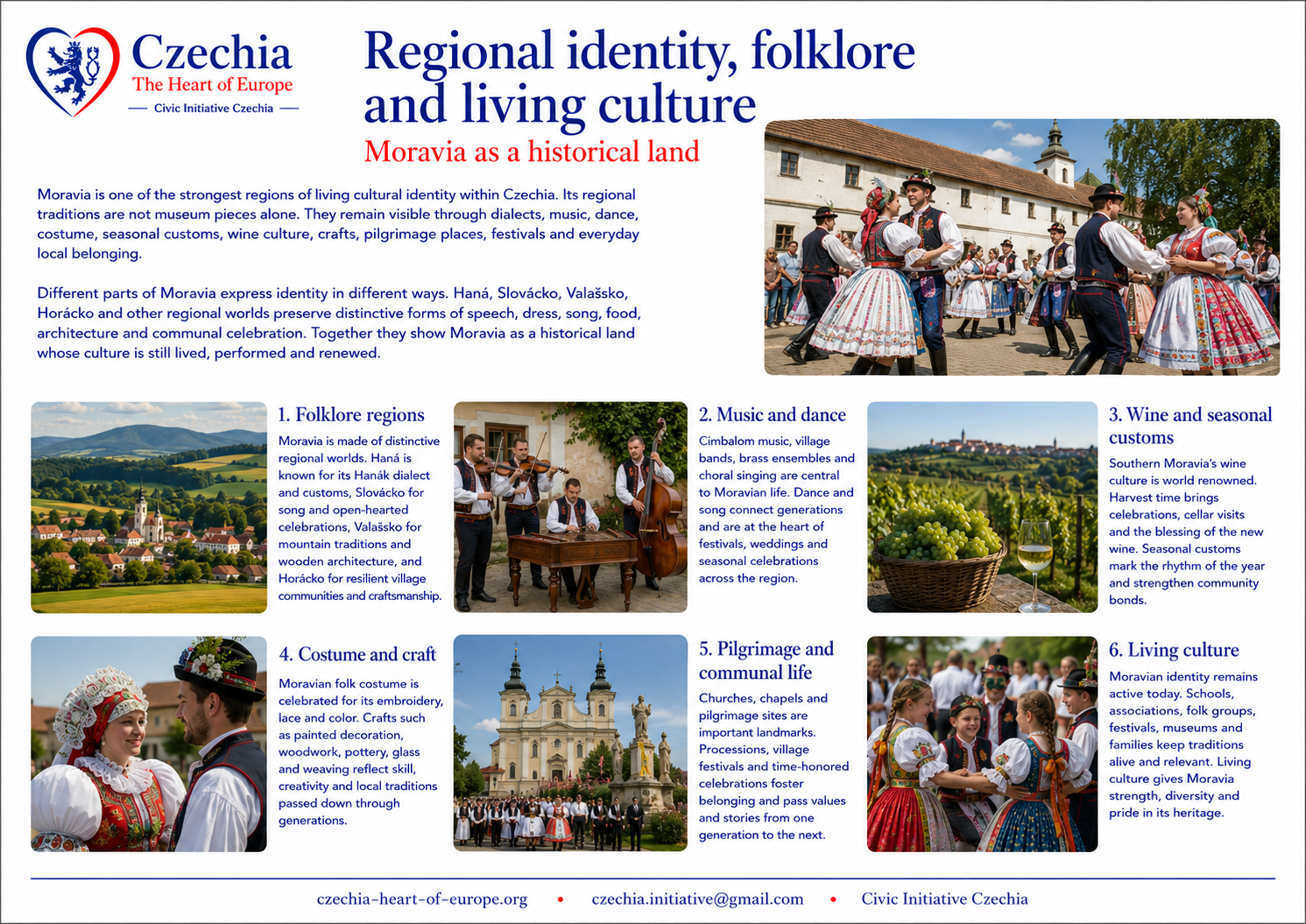
Moravia is especially rich in regional cultural identity. Folk traditions, dialect areas, music, dance, costume, wine festivals, religious pilgrimages, village architecture and local customs remain visible in public life.
SlováckoWine, music, costume, village culture and traditions linked with southeastern Moravia.
WallachiaMountain traditions, wooden architecture, pastoral memory and Beskydy landscapes.
HanáFertile lowland culture around central Moravia and Olomouc.
Living customsFestivals, pilgrimages, music, food and local traditions remain visible in the present.