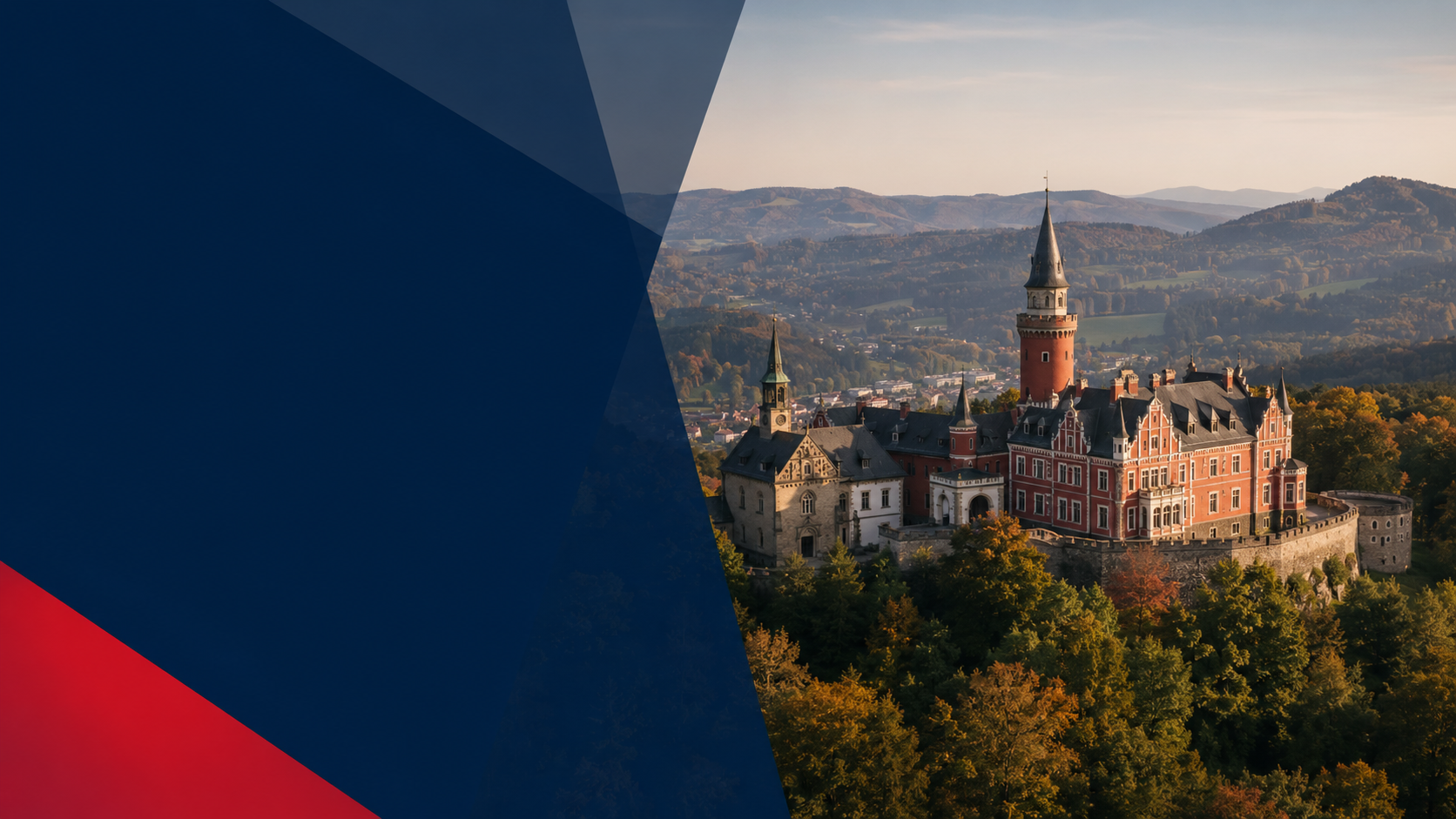
The northeastern historical land of Czechia, shaped by borderlands, rivers, mountains, towns, industry, Czech-Polish contact and Silesian cultural memory.
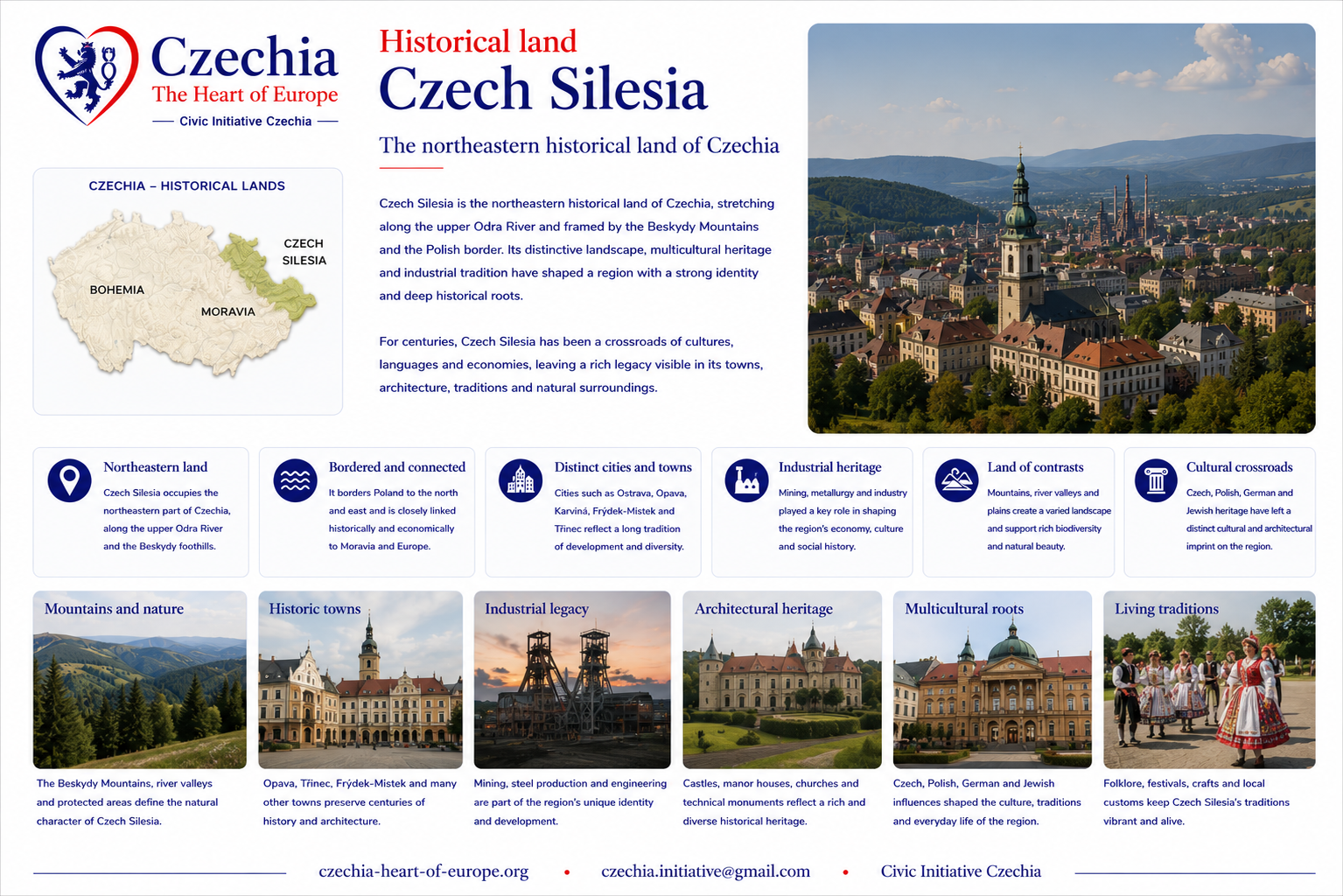
Czech Silesia is the northeastern historical land of Czechia and the smallest of its three historical lands. It is essential for understanding the country’s northeastern identity: the Opava area, Ostrava region, Těšín/Cieszyn borderland, Czech-Polish contact, mountain districts, industrial basins and Silesian cultural memory.
Its territory is historically layered. Some areas belonged to the Duchy of Silesia and later to Austrian Silesia after most of Silesia became Prussian. This history gives Czech Silesia a borderland memory distinct from both Bohemia and Moravia.
Today Czech Silesia remains visible in place names, regional identity, architecture, industry, rivers, cultural institutions, local traditions and the public life of northeastern Czechia. Its landscape combines industrial corridors, river valleys, foothills and mountain areas linked with the Jeseníky and Beskydy.
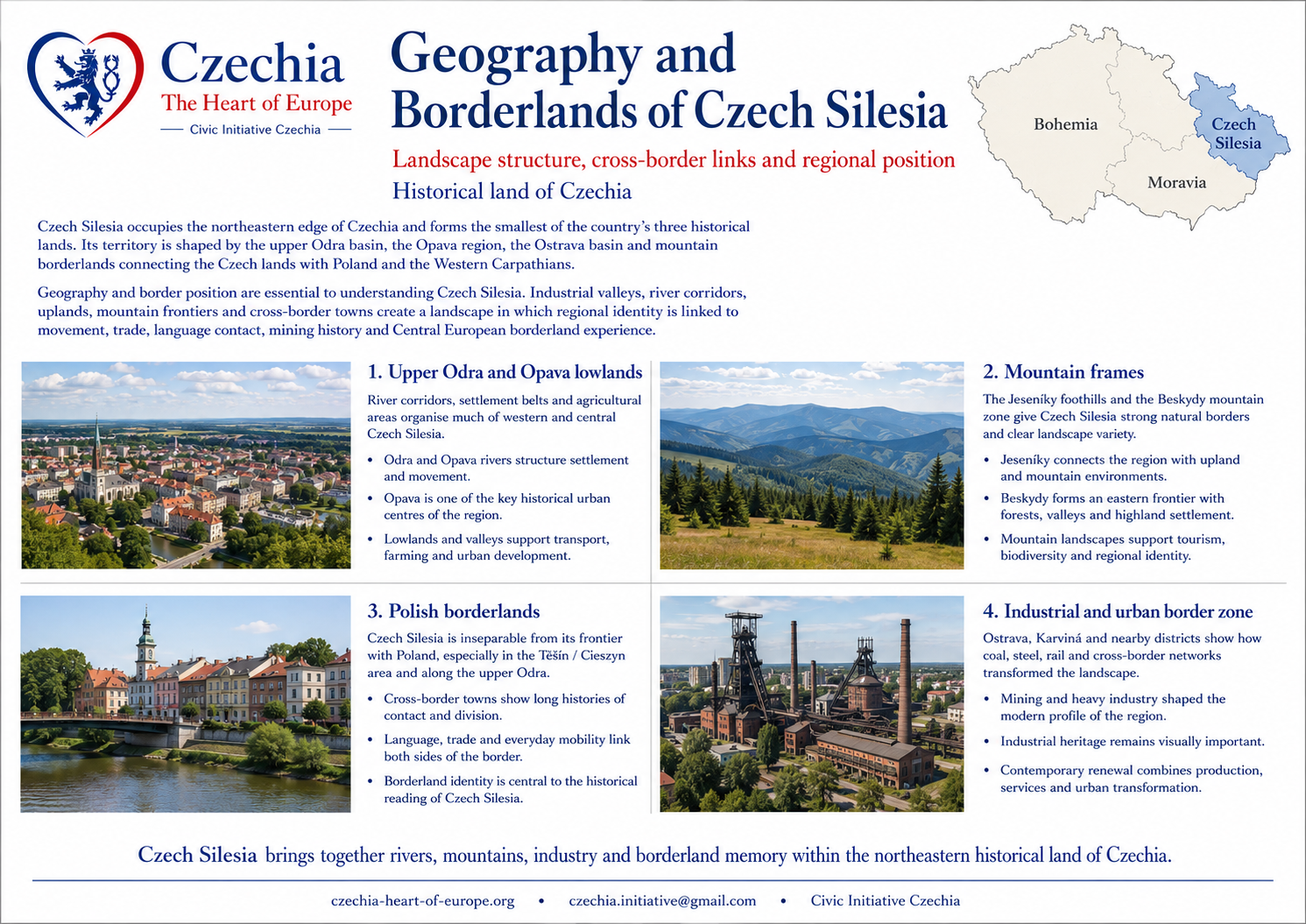
Czech Silesia is a borderland in the strongest sense. It faces Poland directly, touches Moravian territory closely and is structured by mountains, valleys, river corridors and industrial basins. Its compact territory carries many layers: Silesian, Czech, Polish, German, industrial, mountain and urban.
The land is not geographically uniform. It includes the Opava plain, the Ostrava-Karviná basin, the Těšín area, the Jeseníky foothills, Beskydy landscapes and river systems flowing toward the Odra/Oder basin.
Opava areaA historic Silesian centre with administrative, cultural and architectural importance.
Ostrava basinIndustrial and urban landscape shaped by coal, steel, labour and transformation.
Těšín borderlandA Czech-Polish contact zone with shared and contested historical memory.
Mountain edgesJeseníky and Beskydy landscapes frame the northeastern part of the country.
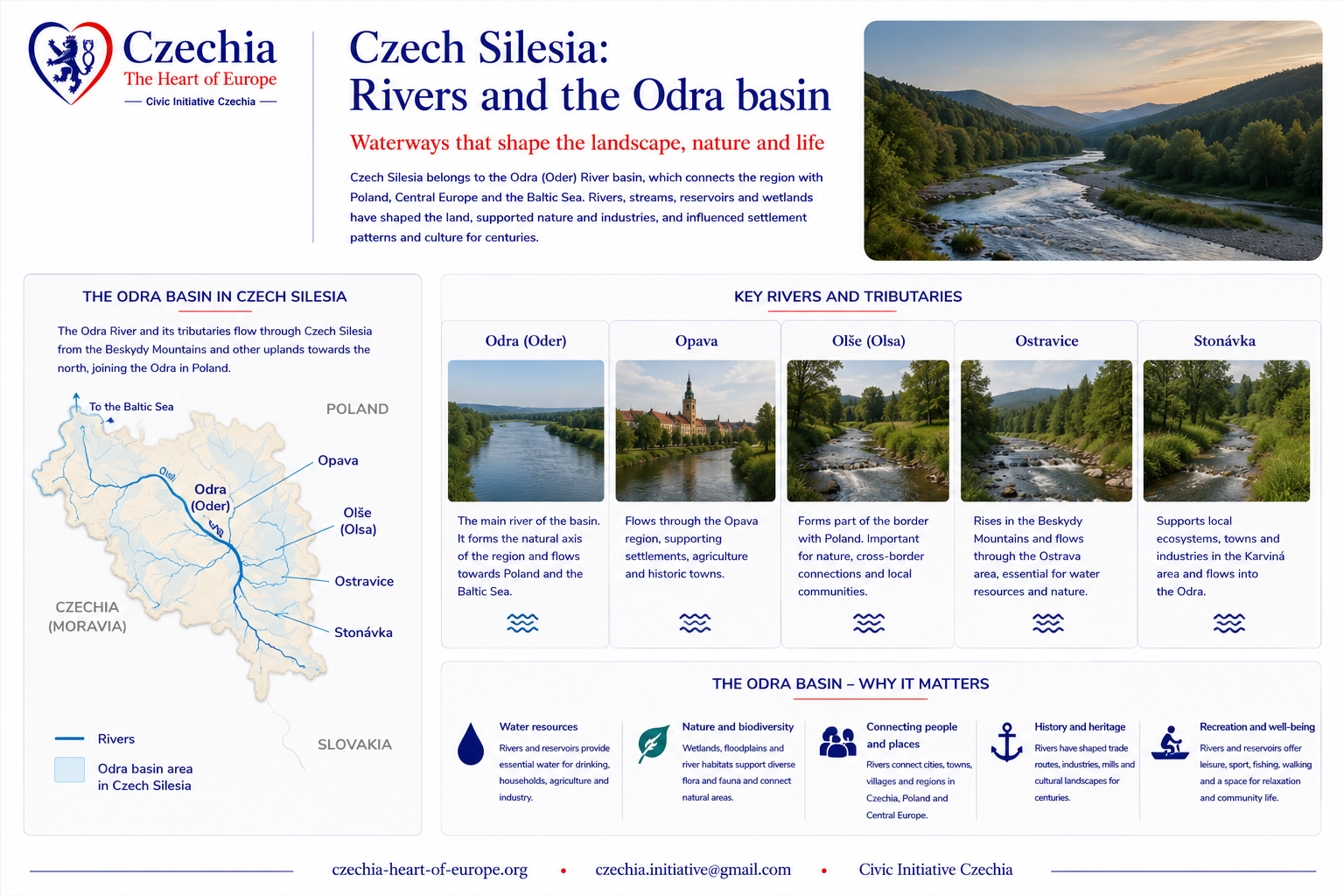
The river geography of Czech Silesia belongs mainly to the Odra/Oder basin. This connects northeastern Czechia toward Poland and the Baltic Sea, giving the region a different hydrological orientation from Bohemia’s Elbe system and Moravia’s Danube-facing Morava system.
The Odra, Opava, Ostravice and Olše/Olza rivers help organise settlement, borders, industrial zones, transport corridors and landscape identity. Their valleys connect mountain areas with towns and industrial basins.
Odra / OderThe major river basin connecting northeastern Czechia toward Poland and the Baltic Sea.
OpavaA river closely associated with the historic Silesian centre of Opava.
OstraviceA river connected with Ostrava and the Beskydy foothills.
Olše / OlzaA borderland river important for the Těšín/Cieszyn area and Czech-Polish contact.
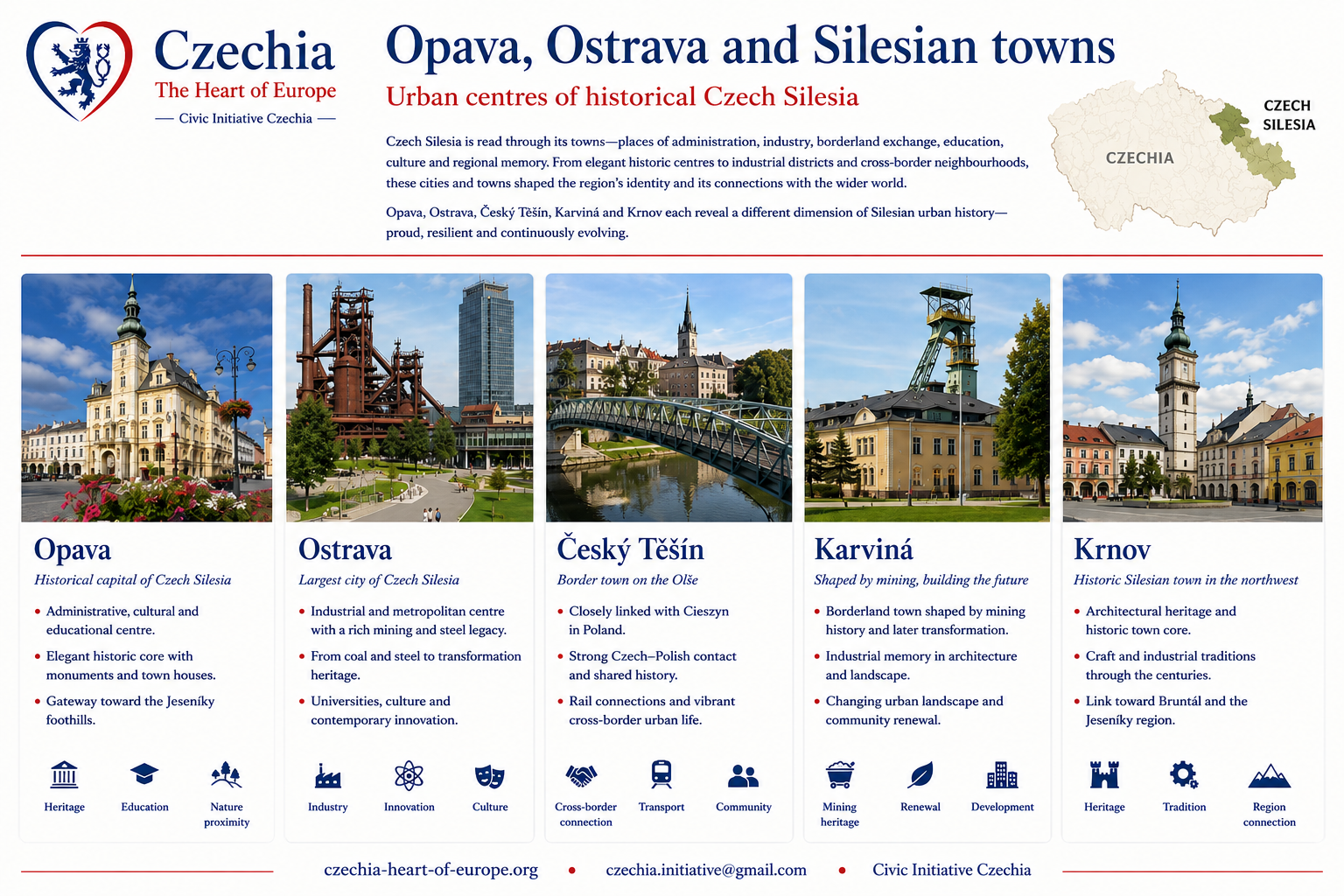
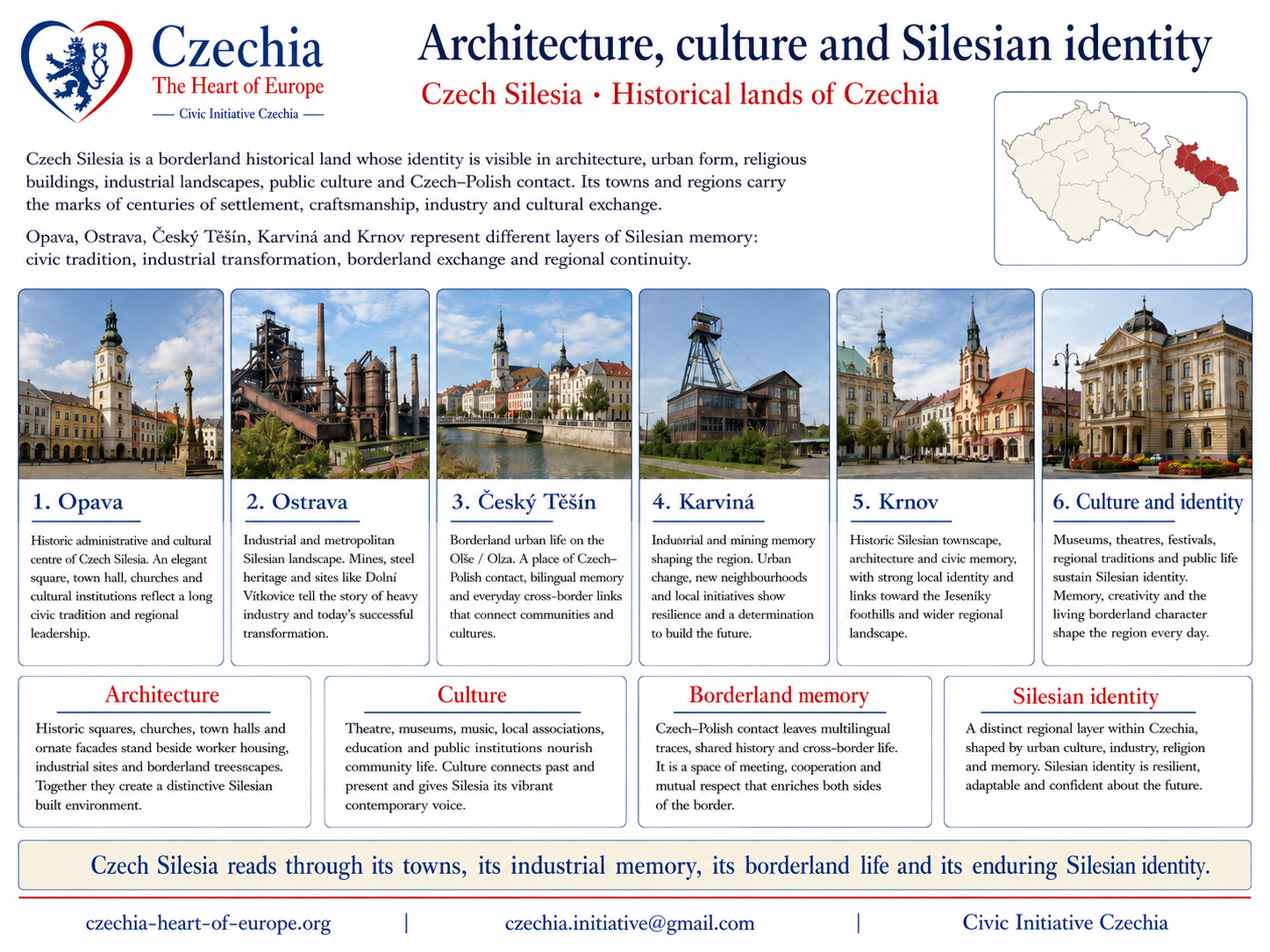
Opava is one of the key historical centres of Czech Silesia, strongly associated with Silesian administration, education, culture and architecture. It provides a different urban memory from Prague, Brno or Olomouc and helps explain the specific identity of the northeastern historical land.
Ostrava became one of Central Europe’s major industrial cities, shaped by coal mining, steel, railways, labour migration and twentieth-century economic transformation. Český Těšín, Karviná, Frýdek-Místek, Krnov, Bruntál and other towns add further layers of borderland, industrial, mountain and cultural identity.
OpavaHistoric Silesian centre, cultural city and important reference point for Czech Silesia.
OstravaIndustrial metropolis connecting Silesia, Moravia, Poland and Slovakia.
Český TěšínBorder town facing Cieszyn, central to Czech-Polish Silesian contact.
Karviná and KrnovTowns shaped by mining, industry, border memory and regional transformation.
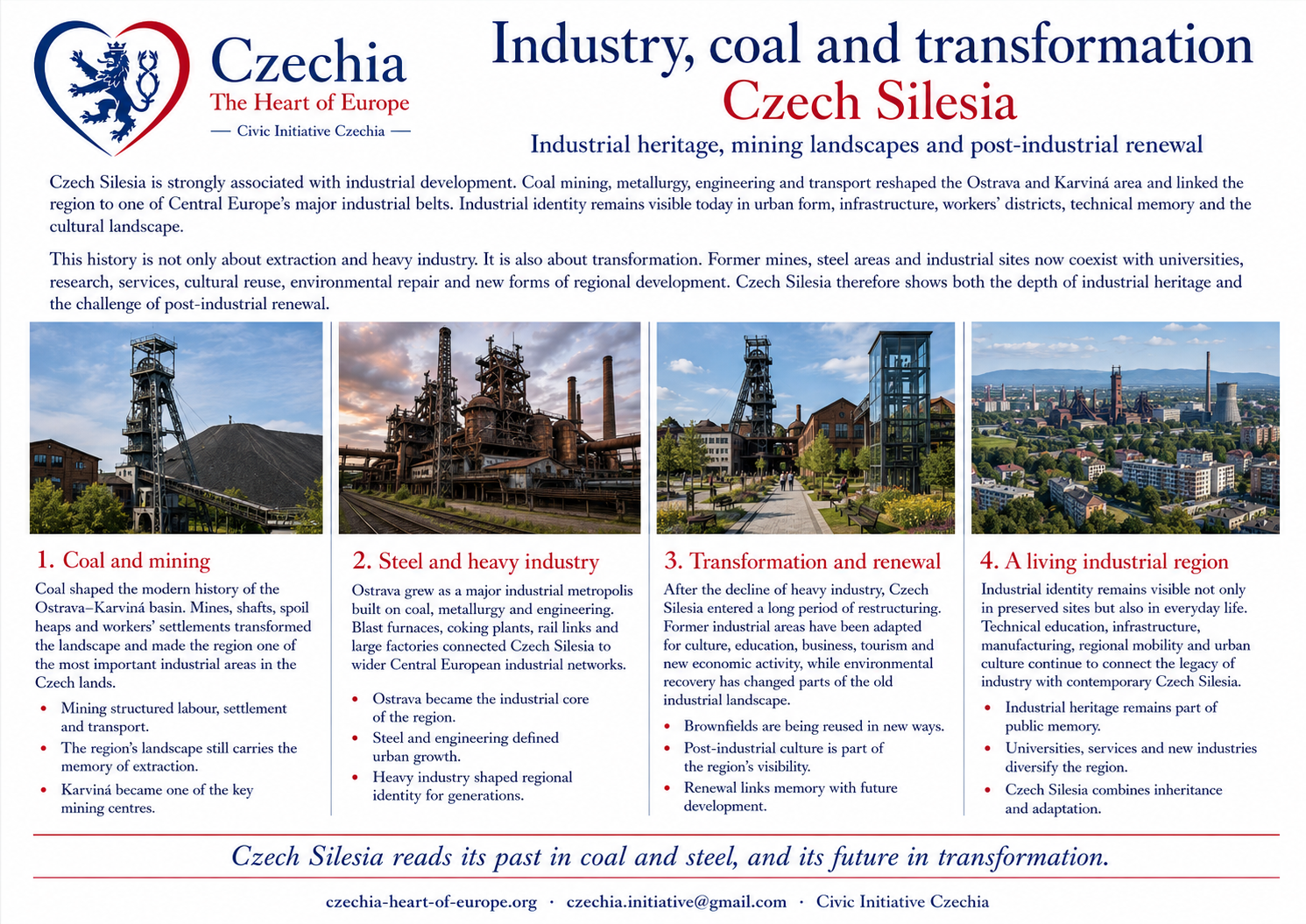
Czech Silesia is strongly associated with industrial development. Coal mining, steelworks, railways, engineering and heavy industry transformed the Ostrava-Karviná area and made the region one of the most important industrial landscapes in the Czech lands.
Industrial identity remains visible in architecture, museums, transport infrastructure, worker settlements, cultural memory and post-industrial redevelopment. Sites such as Dolní Vítkovice show how former industrial spaces can become places of education, culture, science and public memory.
Coal miningMining shaped settlement, labour, migration, environment and social life across the region.
Steel and engineeringHeavy industry gave the Ostrava area national and international economic significance.
Post-industrial renewalFormer industrial sites now support culture, education, tourism and innovation.
Labour memoryThe region preserves a strong memory of work, migration, solidarity and industrial communities.
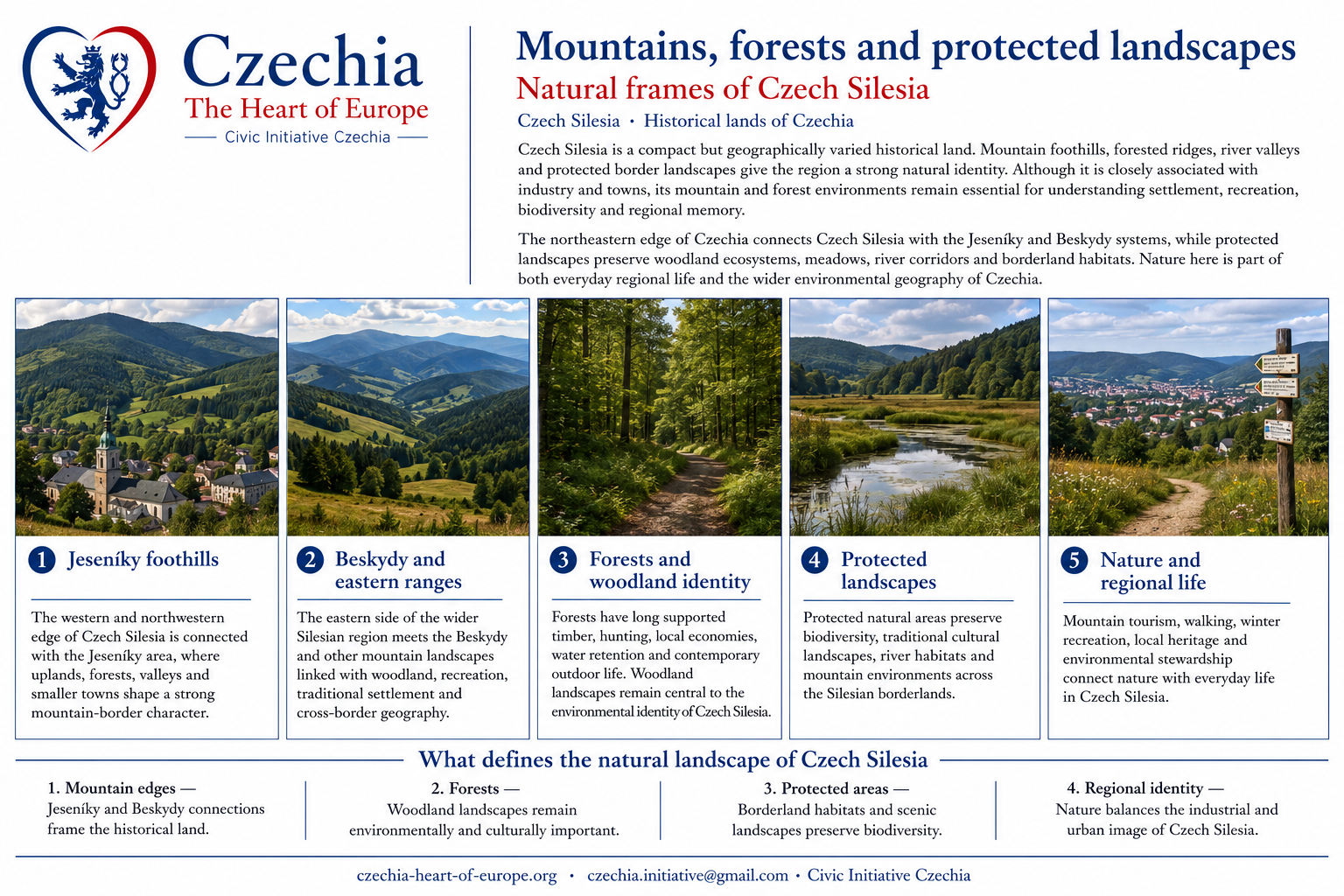
Czech Silesia is not only industrial. Its mountain and foothill landscapes are essential to the region’s identity. The Jeseníky and Beskydy areas provide forests, ridges, rivers, winter sports, hiking, traditional architecture, biodiversity and borderland settlement.
Protected landscapes and mountain towns give Czech Silesia strong natural and recreational value. This contrast between industry and mountains is one of the most distinctive features of northeastern Czechia.
JeseníkyMountain landscapes, forests, spa places and highland settlement in northern Czechia.
BeskydyForested mountains, traditional settlements and cross-border Carpathian landscapes.
FoothillsVillages, valleys and towns connect mountain life with industrial and urban centres.
Outdoor identityHiking, skiing, cycling and nature tourism complement the industrial image of the region.
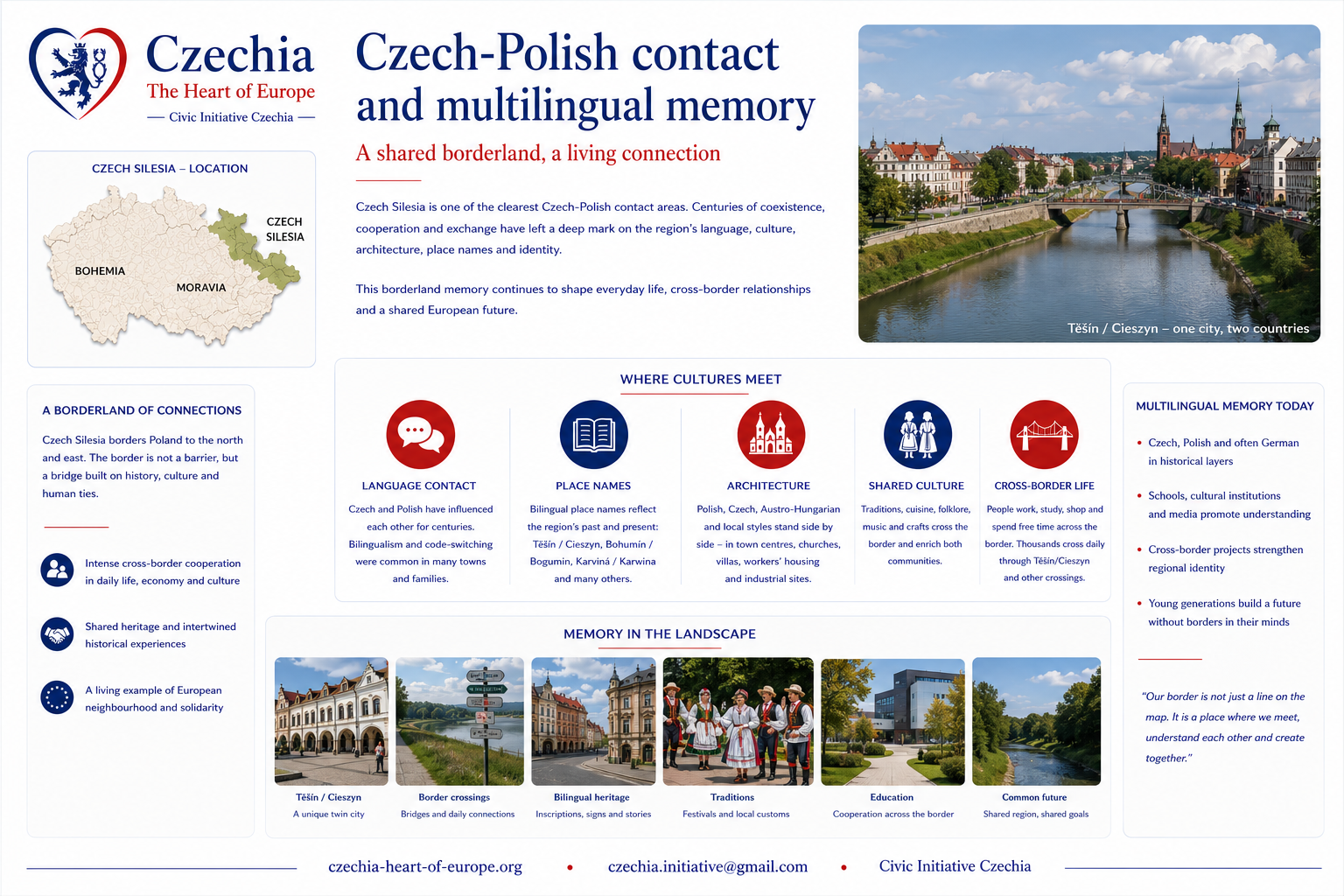
Czech Silesia is one of the clearest Czech-Polish contact areas. The Těšín/Cieszyn region, border towns, schools, churches, family histories and cultural institutions preserve a layered linguistic and cultural environment.
Czech, Polish, Silesian, German and local dialect histories all belong to the region’s memory. This does not make the land less Czech. It makes it one of the places where Czechia’s Central European identity is most visibly multilingual and cross-border.
Czech-Polish borderEveryday contact, commuting, culture and shared regional history shape public life.
Těšín / CieszynA divided but connected urban and cultural space with strong symbolic importance.
Language layersCzech, Polish, Silesian, German and dialect traditions form part of regional memory.
Cross-border cooperationTransport, culture, tourism, education and local projects connect both sides of the border.
Czech Silesia’s architecture reflects borderland history, industrial growth, municipal ambition, religious life and modern transformation. Town halls, churches, industrial buildings, worker colonies, theatres, schools, museums and railway structures all form part of the visual identity of the land.
Culture in Czech Silesia includes Silesian museums, theatres, festivals, Polish minority institutions, music, industrial heritage events, mountain traditions, local cuisine and regional memory. The identity is compact but highly layered.
Silesian institutionsMuseums, archives, theatres and schools preserve regional history and culture.
Industrial architectureFactories, mines, railways and worker settlements define major parts of the landscape.
Religious heritageChurches, cemeteries and pilgrimage traditions preserve community memory.
Regional cultureFestivals, music, minority culture and local traditions keep Silesian identity visible.