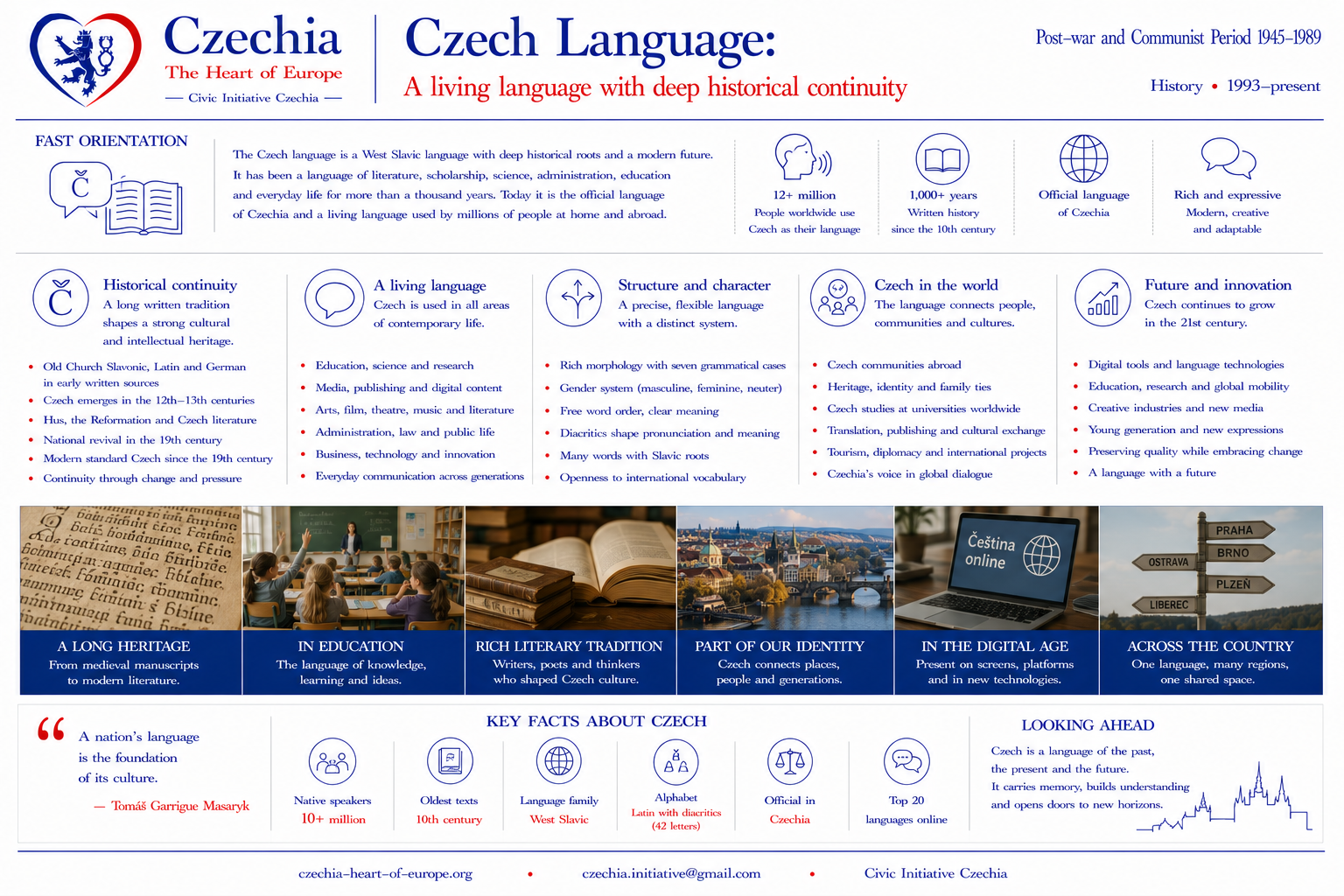
Language is one of the strongest continuities in Czech history. Long before the modern Czech Republic existed, Czech served as a medium of literature, administration, religion, scholarship, education and everyday communication across the historical lands of Bohemia, Moravia and parts of Czech Silesia.
Today Czech is the official language of Czechia and the first language of most of its population. It is spoken within the country, used by Czech communities abroad and studied internationally by students, researchers, translators and professionals interested in Central Europe.
The history of Czech is closely connected with the country’s political, literary and cultural development. Medieval manuscripts, the writings of Jan Hus, the Bible of Kralice, the National Revival, twentieth-century literature, film, radio, television and contemporary digital media all belong to its public story.
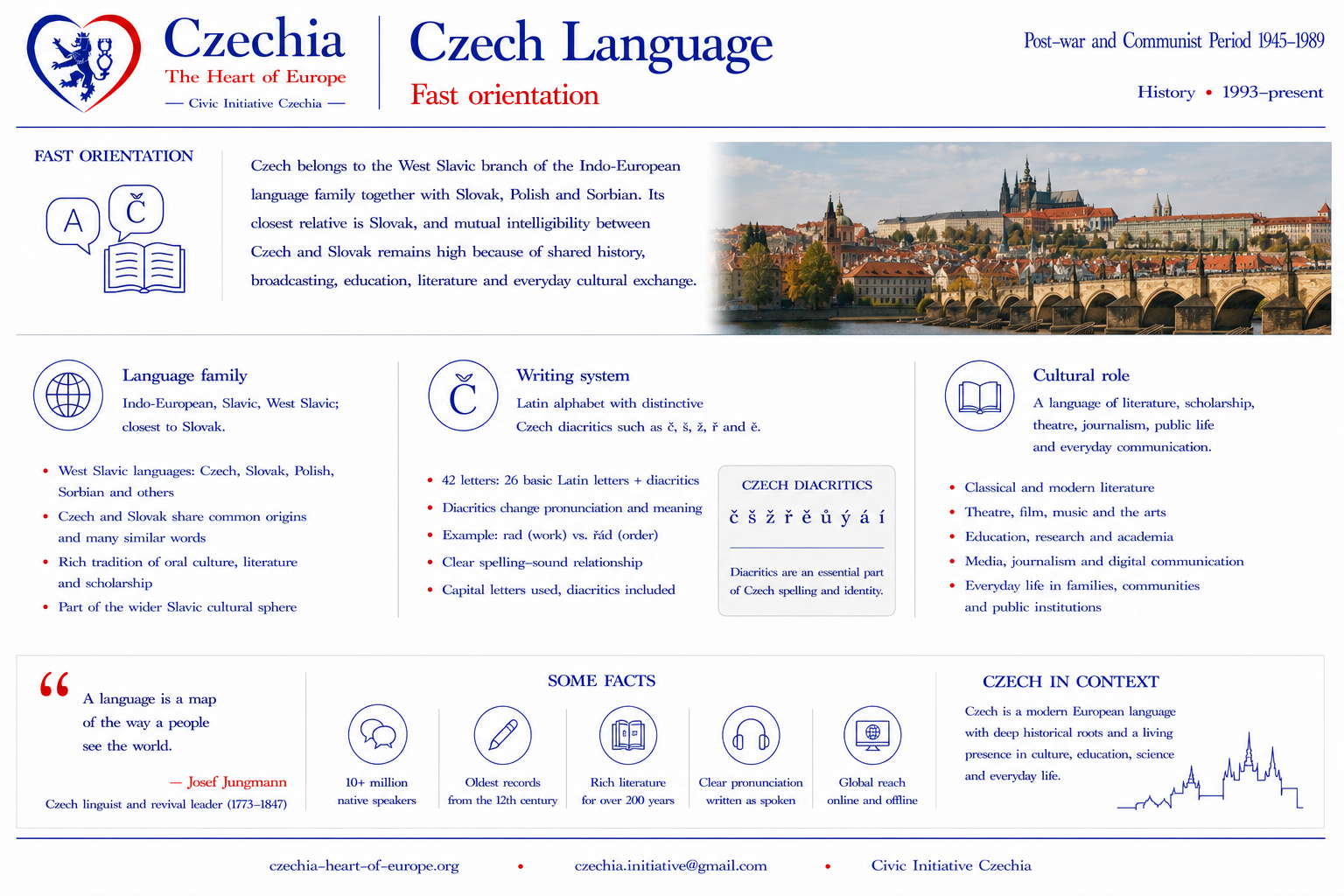
Czech belongs to the West Slavic branch of the Indo-European language family together with Slovak, Polish and Sorbian. Its closest relative is Slovak, and mutual intelligibility between Czech and Slovak remains high because of shared history, broadcasting, education, literature and everyday cultural exchange.
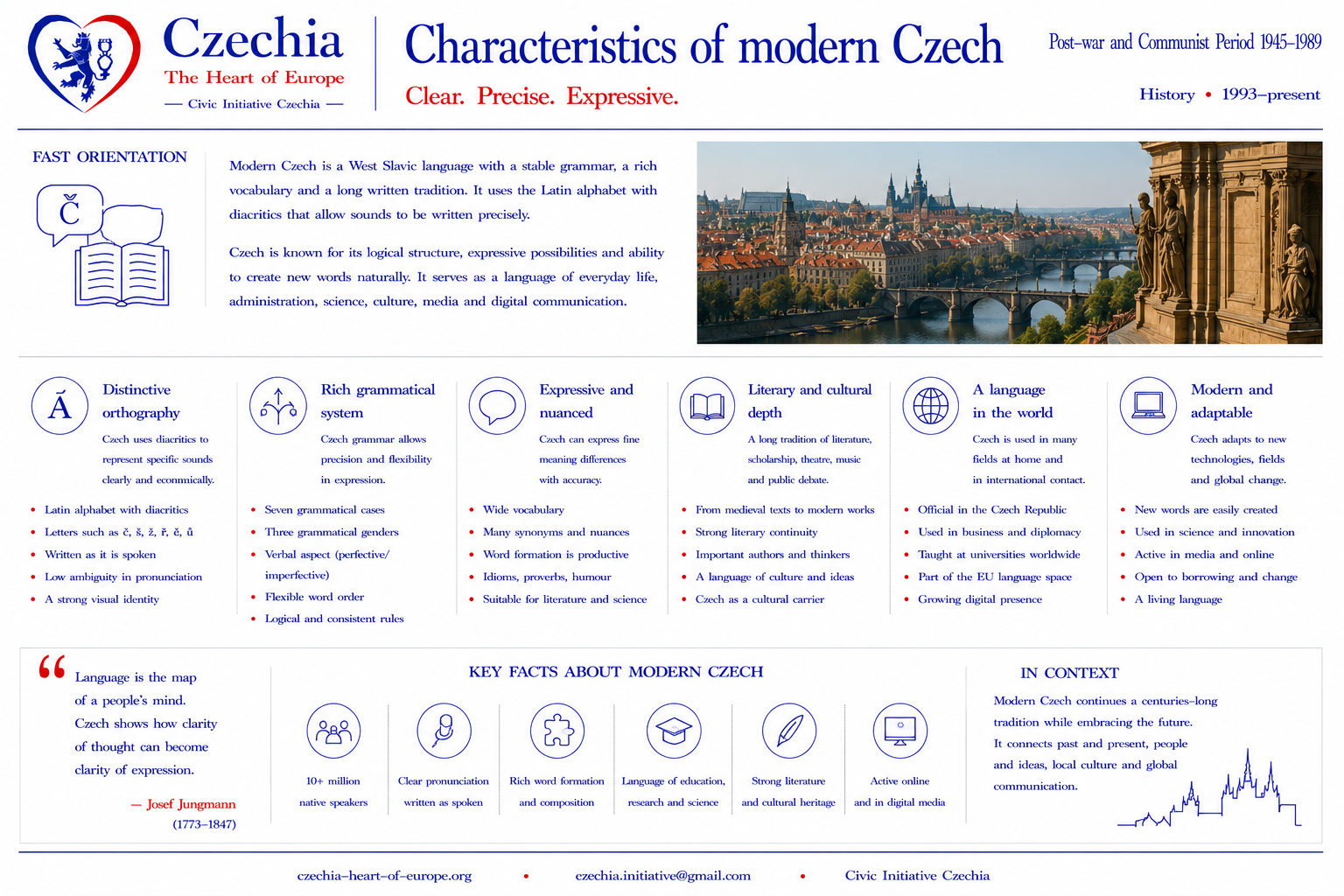
The language uses the Latin alphabet with distinctive diacritical marks. Its grammar includes cases, grammatical gender, verbal aspect and flexible word order. Its pronunciation is comparatively regular because Czech is usually pronounced close to the way it is written.
Language familyIndo-European, Slavic, West Slavic; closest to Slovak.
Writing systemLatin alphabet with distinctive Czech diacritics such as č, š, ž, ř and ě.
Cultural roleA language of literature, scholarship, theatre, journalism, public life and everyday communication.
Czech is one of the official languages of the European Union and forms part of the wider Slavic language world of Central, Eastern and Southeastern Europe. Its position in the centre of Europe has exposed it to long interaction with Latin, German, Slovak, Polish and other neighbouring languages.
Although Czech has fewer native speakers than global languages, its cultural and historical weight is considerable. It is the language of medieval religious writing, humanist scholarship, National Revival dictionaries, modern literature, theatre, film, philosophy, science, journalism and contemporary public debate.
Central European positionCzech developed in contact with German, Latin, Slovak, Polish and wider European intellectual life.
EU languageCzech is used in European institutions, legal translation, public administration and international cooperation.
Neighbouring languagesSlovak remains the closest linguistic partner; Polish and Sorbian share West Slavic ancestry.
International studyCzech is taught at universities and cultural institutions beyond Czechia.
A language with a long written tradition
Written Czech appears in medieval glosses, songs, religious texts, legal documents and literary works before becoming a major language of public and cultural expression. The development of Prague as a political and university centre helped make Czech part of the wider written culture of medieval Europe.
Old Czech literature, religious writings, chronicles, sermons, translations and legal texts show that Czech was not only a spoken language of everyday life. It also became a medium for argument, instruction, devotion, law, poetry and social memory.
Medieval writingGlosses, hymns, sermons and legal texts document early written Czech.
Prague and learningThe university environment strengthened the intellectual and written culture of the Czech lands.
Religious literatureSermons, translations and devotional texts helped bring Czech into public instruction.
ContinuityThe language changed over centuries while preserving a visible documentary tradition.
Jan Hus and Czech orthography
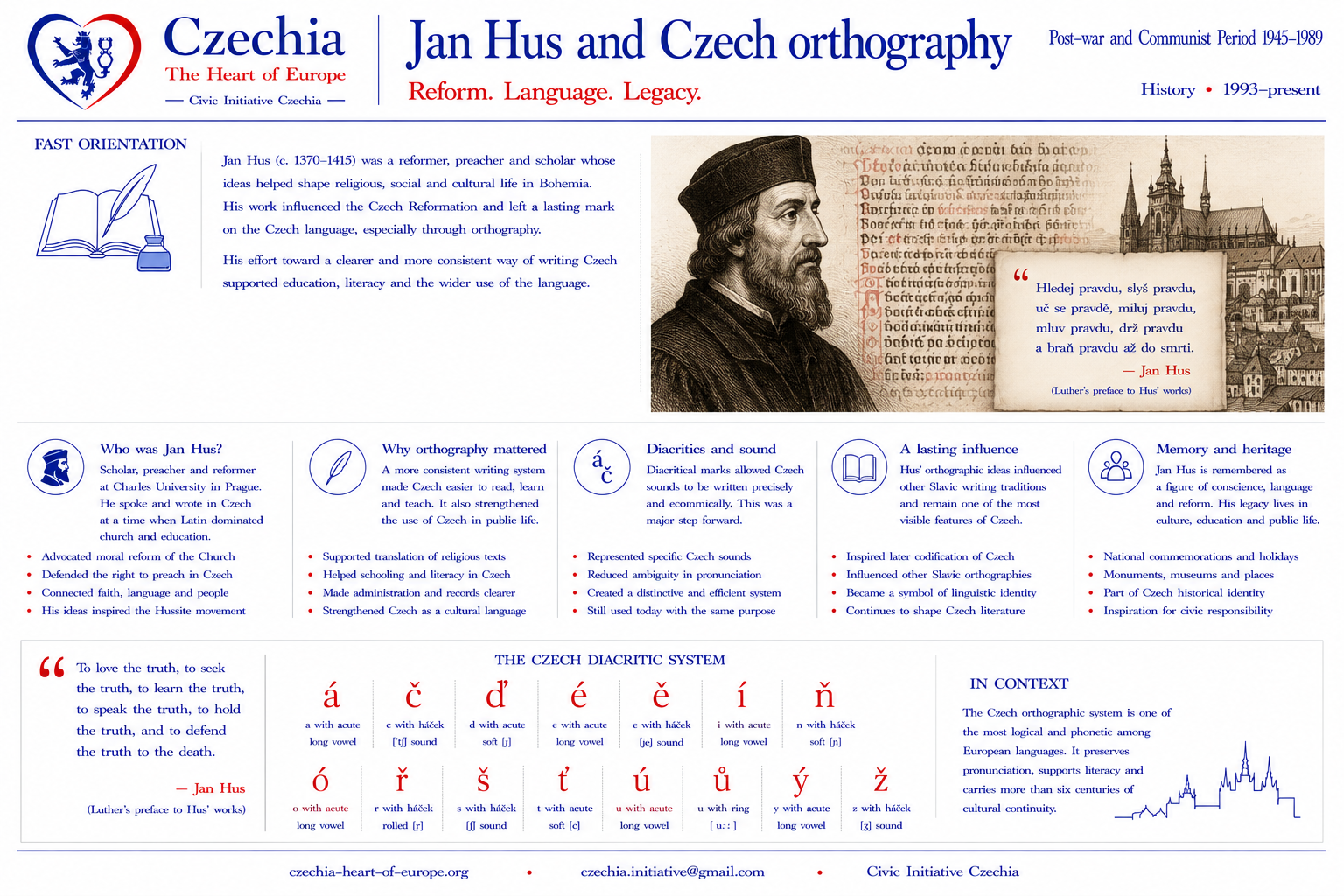
Jan Hus is one of the most influential figures in Czech linguistic history. His name is connected not only with religious reform, but also with the development of a more systematic way of writing Czech. Diacritical marks made it possible to represent Czech sounds more clearly and economically than older spelling conventions.
Letters such as č, š, ž, ř and ě became characteristic features of written Czech. The system also influenced other Slavic writing traditions and remains one of the most recognisable visual features of the language.
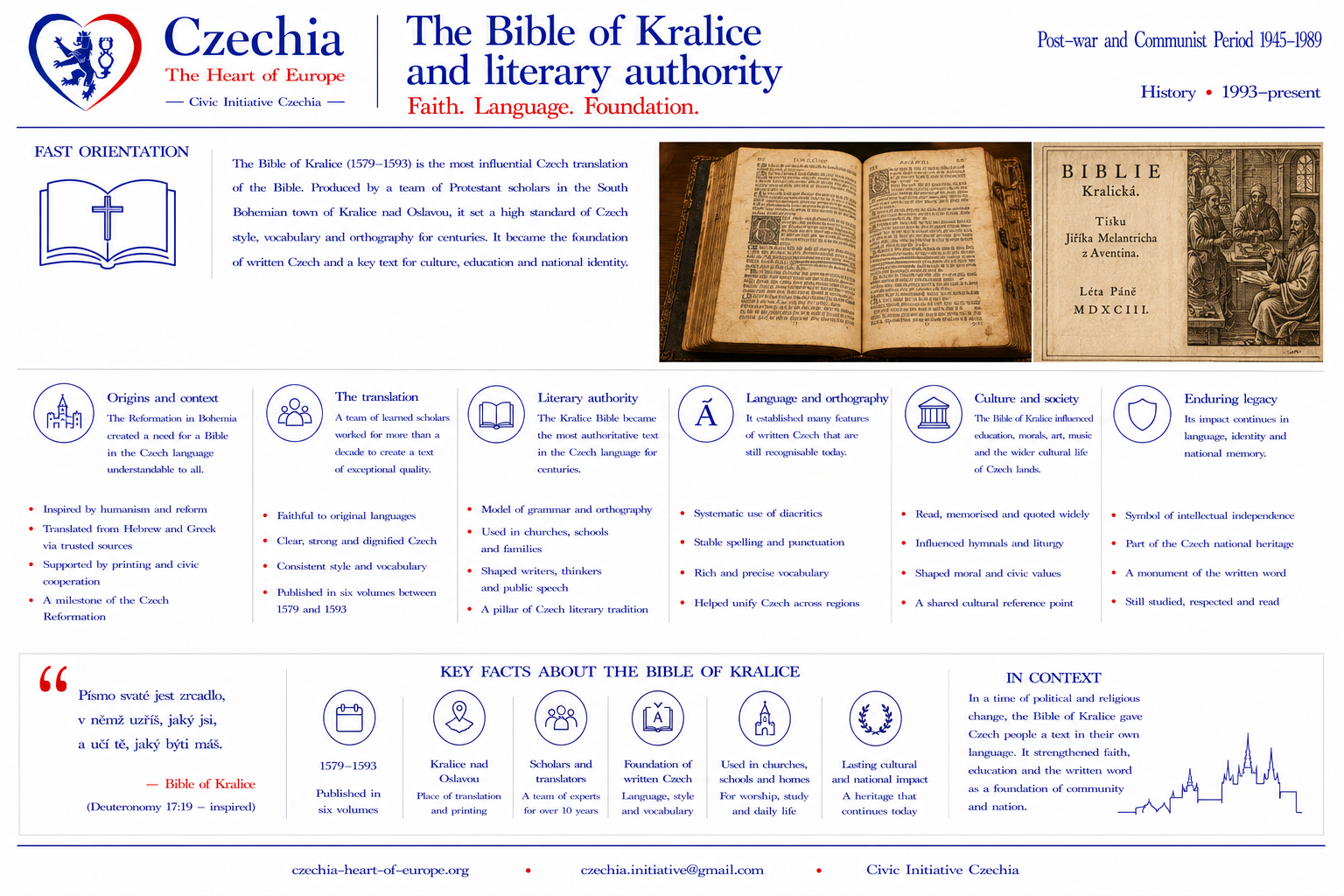
The Bible of Kralice became a major monument of Czech language and literary culture. Its translation quality, style and authority influenced later ideas of cultivated Czech and became one of the reference points for historical language memory.
Religious translation mattered because it joined language, reading, education and public meaning. Czech could carry theology, poetry, instruction and intellectual seriousness in a form that remained culturally powerful long after its immediate historical context had passed.
Czech language history is not only the history of grammar. It is also the history of books, readers, schools, churches, printers, scholars, public voices and shared memory.
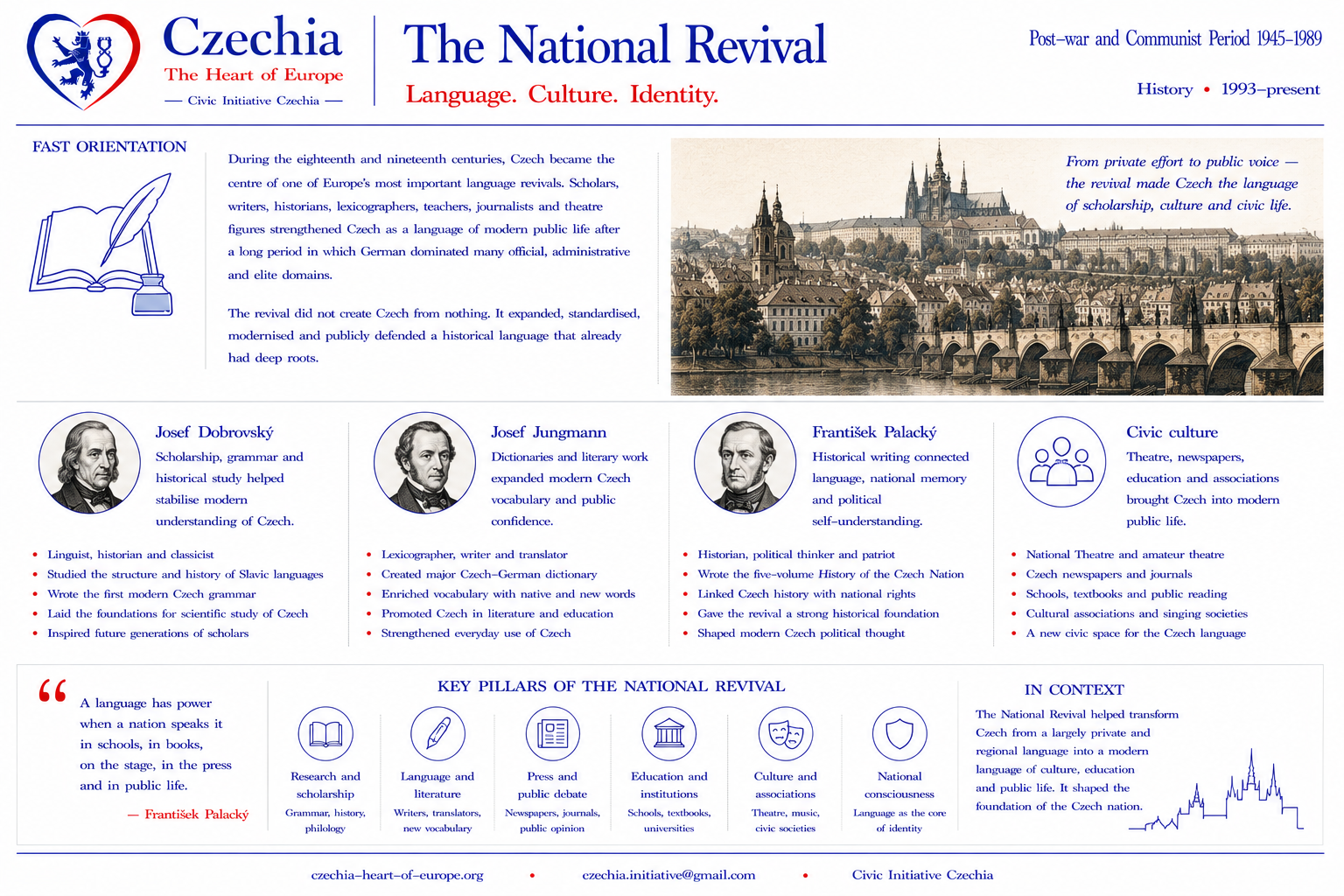
During the eighteenth and nineteenth centuries, Czech became the centre of one of Europe’s most important language revivals. Scholars, writers, historians, lexicographers, teachers, journalists and theatre figures strengthened Czech as a language of modern public life after a long period in which German dominated many official, administrative and elite domains.
The revival did not create Czech from nothing. It expanded, standardised, modernised and publicly defended a historical language that already had deep roots. Dictionaries, grammars, histories, newspapers, museums, schools and theatres made Czech visible as a language of scholarship, culture and civic identity.
Josef DobrovskýScholarship, grammar and historical study helped stabilise modern understanding of Czech.
Josef JungmannDictionaries and literary work expanded modern Czech vocabulary and public confidence.
František PalackýHistorical writing connected language, national memory and political self-understanding.
Civic cultureTheatre, newspapers, education and associations brought Czech into modern public life.
Modern Czech is known for grammatical precision, rich word formation and a flexible sentence structure. Nouns, adjectives, pronouns and numerals change according to case, number and gender. Verbs express tense, mood and aspect, allowing speakers to distinguish whether an action is completed, ongoing, repeated or viewed as a process.
Word order is flexible because grammatical relationships are often marked by endings. This allows Czech sentences to organise emphasis and information flow in ways that differ from English. At the same time, pronunciation is comparatively regular, and most written words give a strong clue to how they are spoken.
Seven casesNoun forms show grammatical function within the sentence.
Verbal aspectVerbs distinguish completed and ongoing or repeated actions.
Flexible orderSentence order can shift emphasis because endings carry grammatical information.
Word formationPrefixes, suffixes and roots create precise families of related meanings.
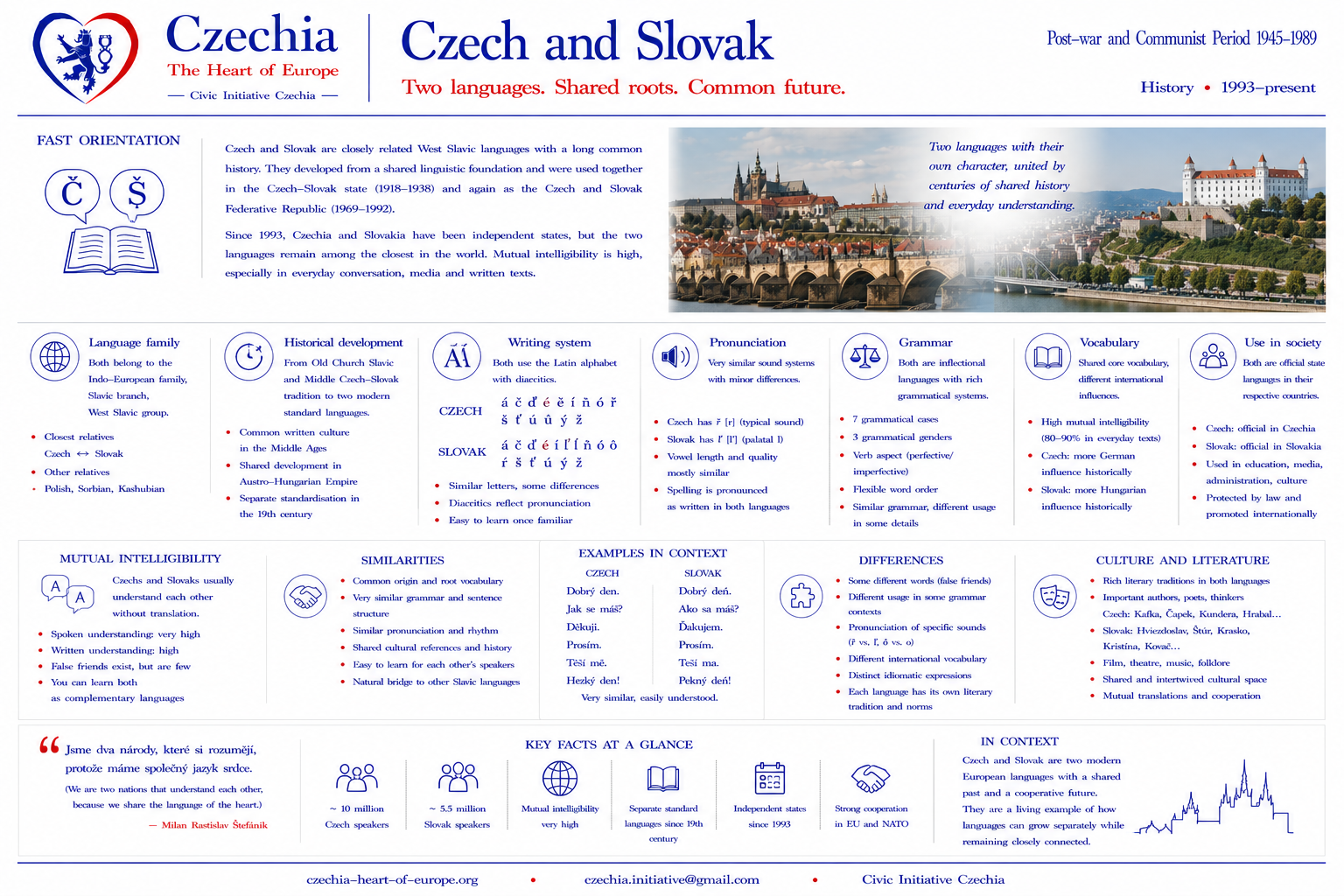
Czech and Slovak are separate West Slavic languages with a high degree of mutual intelligibility. Their closeness is strengthened by shared history, geographical proximity and the twentieth-century experience of Czechoslovakia, when broadcasting, education, publishing and public life exposed several generations to both languages.
Today Czech and Slovak function as independent national languages. Czech speakers often understand Slovak, and many Slovak speakers understand Czech, though younger generations may experience the relationship differently depending on media exposure, education and everyday contact.
Closest relativeSlovak is the language most closely related to Czech.
Shared state historyCzechoslovakia strengthened everyday familiarity between both languages.
Separate standardsEach language has its own standard, literature, pronunciation and public institutions.
Continuing contactCzech and Slovak remain closely connected in culture, study, work and media.
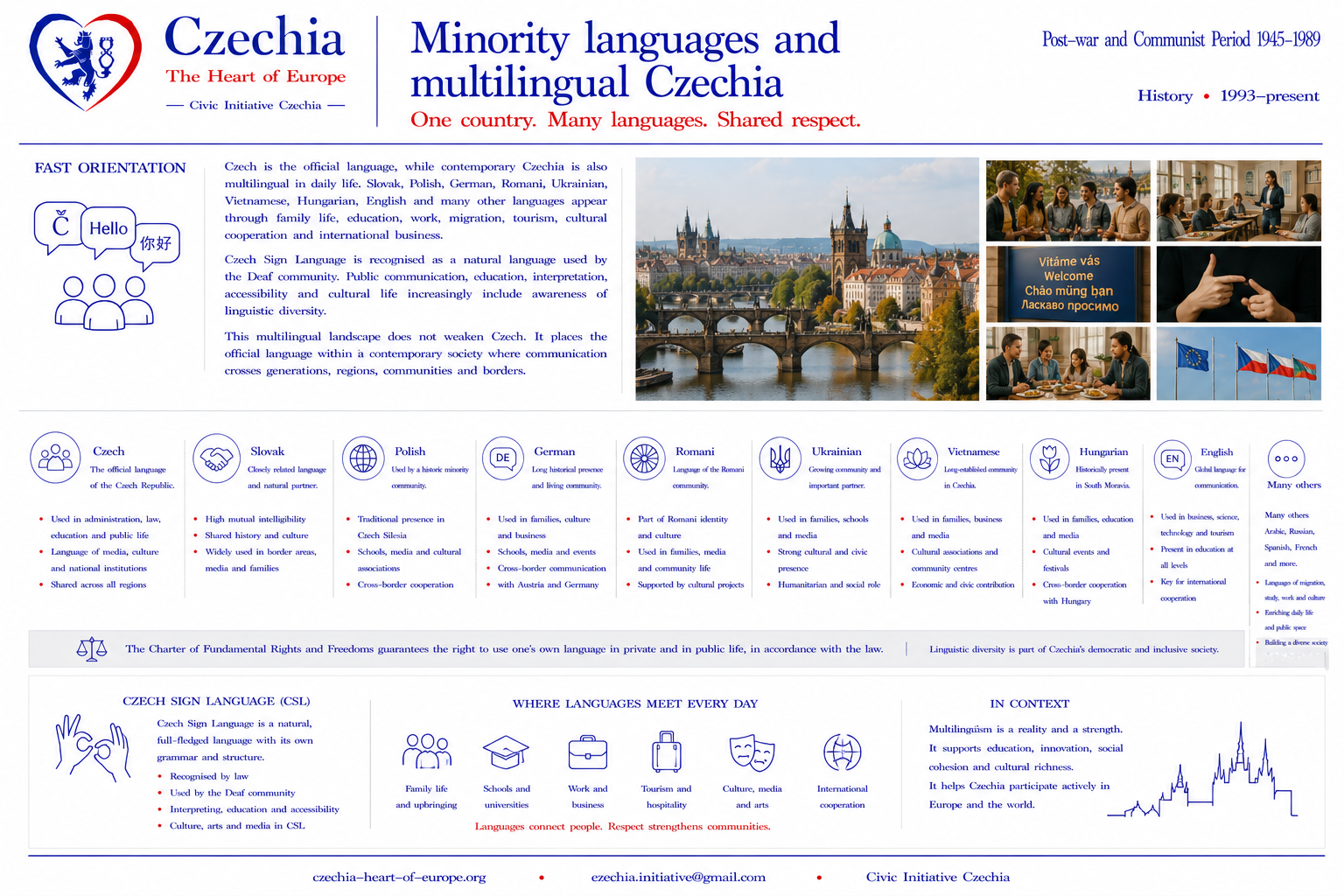
Czech is the official language, while contemporary Czechia is also multilingual in daily life. Slovak, Polish, German, Romani, Ukrainian, Vietnamese, Hungarian, English and many other languages appear through family life, education, work, migration, tourism, cultural cooperation and international business.
Czech Sign Language is recognised as a natural language used by the Deaf community. Public communication, education, interpretation, accessibility and cultural life increasingly include awareness of linguistic diversity.
This multilingual landscape does not weaken Czech. It places the official language within a contemporary society where communication crosses generations, regions, communities and borders.
Czech is spoken beyond Czechia by communities formed through migration, exile, study, family history and professional mobility. Czech-speaking communities have existed in the United States, Canada, Austria, Germany, Croatia, Romania, Serbia, Argentina, Australia and other countries.
Universities, cultural institutes, language schools, archives, libraries and heritage organisations also support Czech studies abroad. For many learners, Czech offers access to literature, family history, music, film, historical documents, Central European research and contemporary professional cooperation.
Communities abroadCzech-speaking communities preserve language through family, associations, schools, churches, festivals and publications.
Czech studiesUniversities and cultural institutions teach Czech language, literature, history and area studies.
Heritage learnersMany learners approach Czech through family memory, genealogy and cultural return.
Professional useTranslation, research, diplomacy, business, tourism and archives create practical reasons to learn Czech.
Czech in everyday life
Visitors encounter Czech through public transport, road signs, restaurants, museums, shops, universities, government services, newspapers, television, radio, theatres, cinemas, websites, mobile applications and local conversations. English is common in tourism, universities and many professional settings, but Czech remains the normal language of public and everyday life.
Learning even a few expressions is usually appreciated because it shows attention to the country’s linguistic environment. Basic greetings, polite forms, place names, transport vocabulary and food words can make daily orientation easier and more respectful.
Public spaceSigns, announcements, forms, maps and services use Czech as the primary language.
Names and placesUnderstanding diacritics helps visitors read towns, streets, stations and personal names correctly.
PolitenessGreetings, thanks and formal address are useful for everyday encounters.
Digital lifeCzech appears in apps, public portals, online media, subtitles, navigation and official information.
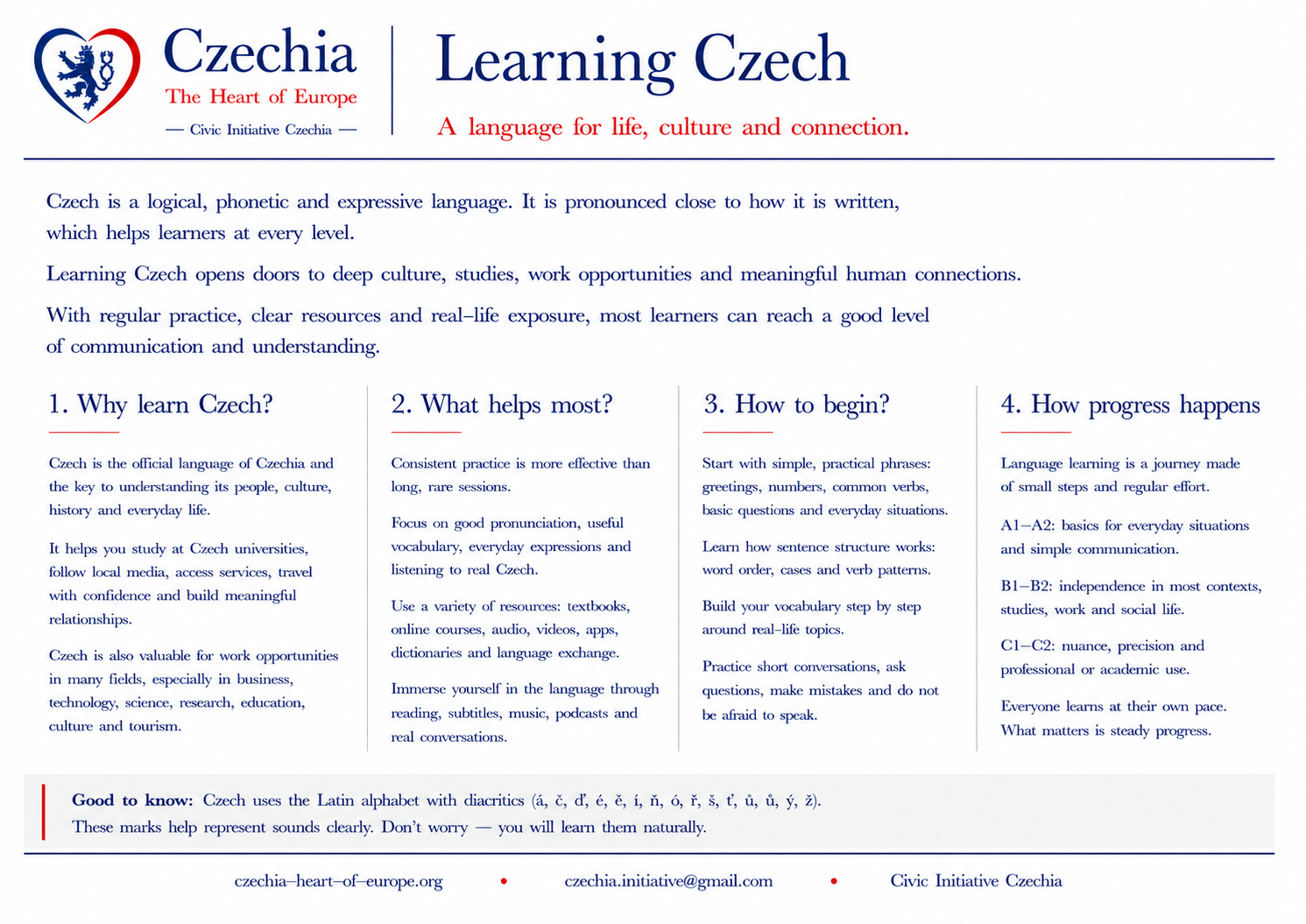
Learning Czech
People learn Czech for study, family, long-term residence, work, research, heritage, travel, business, literature, archives and cultural interest. The language can seem demanding at first because of cases and verbal aspect, but its regular spelling, strong word families and clear pronunciation patterns give learners reliable structures to build on.
Czech also opens direct access to texts and contexts that translation cannot fully replace: literature, comedy, historical sources, songs, public signs, newspapers, legal documents, regional speech, film dialogue and everyday humour.
For residentsCzech supports integration into public services, schools, work, neighbourhood life and administration.
For studentsThe language opens access to Czech universities, scholarship, archives and cultural materials.
For heritageCzech helps reconnect family history, names, letters, places and migration records.
For cultureLiterature, theatre, film, songs and humour become richer when understood in Czech.
Language familyIndo-European · Slavic · West Slavic.
Writing systemLatin alphabet with Czech diacritics.
Closest languageSlovak.
EU statusOfficial language of the European Union.
Distinctive letterŘ / ř, one of the most recognisable Czech sounds and letters.
Timeline in one view
Middle AgesWritten Czech appears in glosses, hymns, sermons, legal texts and literary works.
15th centuryJan Hus is associated with a more systematic diacritical spelling tradition.
16th centuryThe Bible of Kralice becomes a major monument of Czech literary language.
18th–19th centuryThe National Revival strengthens Czech as a modern language of scholarship, literature and public life.
1918Czech becomes one of the central public languages of Czechoslovakia.
1993Czech continues as the official language of the Czech Republic.
TodayCzech is the official language of Czechia and one of the official languages of the European Union.
Language, name and identity
Czech language, Czech culture, the Czech lands, the Czech Republic and Czechia are related terms, but they do not all mean the same thing. The adjective Czech refers to language, people, culture, institutions and the state. Czechia is the short geographic country name. The Czech Republic is the formal political name of the state.
This distinction helps international communication. It allows the language to be named clearly as Czech, the country to be named clearly as Czechia, and the state to be named formally as the Czech Republic where legal or diplomatic precision requires it.
Language makes the country readable: Czech names the language and cultural field; Czechia names the country; the Czech Republic names the state in formal political use.