Czechia has been a member of the European Union since 1 May 2004 and part
of the Schengen Area since 21 December 2007. Its EU profile connects
geography, mobility, trade, public institutions, education, research,
regional development and international cooperation.
Czechia’s EU membership is part of its modern European identity.
Czechia entered the European Union in the 2004 enlargement, together
with other Central and Eastern European states. EU membership places
Czechia inside the European Single Market, European institutions,
common policies and shared legal space, while the country keeps its
own language, national institutions, currency and cultural identity.
The EU layer matters for visitors, students, journalists, businesses
and public institutions because it explains how Czechia connects to
mobility, trade, education, regional development, cross-border
cooperation and European decision-making.
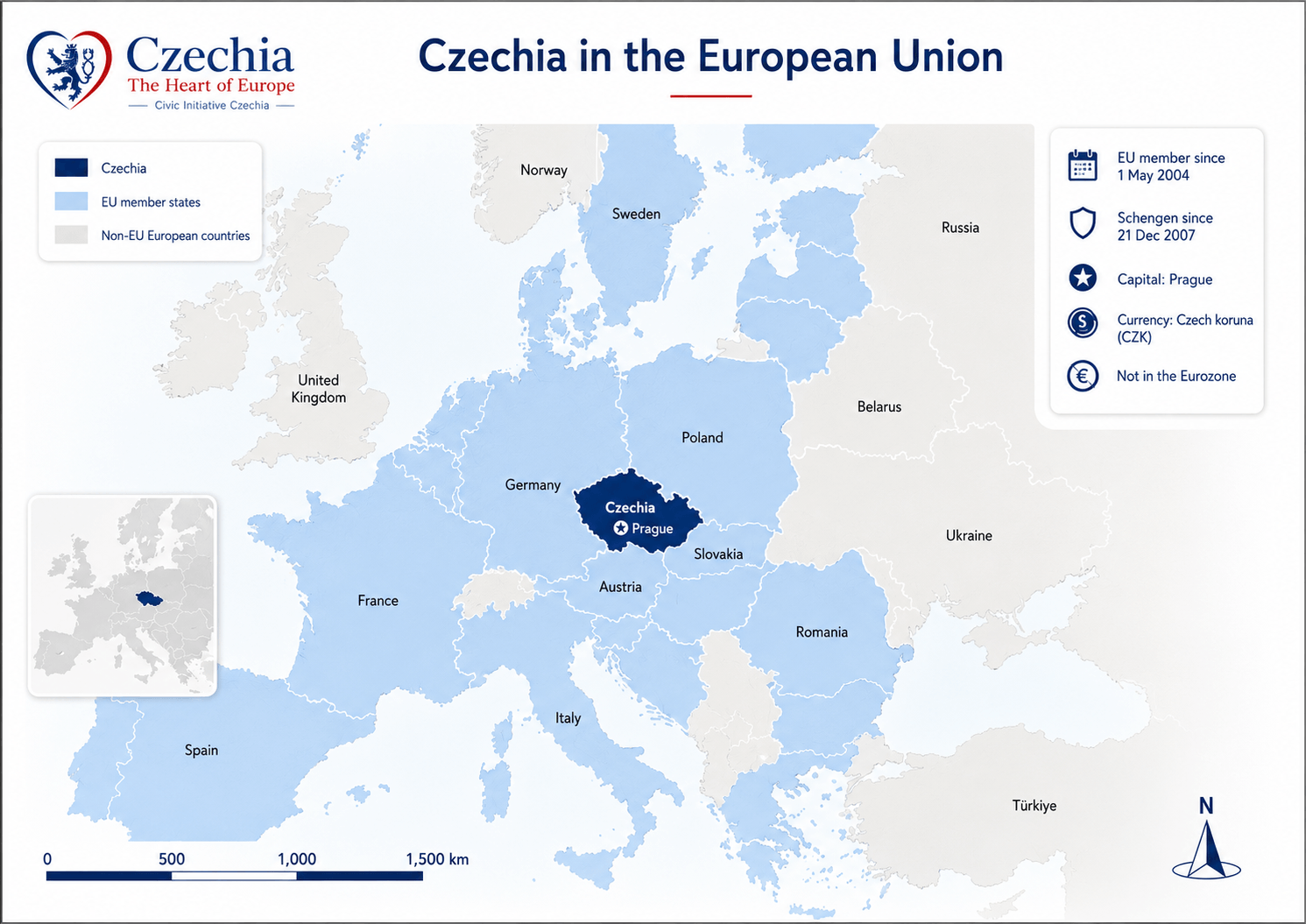
Map context
Czechia in the European Union
The map places Czechia inside the EU and shows its Central European
position among neighbouring Germany, Poland, Slovakia and Austria.
EU membership is not only an institutional fact. It shapes everyday
life, public administration, business, travel, education, research,
regional planning and the way Czechia is represented abroad.
Single MarketCzech companies, workers, students and consumers operate within one of the world’s largest integrated markets.Mobility and SchengenCzechia’s Schengen membership supports travel, cross-border work, tourism, family mobility and regional cooperation.Education and youthProgrammes such as Erasmus+ connect Czech students, schools, universities, teachers and young professionals with Europe.Research and innovationEU frameworks support scientific cooperation, innovation networks, university partnerships and technology projects.Regions and cohesionEU regional and cohesion funding contributes to transport, public infrastructure, development, environment and innovation.Institutions and voiceCzechia participates in EU law-making through the European Parliament, Council of the EU and national representation in Brussels.
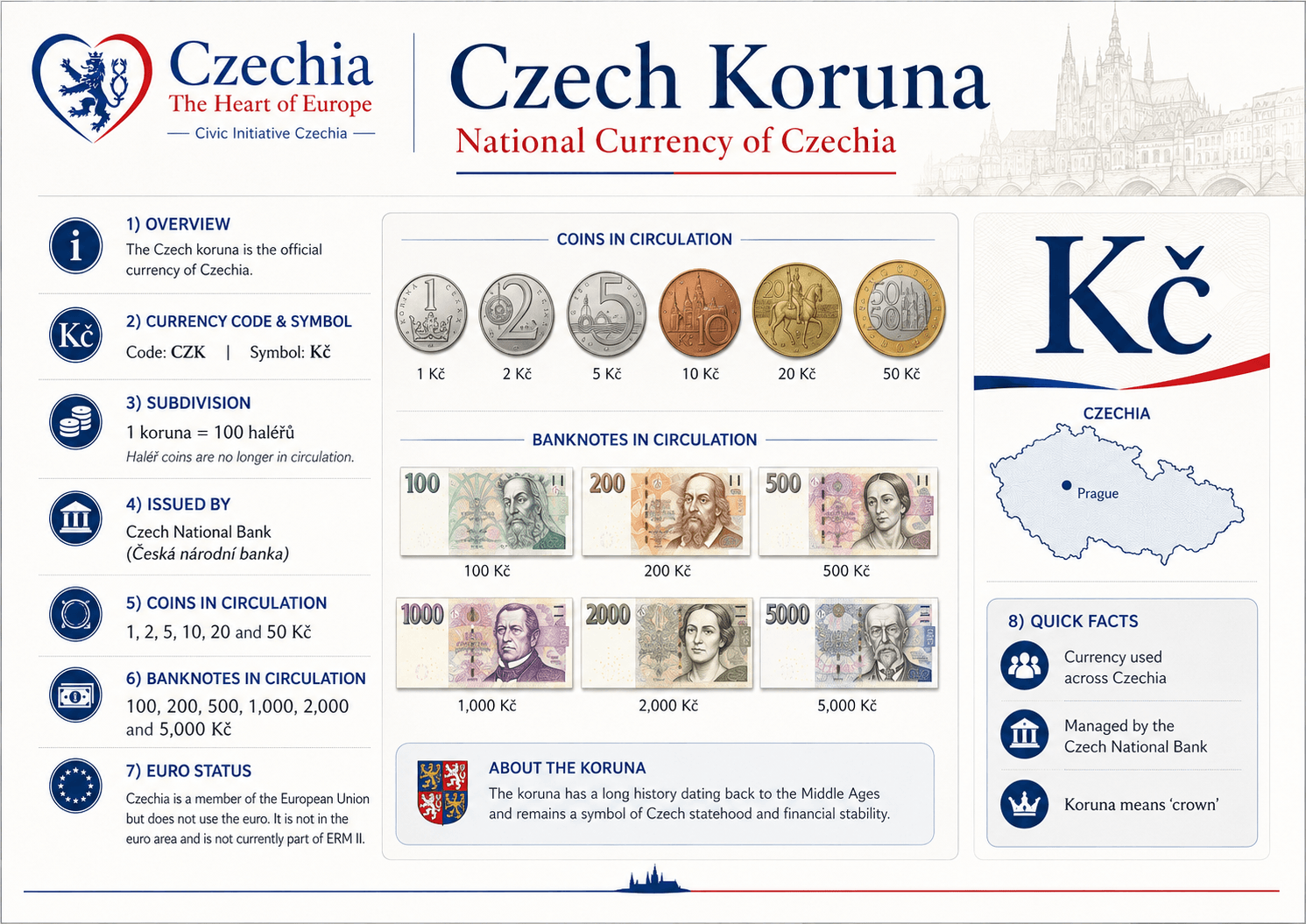
Euro and the Czech koruna
Czechia uses the koruna and has no euro adoption date.
Czechia is legally committed to adopt the euro in the future because
it joined the European Union without an opt-out. At present, however,
Czechia is not in the euro area, the Czech koruna has not joined
ERM II, and no target date for euro adoption has been set.
Adoption of the euro requires legal compatibility, fulfilment of the
Maastricht convergence criteria and participation in ERM II for at
least two years without severe tensions or devaluation against the euro.
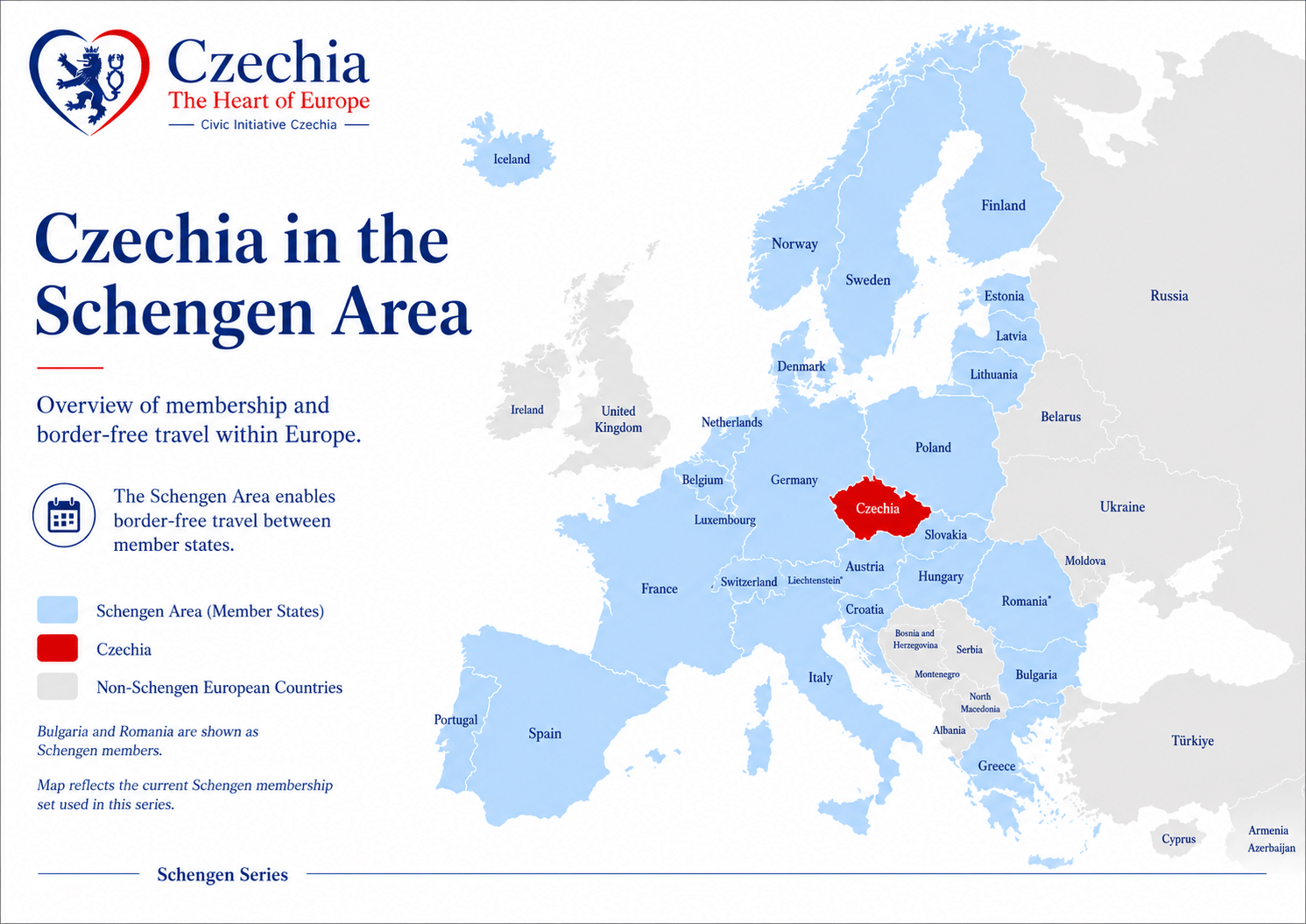
Czechia has been part of the Schengen Area since 21 December 2007.
Regular checks at internal land borders with Germany, Poland,
Slovakia and Austria were abolished from that date; border controls
for internal Schengen flights were lifted on 30 March 2008.
For visitors and residents, Schengen means that travel between
Czechia and other Schengen countries normally takes place without
routine passport control at internal borders. It does not remove the
need for a valid travel document, airport security, police checks
where legally permitted, or the common rules for the Schengen external
border.
Neighbouring Schengen linksCzechia’s direct neighbours — Germany, Poland, Slovakia and Austria — are all Schengen countries, making cross-border travel central to tourism, work, study, family life and regional cooperation.
Short staysFor many non-EU visitors, short stays are counted across the whole Schengen Area, not only inside Czechia. The standard short-stay limit is 90 days in any 180-day period unless another residence or visa status applies.
Business and mobilitySchengen supports conferences, trade visits, cultural events, logistics, commuting, tourism and cooperation across Central Europe by reducing routine internal-border friction.
Security and exceptionsSchengen combines free movement with common external-border rules, visa cooperation and police cooperation. Internal border controls may still be reintroduced temporarily in exceptional situations.
Timeline
Czechia’s EU journey
1 January 1993The independent Czech state is created after the peaceful dissolution of Czechoslovakia.
1 May 2004Czechia joins the European Union in the 2004 enlargement.
21 December 2007Czechia joins the Schengen Area.
January–June 2009Czechia holds its first Presidency of the Council of the European Union.
July–December 2022Czechia holds its second Presidency of the Council of the European Union with the motto “Europe as a Task”.
FutureEuro adoption would require Czechia to meet the Maastricht convergence criteria, enter ERM II and set a national target date. No euro adoption date is currently set.
TodayCzechia is a Central European EU member state with its own currency, official EU language, elected European Parliament representatives and active role in European cooperation.
Role in Europe
Czechia connects geography, industry, knowledge and civic identity.
Czechia’s position in the EU is not defined only by membership dates.
The country sits between Germany, Poland, Slovakia and Austria, linking
western, northern, eastern and Danube-facing European corridors. This
location gives Czechia practical importance for transport, industry,
logistics, culture, tourism and cross-border cooperation.
Czechia also brings a strong industrial base, university cities,
research capacity, cultural heritage, democratic experience and a
public memory shaped by Central European history. Its EU presence is
therefore economic, civic, cultural and strategic at the same time.
Switzerland support
Supported in Switzerland by the Honorary Consulate of the Czech Republic in Basel.
Civic Initiative Czechia acknowledges direct support in Switzerland
from the Honorary Consulate of the Czech Republic in Basel. The
consular office is listed in the Czech Missions Directory of the
Ministry of Foreign Affairs of the Czech Republic and is supervised
by the Embassy of the Czech Republic in Bern.
Office
Honorary Consulate of the Czech Republic in BaselChristoph Merian-Ring 11, Reinach BL, 4153 Basel, Switzerland
Head of Mission
Mr Václav ŠULISTAHonorary Consul of the Czech Republic in Basel
In EU-related public communication, Czechia works as
the country’s short geographic name, just as Austria, Slovakia, Poland
or Germany work as short country names. The Czech Republic
remains appropriate where the formal political name is required by
legal, diplomatic or institutional style.
These public sources support the core facts on Czechia’s EU membership,
Schengen status, currency, language, representation and two Presidencies
of the Council of the European Union.
European Union
Czechia country profileCapital, official EU language, accession date, currency, Schengen status, area, population and EU representation.
European Commission
Schengen AreaOfficial overview of the Schengen Area, free movement, participating countries, external borders, visa cooperation and security rules.
Czech Representation to the EU
First Czech Presidency 2009Official Czech reference on the first Czech Presidency of the Council of the European Union and its results.